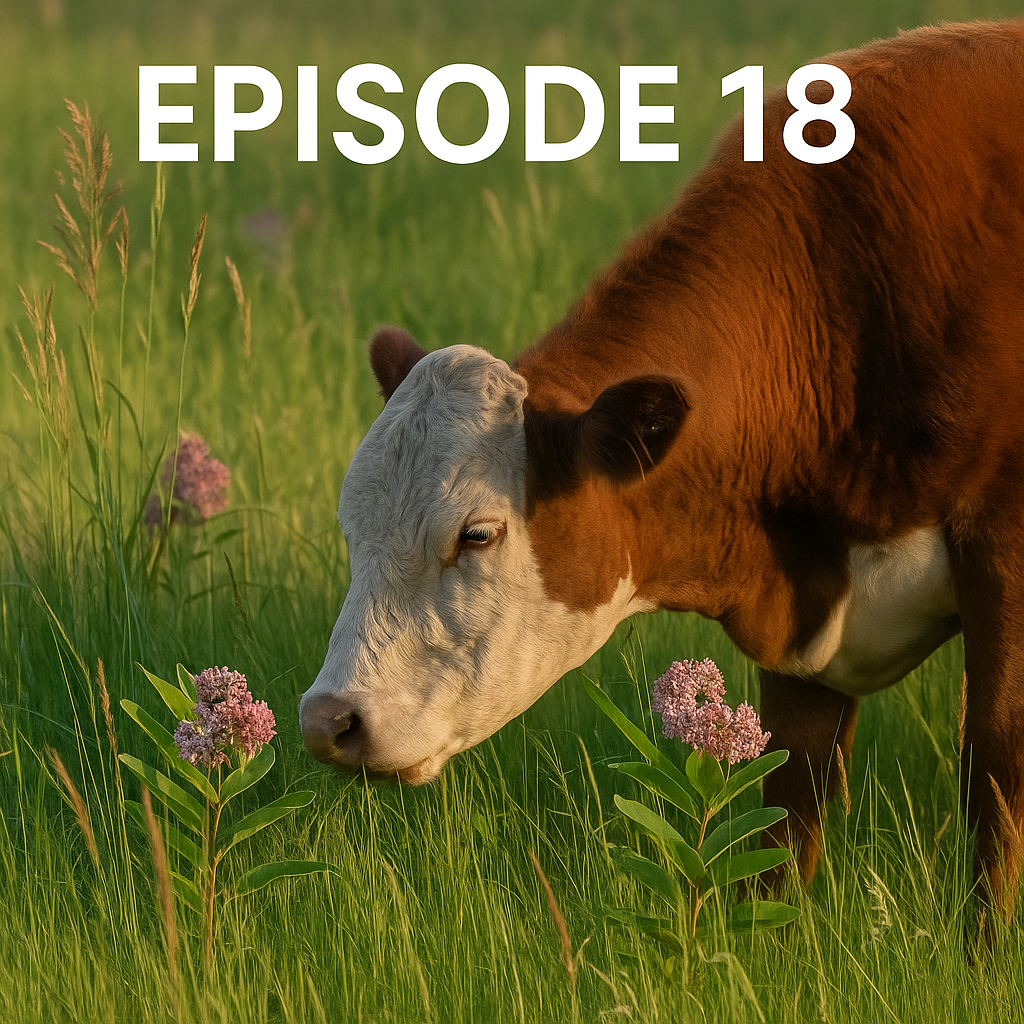
This excerpt from an ecological study investigates the long-held assumption that cattle avoid grazing milkweeds due to their toxicity, focusing on common and showy milkweed in central Nebraska grasslands. The researchers compared milkweed grazing rates and abundance across three management types: ungrazed grasslands and cattle-grazed areas utilizing a patch-burn-grazing system where patches were burned in the study year or previous years. Key findings reveal that cattle regularly graze common/showy milkweed at least as much as surrounding grasses like big bluestem, with no observable negative health effects on the livestock. Crucially, milkweed abundance was found to be significantly lower (34–185 fold) in grazed areas compared to ungrazed controls, suggesting that current grazing practices are contributing to reduced monarch butterfly host plant availability in rangelands, prompting a discussion of alternative grazing deferment strategies for conservation.
source: https://grasslandecology.unomaha.community/wp-content/uploads/2023/03/2023_Dickson_Poynor_Helzer.pdf?utm_source=chatgpt.com
Briefing: Cattle Grazing of Milkweed and Implications for Monarch Conservation
Executive Summary
This document synthesizes findings from a study on cattle grazing behavior in central U.S. prairies, revealing a significant and previously underestimated impact on milkweed, the critical host plant for monarch butterflies. The research challenges the long-held assumption that cattle avoid milkweeds due to their toxicity.
Key Takeaways:
- Cattle Actively Graze Milkweed: Contrary to common belief, cattle graze common and showy milkweed ( Asclepias syriaca / speciosa) at rates equal to, and sometimes greater than, surrounding grasses like big bluestem. By August of the study year, over 73% of milkweed stems in grazed grasslands had been grazed, with no observable negative health effects on the livestock.
- Grazing Drastically Reduces Milkweed Abundance: The study found that milkweed abundance in ungrazed control grasslands was 34 to 185 times higher than in adjacent patch-burn-grazed grasslands. This indicates that current grazing practices are a primary factor suppressing milkweed populations in these ecosystems.
- Patch-Burn-Grazing Is Ineffective for Milkweed Conservation: The patch-burn-grazing (PBG) management technique, designed to create habitat heterogeneity by concentrating grazing on recently burned patches, failed to provide a refuge for milkweed. Cattle grazed milkweed stems at similar rates in both recently burned and unburned patches, even while preferentially grazing grasses in the burned areas.
- Significant Implications for Ranching and Conservation: The findings suggest that herbicide control for low-density common milkweed is often unnecessary for ranchers. For conservation, they reveal that rangelands, which cover a vast area of the U.S., have an immense and largely untapped potential to support monarch populations if grazing management is modified. The study proposes periodic grazing deferment during critical milkweed growth periods as a key strategy to increase milkweed abundance without ceasing grazing operations.
--------------------------------------------------------------------------------
The Monarch Butterfly Crisis and the Role of Rangeland
The monarch butterfly (Danaus plexippus) is facing a severe population decline. The eastern migratory population has an estimated 11-57% likelihood of becoming non-viable by 2035, while the western population has declined by over 99%. This has led the U.S. Fish and Wildlife Service (USFWS) to determine that the species warrants listing as threatened or endangered.
A primary driver of this decline is the loss of milkweed (Asclepias spp.), the sole host plant for monarch caterpillars. Conservation efforts have called for the addition of approximately 1.6 billion milkweed stems in the Midwestern U.S. to support the monarch population.
Historically, these efforts have largely ignored rangelands for two reasons:
- The assumption that rangeland management has not changed as dramatically as cropland practices.
- The belief that cattle inherently avoid milkweed due to its toxic cardenolide compounds, meaning milkweed was likely already at maximum abundance in grazed areas.
This study directly challenges the second assumption, investigating the interaction between cattle and two widespread species, common milkweed (A. syriaca) and showy milkweed (A. speciosa), in the central U.S.
Research Objectives and Hypotheses
The study was conducted in east-central Nebraska on restored prairie grasslands to determine the extent of milkweed grazing by cattle under a patch-burn-grazing system.
- Primary Objective: To examine the amount of milkweed grazed by cattle and compare milkweed densities between grazed and ungrazed grasslands.
- Hypothesis 1: Cattle will graze common/showy milkweed at least as much as the surrounding dominant grass (big bluestem). (Supported)
- Hypothesis 2: Milkweed stem abundance will be higher in ungrazed grasslands than in grazed grasslands. (Supported)
- Hypothesis 3: Milkweed grazing and abundance will be lower in patches burned in previous years compared to patches burned in the current study year. (Not Supported)
Research Methodology
The research involved field studies conducted in 2018 and 2019 across grasslands in central Nebraska managed by The Nature Conservancy, Audubon Rowe Sanctuary, the Crane Trust, and the U.S. Fish and Wildlife Service.
- Management Comparison: The study compared three management types:
- Ungrazed Control: Burned periodically but without livestock grazing.
- Grazed, Previously Burned: Patches within a grazed unit that were burned in 2016–2017.
- Grazed, Currently Burned: Patches within a grazed unit that were burned in 2018.
- Data Collection (2018): Researchers sampled transects every two weeks from May to September. They counted all milkweed stems, marked individual common/showy milkweed stems with vinyl tags, and recorded grazing incidence on both milkweed and big bluestem grass.
- Data Collection (2019): To confirm the 2018 results and test whether the vinyl tags attracted cattle, a follow-up study was conducted across a wider geographic area. Instead of tagging plants, researchers marked the ground 50 cm away from each milkweed stem with a small circle of spray paint.
Key Findings and Results
The study's results provide compelling evidence that cattle grazing significantly impacts milkweed populations in central U.S. rangelands.
1. Milkweed Abundance Suppressed by Grazing
The most striking finding was the vast difference in milkweed density between grazed and ungrazed areas.
- Milkweed abundance was 34 to 185 times higher in ungrazed grasslands compared to grazed grasslands. The median difference was 74-fold.
- This disparity was consistent across the entire growing season.
- The dominant milkweed species were common/showy milkweed, comprising over 99% of stems observed.
2. Extensive Cattle Grazing of Milkweed
The study fundamentally refutes the assumption that cattle avoid milkweed.
- In ungrazed control areas, there was virtually no grazing of milkweed by wildlife like deer.
- In grazed areas, the percentage of milkweed stems consumed by cattle increased steadily through the season. By August, over 73% of marked milkweed stems had been grazed.
- No negative health effects were observed in the cattle despite this regular consumption.
3. Patch-Burn-Grazing Fails to Create Refuges for Milkweed
The patch-burn-grazing (PBG) system, which successfully concentrated cattle grazing of grass, did not protect milkweed.
- Cattle grazed significantly more big bluestem grass in the patches burned in 2018 compared to patches burned in previous years.
- However, there was no significant difference in the percentage of milkweed stems grazed between the different burn patches.
- The study concludes: "...our findings suggest that cattle are regularly grazing common / showy milkweed and that patch-burn-grazing does not provide common / showy milkweeds with a respite from grazing in unburned areas."
4. Milkweed Grazing Preference
The data suggests cattle graze milkweed as much as, or more than, the most common grass.
- 2018 Results (with tags): The percentage of milkweed grazed was significantly greater than the percentage of big bluestem grazed in all patches.
- 2019 Results (without tags): The follow-up study, designed to eliminate potential tag attraction, found a 1:1 relationship, suggesting cattle grazed milkweed and big bluestem in similar proportions.
- Even if tags slightly inflated the 2018 numbers, the collective data strongly indicates cattle do not avoid milkweed.
Analysis: Deconstructing Milkweed Toxicity
The study reviews historical literature to explain why cattle consume milkweed without apparent harm.
- Low Cardenolide Content: Common and showy milkweed generally have lower concentrations of toxic cardenolide compounds compared to other milkweed species known to cause livestock poisoning.
- Dosage is Key: Historical poisoning events involved either force-feeding large quantities of milkweed or situations where milkweed comprised a very high percentage of available forage.
- The 2% Threshold: In the study areas, milkweed consistently made up less than 1% of the total forage biomass. The authors note: "...we have not found a single published account of cattle or sheep death when milkweed made up less than 2% of available forage."
Implications and Recommendations
The study's findings have profound implications for both ranching operations and monarch conservation strategies.
For Ranching
- Re-evaluate Weed Control: The common practice of using herbicides to control common/showy milkweed appears to be an unnecessary expense in pastures where milkweed abundance is low. Cattle grazing naturally suppresses the plant with no observable harm to the animals.
- Low Risk of Poisoning: When milkweed constitutes a small fraction (<2%) of available forage, the risk of toxicity to cattle is extremely low.
For Monarch and Pollinator Conservation
- Rangeland is a Critical Frontier: With rangeland making up a larger area than cropland in the continental U.S. (265 vs. 159 million hectares), modifying grazing practices could dramatically increase national milkweed populations, contributing significantly to the 1.6 billion stem goal.
- Current Grazing Suppresses Milkweed: Both continuous and patch-burn grazing, as currently practiced, lead to low milkweed abundance.
- Proposed Strategy: Periodic Grazing Deferment: The most promising management change is to defer grazing in some pastures during critical milkweed growth periods. This allows the plants to reach maturity and set seed. The study suggests deferment from May until mid- to late-July or even August in central Nebraska could be highly effective.
- Future Research Needs:
- Quantify how milkweed populations respond to various deferred grazing schedules to optimize both conservation and cattle production.
- Examine milkweed cardenolide content and cattle interactions in other geographic regions.
- Assess the direct impacts of grazing and burning on monarch eggs, larvae, and adult butterflies.