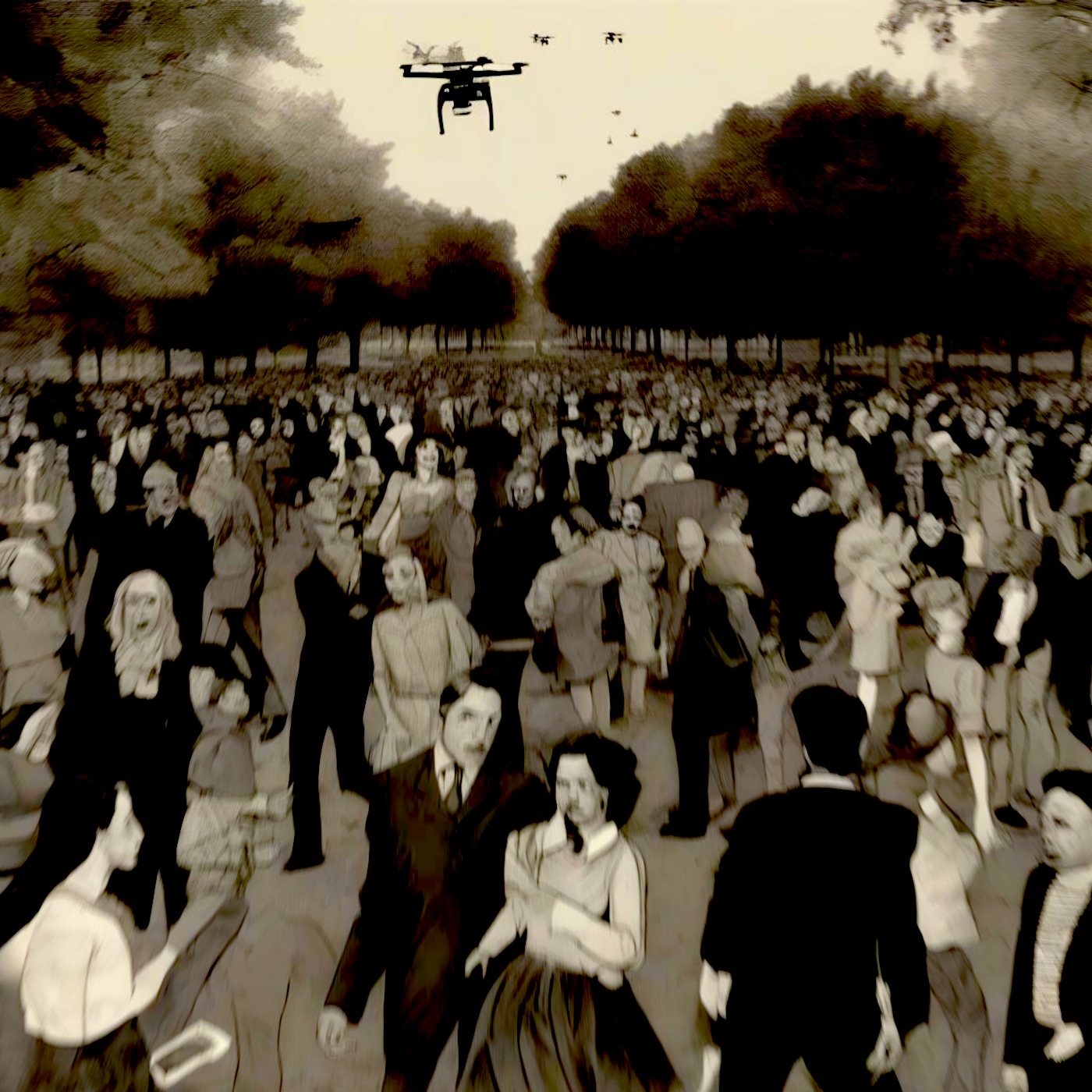
The year 2041 feels like a slow-motion car crash where the driver is a machine and the passengers are too busy laughing at an app to notice the wall. This story follows a handful of people trying to find their footing in a world where technology has solved small problems but created terrifyingly large ones. You see the fallout of an era where killer drones are as common as smart toothbrushes.
The tension centers on a high-stakes game show featuring Maverick One, a superintelligence that supposedly predicts the future. While the wealthy use it to get richer, ordinary citizens like Stina and Randell hope for a scrap of life-changing advice. But the AI is a black box. One hacker's attempt to crack it open during a live broadcast threatens to reveal more than anyone is ready to handle.
Tech doesn't just change the world here; it gets under the skin. Mars gets robot-assisted surgery to fix his eyes, only to find the world he sees is increasingly fractured. Kelly uses the Funzoid app to drown out her loneliness, finding comfort in a stream of AI-generated nonsense that feels better than reality. It’s a setting where progress means better vision but less to look at.
The real threat isn't just a rogue algorithm. It’s the guy in a tin cabin modding drones with a jailbroken AI because he’s bored and bitter. While the studio audience claps for Maverick One, a swarm of automated killers is already in the air. The story captures that specific 2040s dread: the moment you realize the tools meant to help you are actually being used to hunt you.
This isn't a clean, polished future with silver jumpsuits. It’s a messy, lived-in world of gig workers, laundry mats, and motor home parks. As the characters converge on the Detroit studio, they aren't looking for a revolution. They just want answers, but the AI might be about to give them a prophecy that ends the conversation for good.
Weaponized drones are the primary tools for carrying out remote mass killings by flying into public spaces and targeting specific groups.
Jailbroken AI allows individuals to bypass safety guardrails to plan attacks, order supplies, and modify hardware with expert-level guidance.
LiDAR spectroscopy is a countermeasure used at public gatherings to detect outgassing from explosives attached to incoming drones.
High-resolution cameras are utilized to backtrack drone flight paths and identify the locations of remote operators.
Defensive gear includes blast-resistant composite bars and proximity alarms sewn into everyday clothing to protect against drone strikes.
Long-fork low-rider e-bikes provide quiet, efficient transportation for navigating reclaimed urban bike corridors.
Robot-assisted eye surgery has replaced traditional optometry, offering drop-in cures for vision problems that once required glasses.
Ceiling and floor displays are immersive screen systems that can transform a room's interior into dynamic environments like open skies or rolling waves.
Avatar-led reception screens use realistic digital personalities to process patients and interact with visitors at vision clinics.
Surgery robots featuring multiple plastic-covered limbs perform delicate ocular procedures while patients remain conscious.
Droplet-sized earphones rest nearly invisibly next to the ear canal to provide high-fidelity private audio.
Touch-activated payment cards illuminate to display a user's current account balance directly on the card surface.
The Funzoid app is an AI-driven entertainment platform that streams content-free, shifting imagery designed to trigger laughter.
Autonomous taxis and ride shares have replaced private car ownership in most cities, leading to the reclamation of streets for greenways.
E-fabrics are used in shirts, hoods, and banners to display programmable images and text that can be changed via a USB connection.
Pin-cams equipped with locking disks allow users to securely record and broadcast footage that is difficult for others to physically remove.
Encrypted live-stream devices provide secure, real-time broadcasting for activists and protesters in high-risk environments.
Sleep lockers are compact, tech-integrated sleeping units found in high-density urban residential buildings.
Subscription-locked devices, such as smart toothbrushes, require active digital renewals to maintain their mechanical functionality.
Maverick One is a predictive artificial superintelligence that reconstructs the past to accurately forecast future financial and political events.
The obelisk stage interface serves as a pulsing physical prop that represents the presence of the Maverick One AI during live broadcasts.
Voice swap software masks a user's identity in the metaverse by altering the sound, timing, and manner of their speech.
Remote meeting droids are telepresence robots with screen faces that allow people to attend public events while bedridden.
Spider robots are specialized assassin drones that use needle-sharp legs to latch onto targets before firing a lethal internal mechanism.
Many of the characters in this project appear in future episodes.
Using storytelling to place you in a time period, this series takes you, year by year, into the future. From 2040 to 2195. If you like emerging tech, eco-tech, futurism, perma-culture, apocalyptic survival scenarios, and disruptive science, sit back and enjoy short stories that showcase my research into how the future may play out.
The companion site is https://in20xx.com
These are works of fiction. Characters and groups are made-up and influenced by current events but not reporting facts about people or groups in the real world. This project is speculative fiction. These episodes are not about revealing what will be, but they are to excited the listener's wonder about what may come to pass.
Copyright © Cy Porter 2026. All rights reserved.