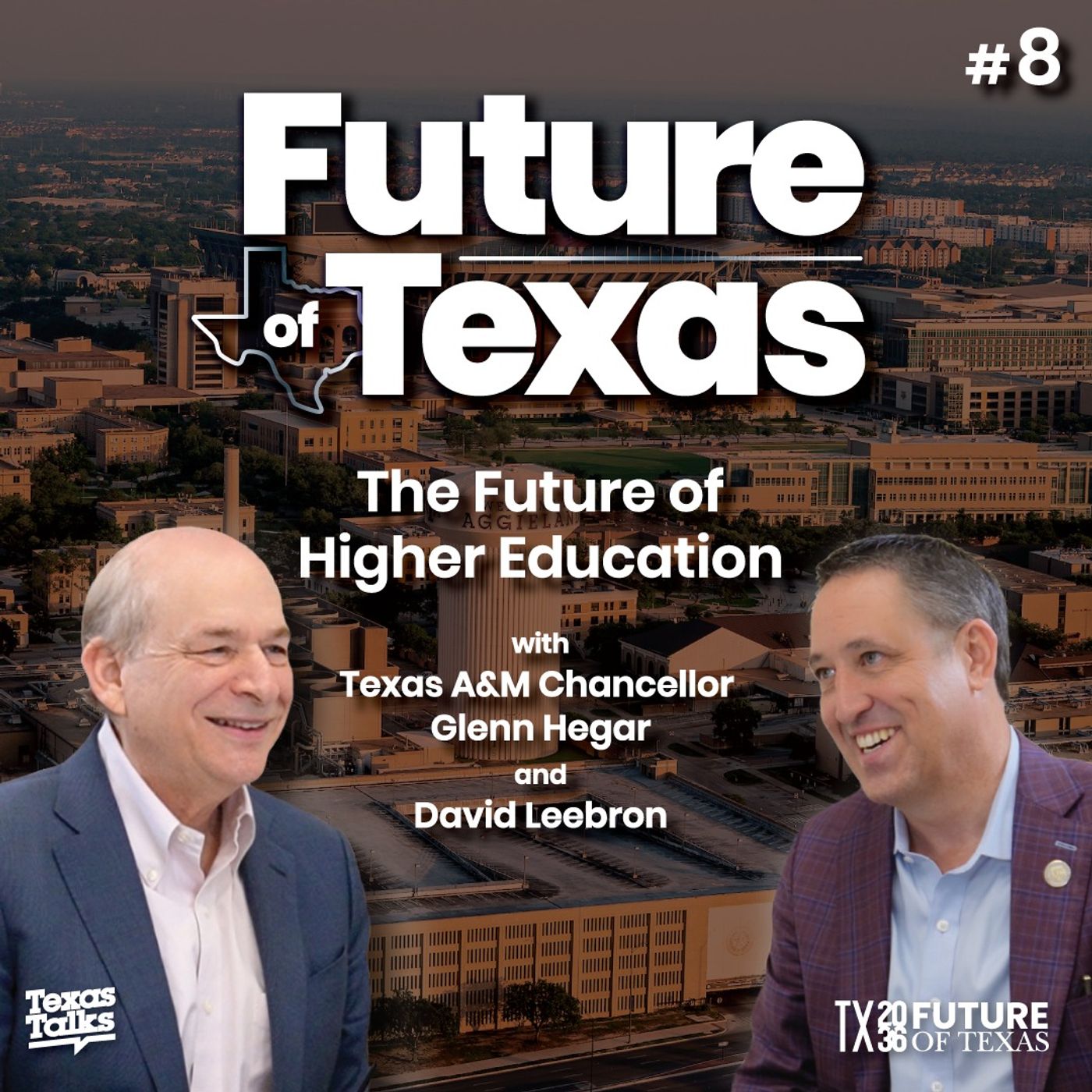
As part of the Future of Texas series in partnership with Texas 2036, this episode explores how higher education will shape the state’s workforce, economy, and long-term competitiveness.
Through the Future of Texas podcast series, Texas 2036 brings together diverse perspectives as we explore the opportunities and challenges facing our state over the next ten years. The views expressed in this program are those of the individual speakers and do not necessarily reflect the views of Texas 2036, its staff or its Board of Directors.
Host Brad Swail is joined by Texas A&M Chancellor Glenn Hegar and David Leebron, President and CEO of Texas 2036 and former President of Rice University, for a comprehensive look at the future of higher education in a rapidly growing Texas.
With millions more Texans expected by 2036, the conversation examines how universities are adapting to rising demand, changing workforce needs, and growing concerns about the cost and value of a college degree.
A major theme is the evolving role of higher education — not just as a pathway to jobs, but as a driver of innovation, economic growth, and opportunity across the state.
The discussion covers:
• How Texas’ population growth is reshaping higher education demand
• The gap between workforce needs and degree attainment
• Why more Texans need postsecondary credentials
• The role of regional universities and community colleges
• Affordability challenges and pathways to lower student debt
• Differences between public and private institutions
• The importance of leadership, flexibility, and institutional independence
• Collaboration across universities and with industry
• How research drives innovation and new industries
• Texas’ growing role in semiconductors and advanced manufacturing
• Why space exploration is becoming a major economic opportunity
• The future of nuclear energy and meeting rising power demand
• The importance of K–12 readiness in long-term success
• How policymakers can better align education with workforce needs
The episode also highlights a key shift: universities are increasingly serving as hubs for talent development, research, and industry collaboration — all critical to maintaining Texas’ economic momentum.
Looking ahead to 2036, success will be measured not just by enrollment, but by outcomes — including workforce readiness, income growth, and the ability of Texas institutions to compete globally.
00:00 — Intro + Future of Texas series overview
00:26 — Why higher education matters for Texas’ future
01:10 — Guest introductions: Glenn Hegar & David Leebron
02:14 — Texas A&M system size and statewide reach
03:19 — Growth across Texas universities
05:00 — Competing for students in a growing state
07:12 — Workforce demand vs degree attainment gap
08:51 — Expanding university missions and impact
10:18 — Growth of AI, semiconductors, and emerging industries
11:44 — Collaboration across universities and systems
13:13 — Interdisciplinary innovation and research
14:09 — Public vs private universities explained
15:55 — Leadership and institutional flexibility
17:09 — Affordability challenges in higher education
18:01 — Community colleges and alternative pathways
19:07 — Financial aid transparency and access
20:21 — Policy priorities for the next decade
21:57 — Investing in research and innovation
23:04 — K–12 pipeline and readiness challenges
24:59 — Space industry growth and Texas’ role
27:35 — Economic impact of space innovation
30:37 — Semiconductor investment and workforce pipeline
33:10 — Universities and private industry collaboration
36:14 — Nuclear energy and future power needs
38:46 — Measuring success by 2036
41:15 — Final thoughts on leadership and opportunity
43:07 — Closing
Watch Full-Length Interviews: https://www.youtube.com/@TexasTalks
Follow us on social media
X: @Texas_Dispatch
Instagram: thetexasdispatch
LinkedIn: The Texas Dispatch
TikTok: texas_talks_podcast
Find more at The Texas Dispatch
Your source for state news, policy, and investigative journalism.
https://thetexasdispatch.com