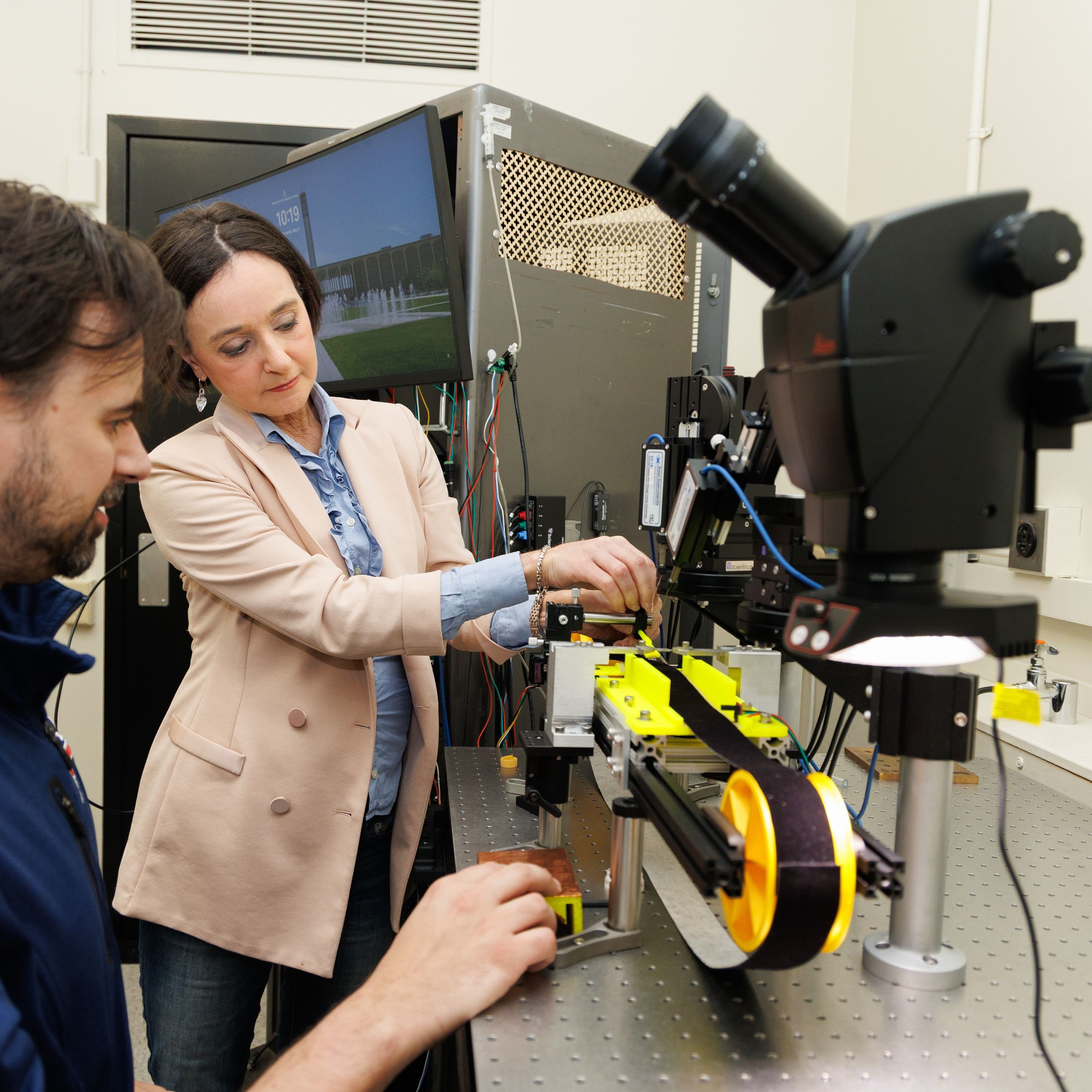
Annalisa’s lab is working to understand how the brain processes spatial awareness — both to inform medical advances for dementia research and to advance technologies seeking to mimic the efficiency of the human brain. Here’s a look into how her team uses mouse models to answer these questions.
AS: Genetically, mice are surprisingly similar to humans. In our studies, we allow them to navigate through space, and we have them run on a treadmill that has different cues that indicate different environments. For example, there are portions with grass, there are portions with different textures or different colors. As the mice move, we record the electrical activity of cells within the hippocampus called “place cells” that encode cues that tell us where we are. This allows us to monitor how place cell formations change in mouse models with different diseases.
One thing that we have found is that allowing neurotransmitters (chemicals used by the brain to communicate) to travel further in the brain tissue is a key mechanism that facilitates our perception of space. If changes in brain structure like those seen in Alzheimer’s disease block or prevent neurotransmitters from travelling where they need to go, this affects our ability to perceive where we are.
How do you know that what you see in mice can accurately be mapped onto a human brain and connected to neurodegenerative diseases?
AS: We never know that for sure; it’s more of an inference than a certainty. It's difficult because we cannot do these types of studies in healthy versus unhealthy human volunteers. Clinical trials are limited in how many people can be involved and they take a very long time. Instead, we can use mice to repeat these experiments across a larger population, which we can follow through time in healthy and diseased states and make predictions. In the future, clinicians could see whether our predictions are accurate or not.
Studies like these are really important for informing new ways to manage dementia. If we can find therapies, either pharmacological or behavioral, that can delay the progression of the disease and keep the patients in a clear state of mind for longer— if I could achieve that in my lifetime, that would be a huge success.
What do you think it will take to answer these questions?
AS: Right now, everyone is talking about artificial intelligence and how AI could help us solve this sort of question. While AI is booming, it's also environmentally and energetically hungry. At this pace, we can't sustain the developments, so what can we do? The solution is to go back to the brain to learn how it allows us to be so intellectually complex at the energetic cost of a dim light bulb.
It can be easy to think that there's no hope, but we have to overcome that. When I was a kid, there was an environmental concern about how much light we were using and then LEDs were developed. But oftentimes, when you think that there's no solution, the solution is there and it's innovation.
Look inside Annalisa’s lab to see how her team is building novel tools to study how the brain works and how it is affected by neurodegenerative disease.
Learn more about the biology of Alzheimer’s and how the disease takes hold in this Q&A.
Annalisa’s work was among six projects to recently receive funding as part of the SUNY Brain Institute. Learn more in this Times Union coverage about SUNY’s $10 million, cross-campus investment in neuroscience, featuring insights from Annalisa.
Audio editing and production by Scott Freedman
Photo by Zach Durocher
Hosted and written by Erin Frick
The Short Version is produced by the Office of Communications and Marketing at the University at Albany, which is part of the State University of New York.
Comments, ideas, suggestions?
Send them to mediarelations@albany.edu and be sure to put The Short Version in the subject line.