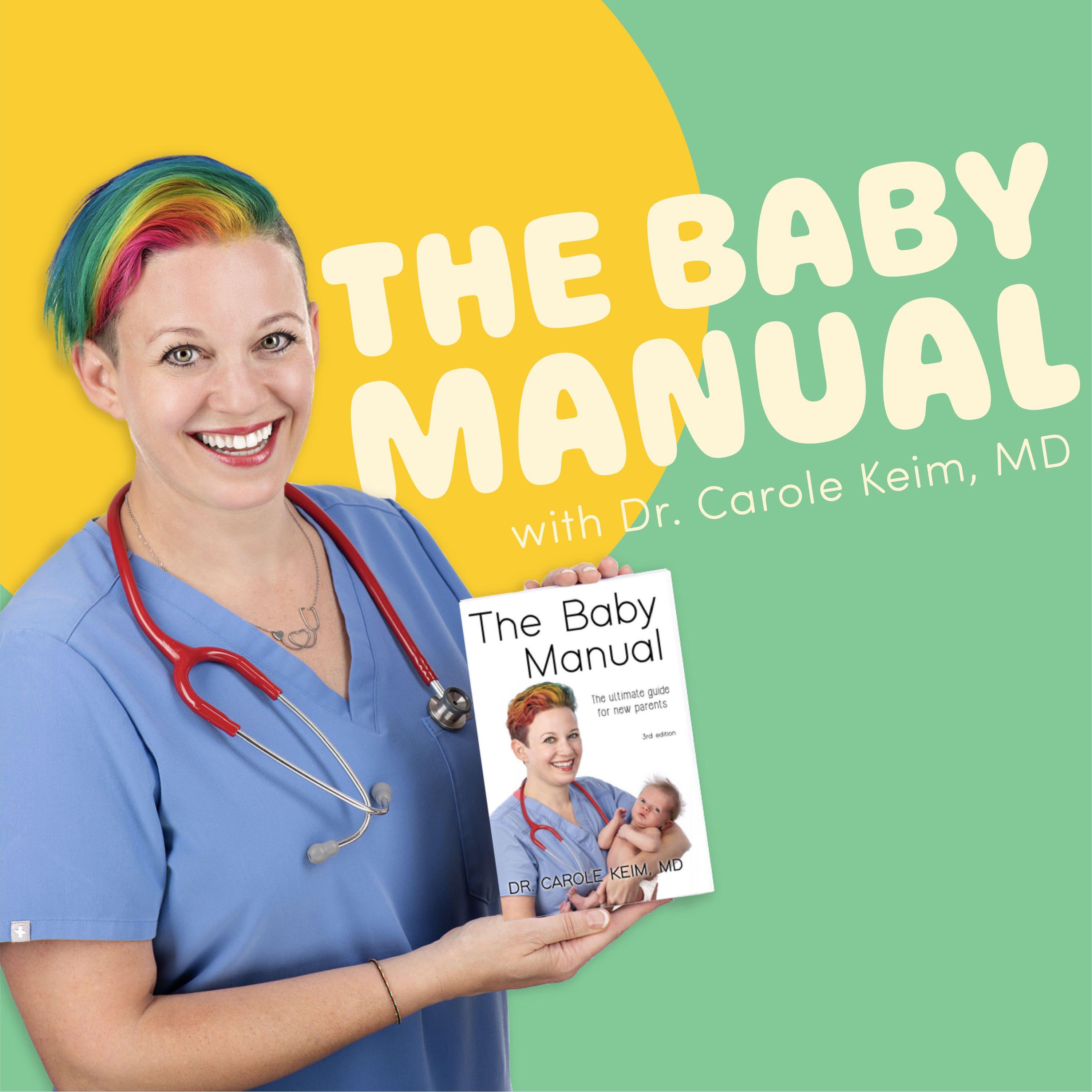
Some newborns will eat eight to twelve times a day. In this episode, Dr. Carole Keim MD talks about breastfeeding, formula feeding, pacifiers/nipple confusion, and teething/oral hygiene (also thrush). For the first couple of months, your baby should be eating at least once every 4 hours for development. Pumping can be done right after your baby is born and sometimes even before. Are you looking at formula options? She goes over different types and how to choose what’s best for your little one.
Dr. Carole Keim MD goes over the benefits of breastfeeding for both mom and baby. Eventually, your baby will start to show interest in food, so it is essential to know how to introduce solid foods and approach the risk of allergic reactions. Your baby may start teething at around six months; she talks about signs to recognize, ways to help your baby during this time, and oral hygiene practices.
The next few episodes will be a deep dive into certain topics that I get asked about a lot; these are also laid out just like this in my book, The Baby Manual, available on Amazon/Kindle
- feeding, teething - 5/4
- pee/poop, gas/colic - 5/18
- skin - 6/1
- sleep - 6/15
- illness/red flags - 6/29
- vaccines 0-6mo - 7/13
How often to feed: (0:54)
- Newborns eat 8-12x per day, need frequent feeds because their stomach is so small
- Birth - stomach size of a cherry (5-10ml, or 1-1.5 tsp) - colostrum
- Day 2 - walnut (20-30 ml, or 0.75-1 oz)
- 1 week - golf ball (45-60ml, or 1.5-2oz)
- 1 month - (80-150ml, or 2.5-5 oz)
- The stomach stretches like a balloon
- Overfeeding -> spit ups
- The lower esophageal sphincter develops by 6-12mos of age
- 8-12 feeds aren’t exactly every 2-3 hours
- Cluster feeding 2-6 am because prolactin is highest
- This typically lasts about 2 weeks, then they learn the night/day difference
- If they sleep 4 hours you MUST wake them
- Newborn - 2 weeks: may eat more than 12x per day
- 2weeks - 2 mos: typically eat every 2-3h
- 2-6 mos: can sometimes go more than 4h between feeds if they are gaining weight and your doctor ok’s it
What to feed them: (4:00)
- Breastmilk or formula ONLY for 4-6 mos
- Contains all the protein, fat, carbs, vitamins, minerals, and water your baby needs
- At 4-6 mos can start to introduce foods: will come back to this in a bit
Breastfeeding: (4:29)
- AAP recommends exclusive breastfeeding x 6 mos, then BFing + food/water until age 1 year or later
- Ok to breastfeed as long as you want
- Eat a wide variety of foods
- Vitamins:
- A prenatal vitamin that contains iron and folic acid
- Omega-3 fatty acids (200-300mg per day)
- Calcium (1000mg per day)
- Vitamin D (5,000-6,400 IU per day)
- Ok to drink alcohol because of first-pass metabolism: an 8oz drink of 10% alcohol becomes 0.04% BAC (and 0.04% breast milk concentration - 250x less concentrated). 0.08% consumed by baby makes their BAC 0.0001% (undetectable; less than BAC after a child drinks orange juice or eats an over-ripe strawberry)
- When inside, your BAC = baby’s BAC
- Each time baby eats, they are placing an order for the next feed
- First 3-5 days colostrum; need to nurse for 15-20 min per side per feed to stimulate milk production
Benefits of Breastfeeding: (9:53)
- Emotional: releases oxytocin, a bonding hormone, and endorphins
- Health: decreases postpartum bleeding, decreased risk of breast cancer and ovarian cancer, decreased risk of rheumatoid arthritis, decreased risk of postpartum depression, can help you lose baby weight because burns an additional 500 cal per day
- Baby benefits: decreased risk of obesity and type 2 diabetes as adults, less chance of infection due to IgA, decreased risk of SIDS, less likely to develop atopic and autoimmune diseases
- Extra benefits nobody really talks about: poop won’t smell bad and is water-soluble, you always have it on hand, the composition changes as your baby grows, it’s free
Tricky things about breastfeeding: (12:40)
- Takes babies up to 2 weeks to get a hang of it
- Can be painful for the first 2 weeks
- Aggressively moisturize your nipples
- Tongue-tie: only class 4 needs repair. Lip and cheek ties do NOT need to be repaired.
Pumping: (14:37)
- Can start as soon as the baby is born; pumping while pregnant can induce labor
- Choosing a pump: manual vs. electric, how much suction, how portable, single or double
- Getting the best return:
- Early morning (prolactin peak)
- One side while baby latches on the other side, or within 15 mins of baby finishing
- If at work, look at photos/videos of baby
- Stay hydrated
- Can try herbal teas, lactation cookies, dietary supplements; these are not proven to be effective and are unlikely to be harmful
- outside the US: domperidone
- Pumped milk lasts 6 mos in the freezer, 6 days in the fridge, 6 hours at room temp
Giving bottles to a breastfed baby: (17:11)
- Allows partner and other family members to bond with baby
- Can allow mom a little more sleep at night
- Always pump while your baby gets a bottle to keep supply up
- Brush baby’s cheek and let them latch on; don’t put the nipple into baby’s mouth
- Start with it horizontally, angle up after 1-2 seconds
- Use a preemie flow nipple
Choosing a formula: (19:07)
- All brands are fairly equal in the US; choose based on the type of formula and look at the ingredients!
- Regular (cow’s milk-based) - best mimics breast milk
- Goat milk formula is ok; goat milk is NOT (nor is any animal milk other than human)
- Preemie formula - has extra iron, calcium, and calories because the last month is when babies store Fe/Ca/fat
- Soy-based - for vegan families or babies with galactosemia; NOT for milk protein allergy because tend to cross-react
- Sensitive formulas - more simple sugars, corn syrup-based - I hate these but they do have their place; more info in the next episode (gas/reflux/colic/spit-ups)
- Anti-reflux formula - has added rice starch
- Hydrolyzed formulas (partially digested, amino acid-based) - protein, fat, and/or carbohydrates are broken down and easier to digest; for babies with milk protein allergy
To prepare the formula: (21:38)
- Ok to mix up to 1 day’s worth (24-30oz) and keep in the fridge
- Can get ready-to-feed (liquid) formula; do NOT water it down
- Powdered formula - follow instructions on the package exactly
- Can mix with drinking water if the clean source
- Temp should be lukewarm / room temp
- Reminder: let baby latch onto the bottle, always hold baby and bottle while feeding (don’t prop)
- Burp halfway through and at the end
- Any leftover in the bottle must be thrown away
Baby cues: (9:05)
- Hungry - eyes open, looking around; rooting; crying
- Done - falls asleep, sucks slowly, or turns away
- Can offer pacifier
Starting solids: (23:03)
- 4-6 mos of age in the US; 6 mos elsewhere
- Signs of readiness: sit with support, loss of extrusion reflex, watching you eat, bringing hands/objects to mouth
- One food every 3-4 days; watch for signs of allergy
- Food order doesn’t matter; can have anything other than honey and animal milk
- Puree method: rice cereal, green veg, orange veg, fruit
- BLW: give babies mashed up foods that they can swallow, or pieces too big to fit in their mouth for them to suck on
- Start water with solids, 1oz per each 1-2oz of food
Food allergies: (26:46)
- Signs - blood in stool, rash, vomiting
- Must discontinue food and wait until after 1st bday with your doctor’s approval
- Top 8: peanuts, tree nuts, fish, shellfish, dairy, wheat, egg, soy
- Risk factors: family member with asthma, eczema, or allergy (likely to something different), a baby with severe eczema
- Introducing peanut protein
Nipple confusion: (18:27)
- Not a real thing, but flow preference is
- If you’re going to give bottles ever, start early
- Pacifiers don’t cause nipple confusion and can soothe the baby and decrease SIDS risk
Teething: (29:28)
- Average 6 mos of age; anytime in the first year
- Teeth order; 20 total baby teeth (for tooth-fairy planning)
- Signs: fussiness, drooling, low-grade fever, pink cheeks, chewing on hands/toys, tooth buds, diarrhea
- How to help: teething toys, frozen washcloth, frozen fruit in a mesh bag, topical medications, Tylenol
Oral hygiene: (33:12)
- Pre-teeth: don’t need anything special
- As soon as teeth emerge, brush 2x/day with water or fluoride-free toothpaste
- Start fluoride at 6mos of age if it’s not in your drinking water; the size of a grain of rice
- Dentist at 1 year of age
Thrush: (34:41)
- Yeast infection
- Thick white coating on the tongue
- Doesn’t wipe off
- Nystatin
- Can spread to breasts - pills for mom
The next episode will be gas, colic, spit-ups, and reflux
Resources discussed in this episode:
--
Dr. Carole Keim MD: linktree | tiktok | instagram
Win an awesome bundle of free hair care products and accessories!
We're running a competition in collaboration with Arctic Fox. Be in with the chance to win a complete hair transformation kit.
Enter the competition today!
Check out Arctic Fox's website - use code DRKEIM at checkout for 15% discount.
——
Did you know an estimated 18 to 20 billion disposable diapers go into the landfills every year in the us? And those diapers take between 400 and 500 years to break down because of the plastic in them. HIRO Diapers is helping the planet and also helping parents out by not being any more expensive than regular disposable diapers.
These diapers are made with no plastic. They also come with these packets of fungal spores that you can drop in the diaper. And when those go into the landfill, they grow into a fungus that eats the plastic around them so you can help the planet get healthier while also helping your baby.
Check out the website. They also do a monthly diaper subscription. Use code DRCAROLEKEIM for a discount.
Hosted by Simplecast, an AdsWizz company. See pcm.adswizz.com for information about our collection and use of personal data for advertising.