http://www.sonicobjects.com/index.php/2019/12/16/sonus-maris/
You will need either big sub-woofers or some audio actuatiors bolted to something big to listen to this :)
Technical Notes.
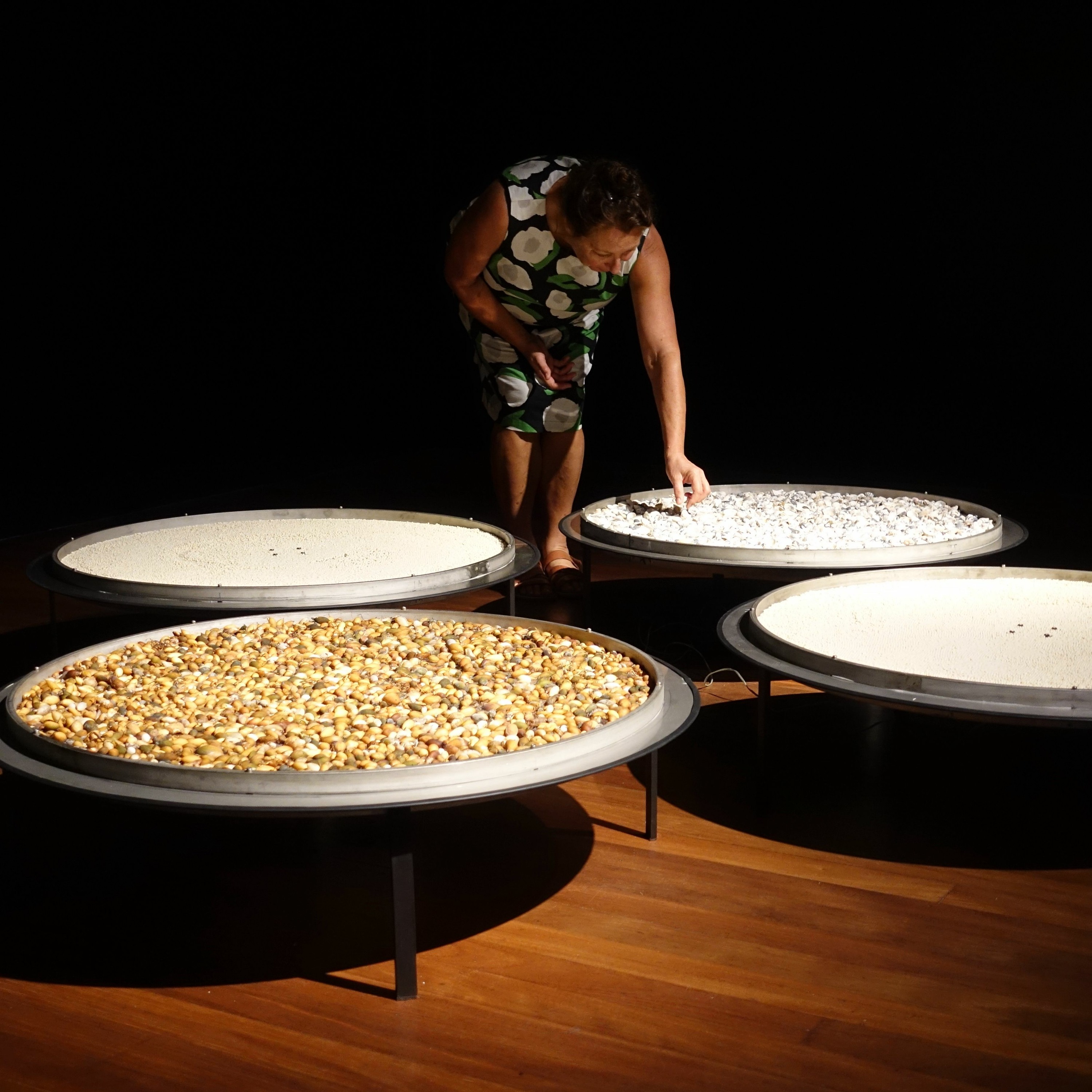
Sonus Maris is the result of an Art and Science collaboration with the scientists and engineers of the Water Research Laboratory of the University of New South Wales.
The artist worked with data relating to the movement and deposition of sand on the beach at Narrabeen (in fact this is the world’s longest observation of sand deposition – taken over a period of 43 years) and is accompanied by tidal data and wave height. The artist quantised these data and then assigned a range of tonal values, that are played via audio actuators fitted to four Chaldini plates* and which excite various particulate matter on the plate’s surface. Sonus Maris sonifies and visualises abstract data sets across the four plates operate at very low frequencies generating a palpable and visceral experience.
The project has been extremely popular with both the general public and with the scientists and engineers of the laboratory – so we shall continue our collaborations.
* Ernst Chaldini (1756 – 1857 Hungarian/German) developed Robert Hook’s experiments of 1680 where he had observed nodal patterns manifest on vibrating glass plates (he employed flour activated by a violin bow stroking the edge of the glass). Chaldini patterns or figures are a method to demonstrate nodal boundaries in vibrating surfaces and have similarities with the solutions of the Schrödinger equation for one-electron atoms.