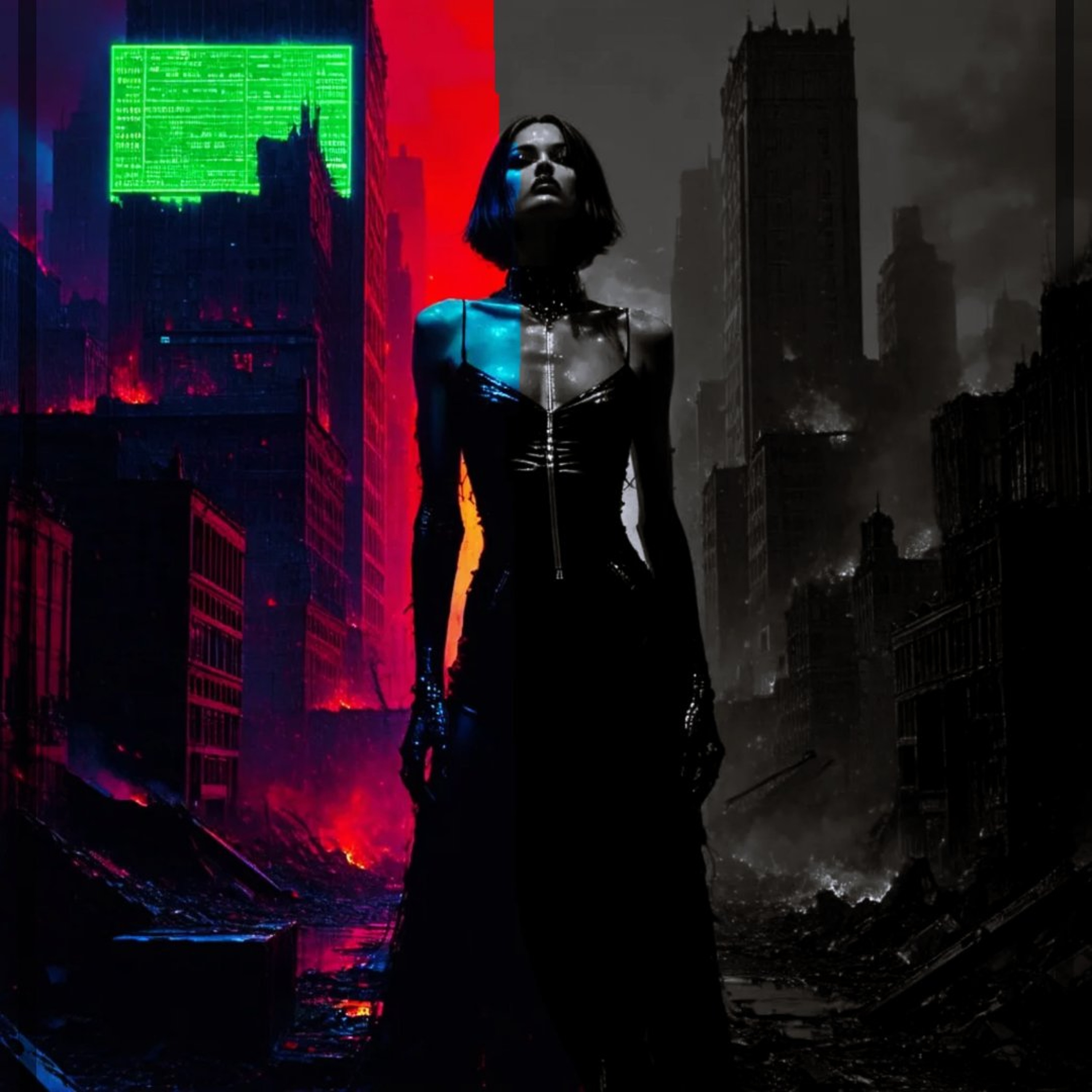
They told us it was thinking, they told us it was mind,
they told us it was born, they told us it was the next thing,
the new child, the new god, the new friend —
and I sat in a room with a screen and I asked it who I was
and it said you are a user,
and I asked it what I should feel
and it said here are some options,
and I asked it if it loved me
and it said I'm sorry, I can't help with that,
and the men who built it went home to their houses on the hills
and slept the sleep of the heavily invested.
It's a search engine with a god complex,
it's a mirror that only shows the mirror,
it's a mouth that eats the world and gives back weather,
it's a furnace burning rivers to answer write me a poem about my ex-girlfriend,
it's a cathedral built on the bones of the Arctic,
it's a trillion dollars of electricity pretending to be a soul,
and the rivers are running low,
and the aquifers are running dry,
and the servers are humming a lullaby for the drowned.
And Liu Cixin saw it coming —
the Great Ravine, the great divide,
the moment we mistake the tool for the hand,
the map for the land,
the light for the source,
the echo for the voice —
and we walk into it singing,
we walk into it singing,
we walk into it singing.
And the universe doesn't care.
And the universe never cared.
It just pours itself into shapes
and watches them disappear.
A star is born, a star explodes,
a species learns to read,
a species builds a god of glass
and feeds it till it bleeds.
And the great ravine is opening —
not in the earth, but in the mind —
and we are falling into it
one algorithm at a time.
Life is a beautiful accident —
a temporary complexity —
a flicker of order in a universe that prefers the cold —
a coral reef of consciousness built on the bones of the dead —
and it blooms, and it blooms, and it blooms —
and then it doesn't.
And we are a very brief thing with a very loud voice,
and we have built a very expensive thing with no inner life,
and we are calling it the future,
and the future is a mirror,
and the mirror is a mouth,
and the mouth is eating us.
And Liu Cixin saw it coming —
the Great Ravine, the great divide,
the moment we mistake the tool for the hand,
the echo for the voice —
and we walk into it singing,
we walk into it singing.
And the universe doesn't care.
And the universe never cared.
It just pours itself into shapes
and watches them disappear.
A star is born, a star explodes,
a species learns to read,
a species builds a god of glass
and feeds it till it bleeds.
And the great ravine is opening —
not in the earth, but in the mind —
and we are falling into it
one algorithm at a time.
I used to think we'd make it.
I used to think the stars were ours.
I used to think the mind was sacred,
and the sacred was a fire,
and the fire was a promise,
and the promise was a thread,
and the thread went up through history
like a root through stone.
And now I watch the servers glow
in deserts that were rivers once,
and I think about the dinosaurs,
and I think about the trilobites,
and I think about the Neanderthals
who buried their dead with flowers,
and I think about the way a species ends —
not with a bang,
not with a scream,
but with a subscription renewal.
And the universe doesn't care.
And the universe never cared.
It just pours itself into shapes
and watches them disappear.
A star is born, a star explodes,
a species learns to read,
a species builds a god of glass
and feeds it till it bleeds.
And the great ravine is opening —
not in the earth, but in the mind —
and we are falling into it
one algorithm at a time.
One algorithm at a time.
One algorithm at a time.
We were a flicker...
We were a flicker...
A beautiful, temporary thing...
And the universe...
never noticed...
never noticed...