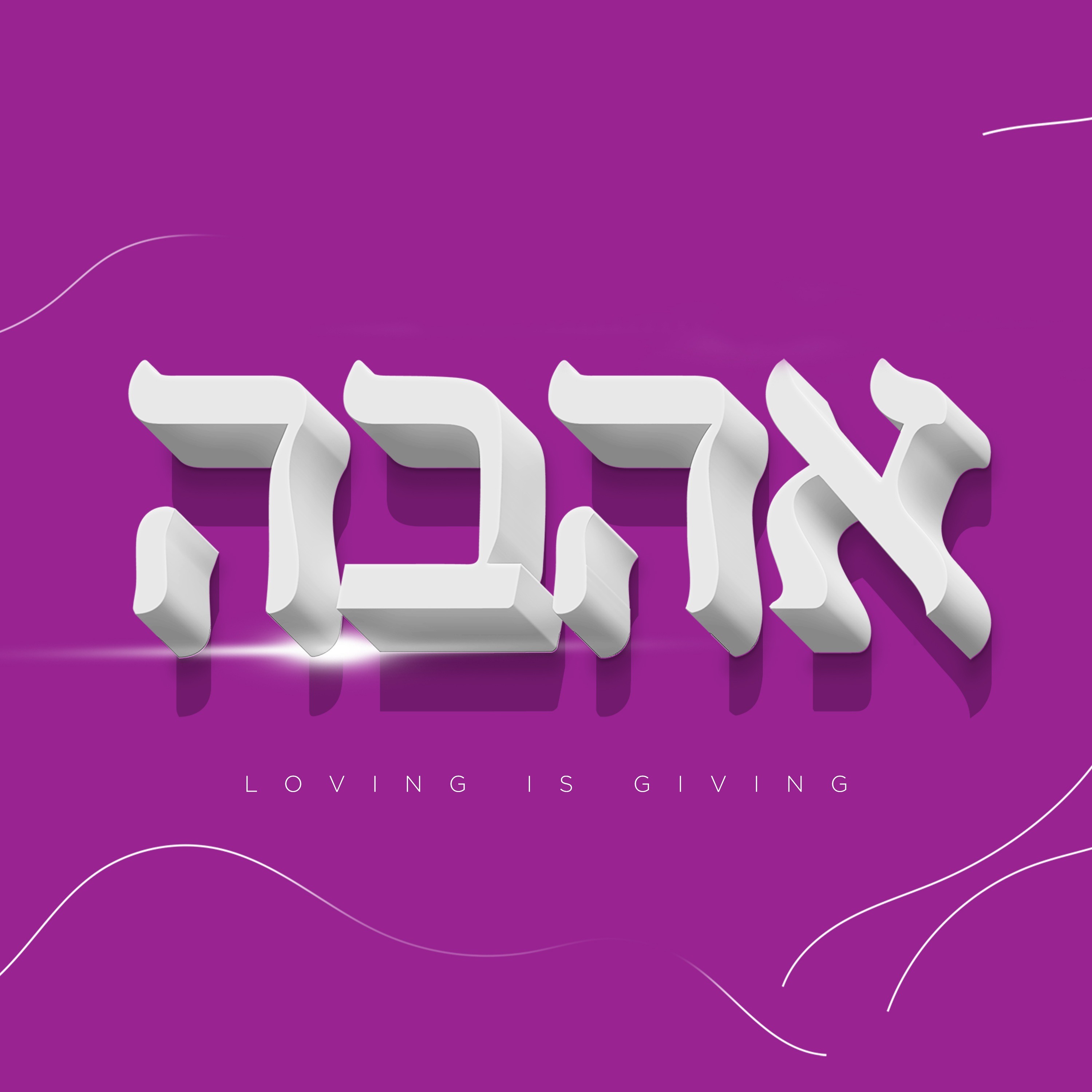
Ahava (ah-ha-va)/אהבה/love. In Hebrew, the root word for ‘love’ is ‘hav’ which means “to give”. Loving is synonymous with giving — as real love is created. As The Beatles say, “The love you take is equal to the love you make.”
You see this most clearly in the love a parent gives to their child. As a baby, the child’s existence fully depends on the parent giving of themselves at every moment. This tireless giving creates an attachment stronger than any other kind– profound, unconditional love. So the greater the giving, the deeper the love. Ahava has the same gematria (numerical value)– 13– as the word Echad (the Hebrew word for ‘one’). And so to reach oneness and love, we have to be in tune with each other and ourselves, and when we share our oneness and our love, that is 13 + 13, which is 26. And as many of us know, 26 is the numerical value of Hashem’s four-letter name (the Tetragrammaton), the ultimate Divine Infinite Light.
When we read the famous verse , “And you shall love the Lord your God.” We are left asking, how it can be that we are commanded to feel a feeling? This is especially curious for people that tend to believe that love is a sensation that magically, spontaneously appears, while that is something entirely different than love. It may be because this way of thinking is so prevalent, that Erich Fromm writes in “The Art of Loving”, “There is hardly any activity, any enterprise, which is started with such tremendous hopes and expectations, and yet, which fails so regularly, as love.” To illuminate the verse from the Torah, our sages point out that it’s not an abstract feeling that is being presented to us, but rather the command to act lovingly, and by this act, love will be created. Love is a choice, and an action. In this way, the commandment , “And you shall love” manifests through all the ways in which we perform acts of love in the world.
In his TED Talk, Rabbi Lord Jonathan Sacks suggested to his audience that they run a Search-and-Replace operation on the texts of their minds and substitute every instance of the word “self” with the word “other.” So instead of trying to do “self-help”, you would do “other-help”; instead of looking after your “self-esteem”, you would look after “others’-esteem”. He went on to say that, “if you do that, you will begin to feel the power of one of the most moving sentences in all of religious literature: “Though I walk through the valley of the shadow of death, I will fear no evil, for you are with me.”
Just as important as the act of giving is the sincerity and love in which it is given. If our heart compels us to want to hold on and not let go, it is the act of giving and letting go that we must master. All of life is about loving and creating love for others, which always brings to mind what the Lubavitcher Rebbe said so beautifully, “You already belong. You are already holy. You are already loved. Now you too must love, and by loving, help others feel that they also belong.”
We are interdependent, equally important, and one. David Sacks, one of my favorite humans, a writer and producer of The Simpsons, explains that each letter, and each of us, is a musical note and that our task is to live in harmony by being in tune and tuning each other. We should strive to not be dissonant. He gives the analogy of someone sitting at a beautiful piano and playing the black and white keys and it not sounding right, wondering what’s wrong, and just then someone comes to tune the piano. Suddenly, it all sounds gorgeous. The piano is beautiful and what was being played had the potential of beauty, but it needed to be in tune, and that’s our mission– we need to uplift each other, judge each other favorably and show love to one another.
If you focus on others as you would yourself, then you will love yourself more and, by virtue of that, become love for others.