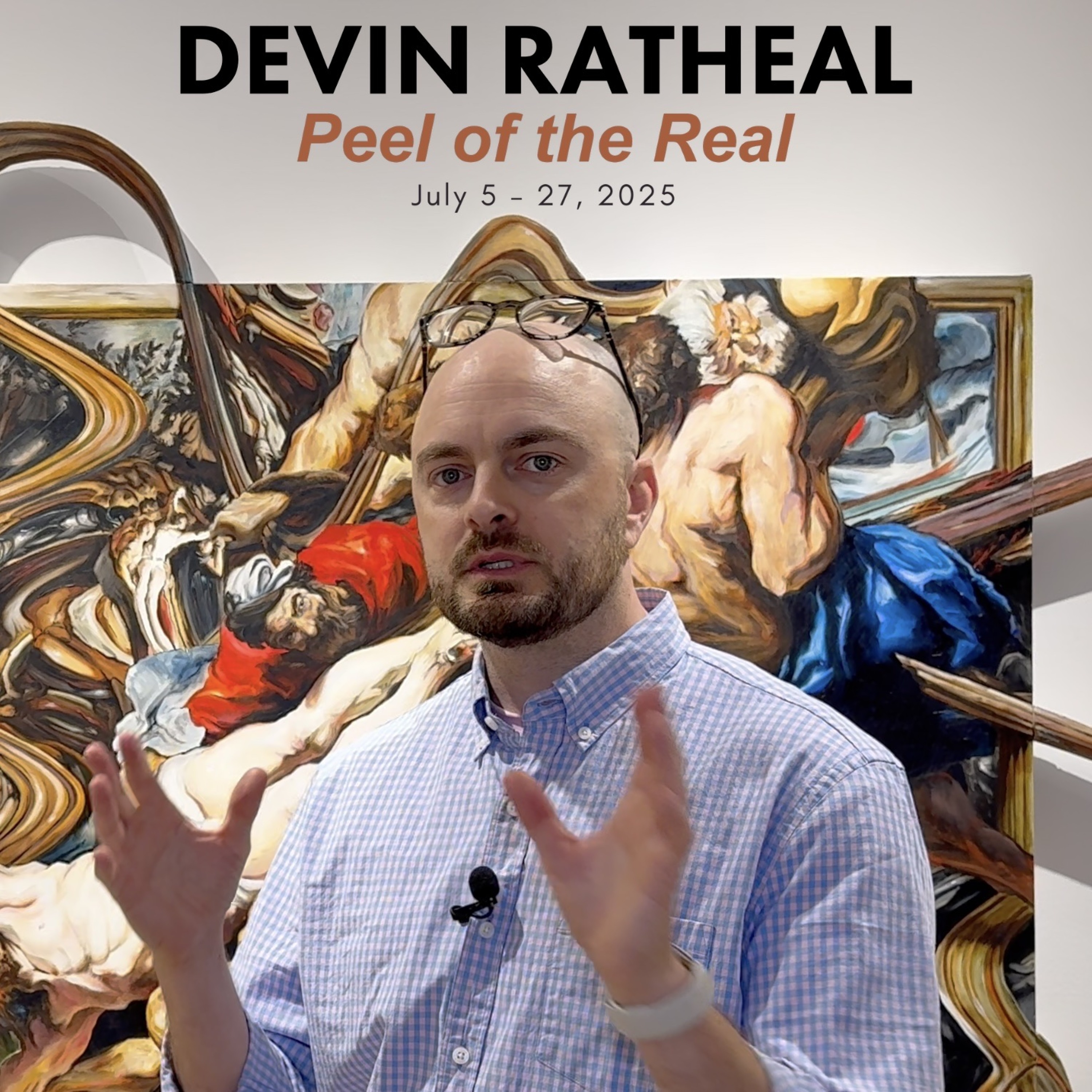
Like the Romantic notion that vertebrate evolution is recapitulated in the human fetus, this work imagines Ratheal’s materialist experience as a transmogrification of his ancestors’ religious worldviews. He sees religious European paintings as expressions of a long history of negotiating with unknowable, nonhuman otherness. He tries to make visible the alien immediateness he perceives in them—to give them space to breathe and express themselves anew.
In his recent works, the content referenced from these paintings drip and burst onto the wall. The works are also a register of seismic seizures of a collective unconscious, marking the violent destabilization of identity that is disconnected from being and cannot admit difference. They mark the inability of the descendants of Europeans to find a new expression for the memory embedded in their inherited images, who seek to make the world an image of hell, so that it can, at least, be recognized.