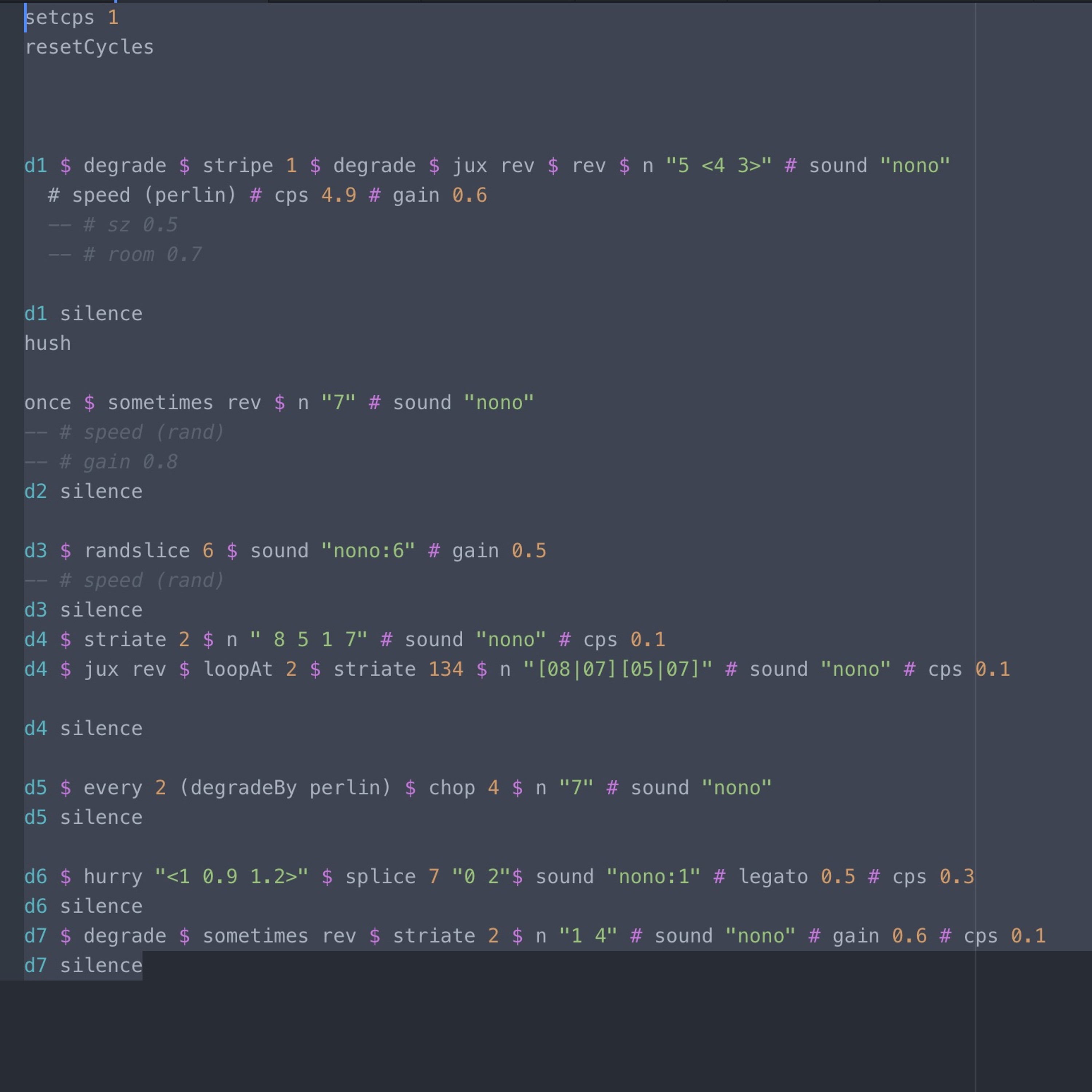
This is my response to the second assignment for Tidal Club. The assignment essentially asks us to look for samples of speech and slice/cut them up in a way that makes it all interesting. In this attempt, I ended up trying out a non-rhythmic approach, trying to use the prepared samples as spliced tape. While doing this, I realized that by layering different samples at different speeds (at different volumes), that clear "sample cut" feeling is blurred out, making it seem like I am avoiding the assignment altogether.
The assignment is as follows:
Once you have your sound source, you'll need to edit it into a coherent loop. You need to somehow edit it so that it starts on a 'down beat' and lasts a certain number of beats (usually a power of 2, e.g. 4, 8, or 16 beats). In audacity you can hold down shift and press space to play a selection on loop, which is a good way of testing if something is looping properly by ear.. I'll do a live stream soon to demonstrate this process.
Alternatively you could manually cut the sounds into short percussive parts for arranging with the n patterns and mininotation, if you prefer - that might be more work.
Then start slicing, splicing, chopping and striating until you come up with something weird/interesting. Try juxtaposing / mixing that with a less messed-up version. You could then either record a few repetitions of a single pattern, or if you fancy it and have some time, try to flesh it out into a whole track. Have fun with it!
Things to think about
How speech changes when you start treating it as sound
The relationship between speech perception and movement (check out the McGurk effect 5)
How does slicing longer sounds feel compared to sequencing individual sounds?