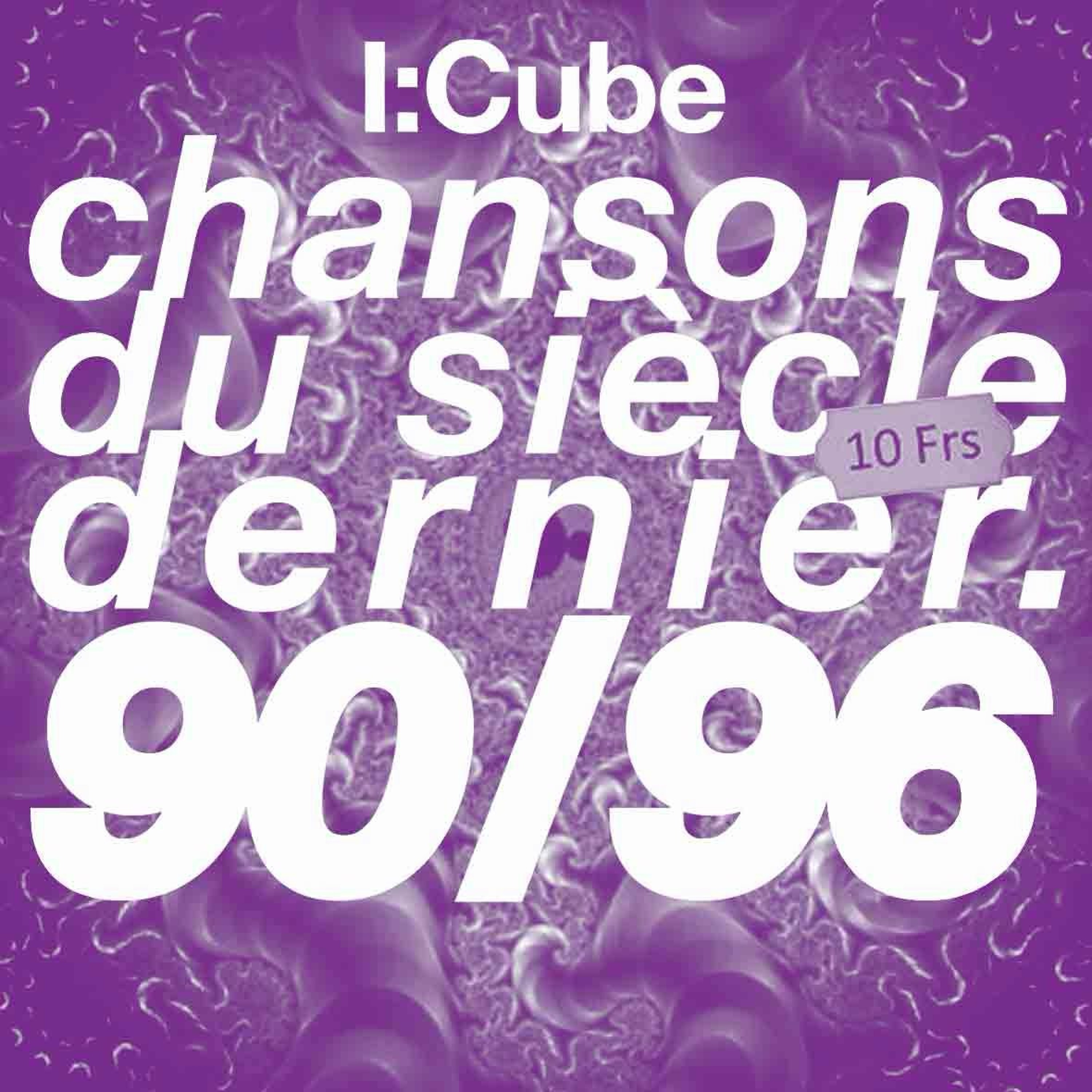
I:Cube
" Chansons du siècle dernier (1990-1996) "
-------------------------------------------------------
a mini mix of old tracks from the cassette archives.
Let's indulge in a little nostalgia for once. I'm going to talk about a period which goes from 1990 to 1996, with modest beginnings in the production of house "musique de chambre" in which freedom and enthusiasm were more important than anything else.
Inspired by the discovery of dance music at the end of the eighties in England and through listening to the radio, I tried to reproduce what I heard with a small Casio toy sampler, and a Mattel Electronics rhythm box played by hand. Gradually more machines were added to this primitive set-up, and by 91 i got a better sound with a Roland sampler. Like all bedroom producers of this period, you did the best you could with the means you had at your disposal, not having much idea of "how it was done". All this air of mystery contributed to the aura of the records which came out during this period.
The role played by FM radio during this time in Paris was of prime importance. For additional information I suggest you should read Etienne Menu's excellent article on this subject : http://daily.redbullmusicacademy.com/2015/11/french-radio-feature.
I constantly zapped between stations. Radio Nova (Deenastyle with Dee Nasty and Lionel D, Guillaume la Tortue's mental mixes in 1990, Garnier and his "paradise garage" show, the Nova mix with Loik and Gilb'r, as well as numerous different guests).
Also Radio FG which played ambient (the "radio mental" mix on monday) as well as hardcore techno and garage, with very good guest DJ's ( Liza N'Eliaz, DJ Deep, Jeff Mills…). Public service radio France Culture offered sound creation (in particular the famous Atelier de Création Radiophonique, Clair de nuit, and radio drama), radio Ici & Maintenant for UFO's and New Age weirdness, radio Libertaire for its "epsylonia" show, Transat FM for rare groove and so on…..
Public record libraries (which are free and well-stocked in Paris), as well as flea markets, were my main source of samples, as well as numerous musical finds.
What was most important for me was not to make a record, but above all to make music. The end product was a multitude of bits of music which I collected on cassettes over the years, recording moments of creation and fun.
It went in all directions, from dadaist deep house to hazy trance. Freedom and lack of production techniques meant so-called rules of good or bad taste were immaterial and it was all the better for it.
There was an overpowering desire to take pleasure in doing it and experimenting ("how would it sound if I mixed a reversed zouk beat with an acid baseline?").
This minimix, which is a bit difficult to stomach when you listen to it, is interspersed with short radio extracts which take us back to the atmosphere of the period. The absolute roughness and lack of sophistication of it, the naivety and the passion make it all the more charming.
In 1996, I sent some cassettes out to have a second opinion on them, without much conviction. The only reply came from Gilb'r who was working at Radio Nova and decided at that time to start a record label. Everything happened by trial and error and in an atmosphere of enthusiasm and curiosity. As a result of all this collective energy (big up Isabelle, Didier, Jérôme, Stephane, Ygal) and all those who joined in the adventure at some time or other, the image of Versatile has developed as each record has come out, preferring to be always a little on the sidelines, not wanting to be confined to what sound is fashionable or just restricted to dance music. Because nothing has been pre-determined, instead relying on gut-feeling on the spur of the moment, Gilbert has been able to retain this freedom and enabled his label to stand the test of time.
I:Cube