Enochian1 is the first sketch of a larger effort referred to as The Harmonic Monad, that treats John Dee’s esoteric system as a complete mathematical and metaphysical architecture for music. Dee, a Renaissance mathematician, astrologer, and occult philosopher, saw no division between science and angelic magic, regarding number, geometry, and language as sacred media that reveal the hidden structure of reality.
The first pillar is the Monas Hieroglyphica, Dee’s cryptic treatise on a single glyph meant to express the mystical unity of creation. Its twenty‑four theorems become formal and motivic “axioms”: early propositions on point, line, and circle map to a tonic center, linear melody, and cyclical rhythm, while later developments involving Sun, Moon, crosses, and numerical progressions (10, 50, 100) inform theme–reflection pairs, mixed meters, and large‑scale temporal proportions.
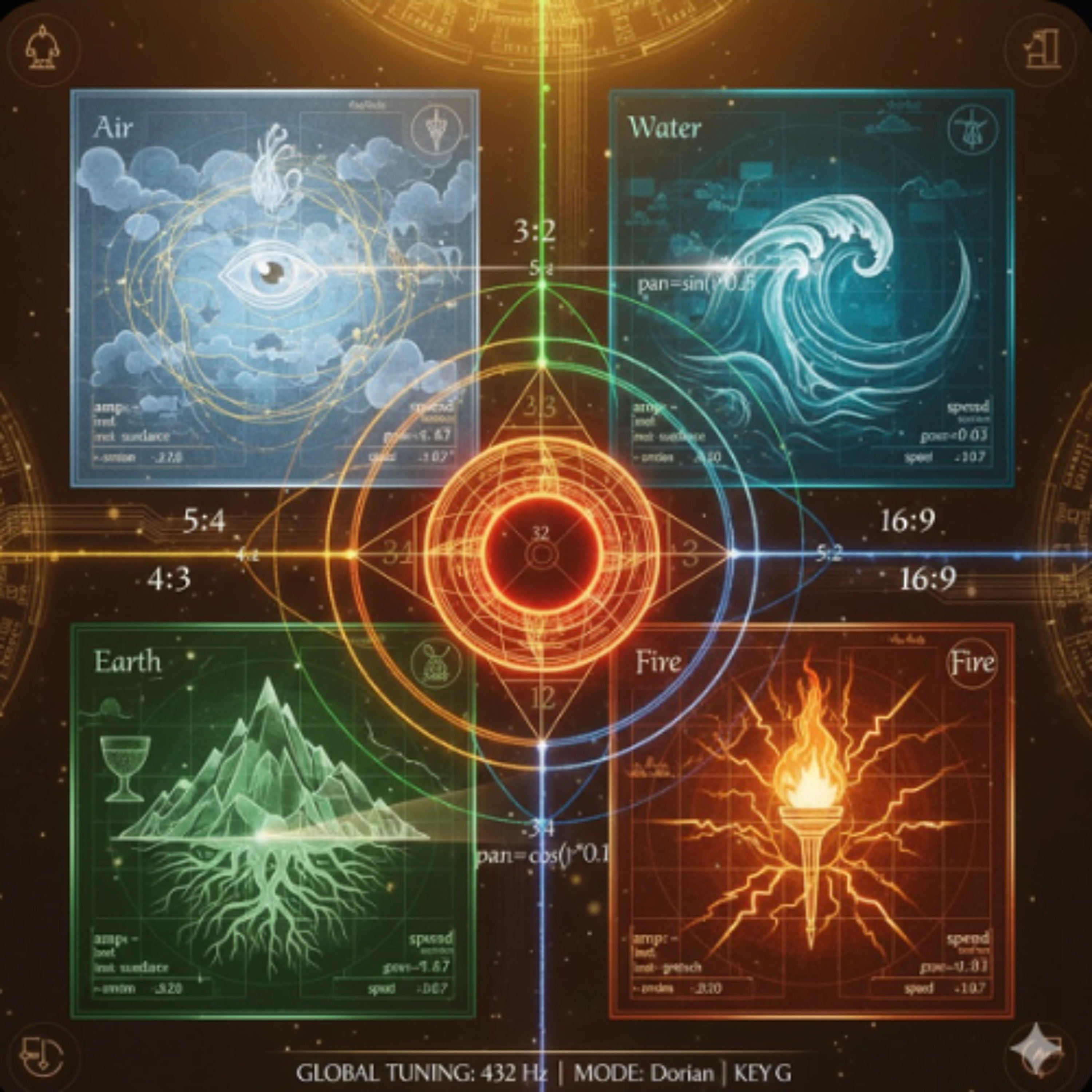
The second pillar is the Enochian Great Table of Earth, a four‑part 12×13 elemental grid joined by a central Tablet of Union that encodes a strict angelic hierarchy. Each Watchtower (Air, Fire, Water, Earth) supplies 156 cells that can be mapped to discrete musical events, with major names (Kings, Seniors, Holy Names) assigned to foundational harmonies or prominent instruments and lesser spirits distributed as finer rhythmic or timbral detail. The presence of hostile or chaotic entities becomes a rationale for programmed “fault lines” where noise, dissonance, and metric disruption temporarily subvert the otherwise ordered grid.
A letter‑to‑pitch system translates Enochian names into melody by grouping letters into seven sets corresponding to scale degrees, allowing archangels, Governors, and other spirits to generate characteristic pitch sequences. Systematic letter substitutions found in the Heptarchia Mystica then model incremental motivic variation: pitches mutate one at a time while rhythmic scaffolding remains stable, mirroring the descent from celestial Kings to subordinate Princes.
The third pillar is the vertical hierarchy of the Thirty Aethyrs, each ruled by three Governors (except the lowest, which has four), giving a set of 91 ruling names.These form a spectral ladder: as the piece “ascends,” harmony moves through increasingly high partials, textures thin, and registral focus rises, while Governors’ sigils function as graphic scores for gestural instrumental or vocal figures layered over grid‑derived materials.
Formally, the composition is divided into three spheres that mirror Dee’s cosmology of natural, celestial, and super‑celestial realms. Sphere I (Natural World) spatializes the four Watchtowers around the audience, using elemental timbres and periodic demonic disruptions of its algorithmic logic. Sphere II (Celestial World) centers on the seven‑planet Heptarchic system with a constant B‑pedal, planet‑linked tempi, and name‑driven “word‑ladder” transformations. Sphere III (Super‑Celestial World) enacts an Aethyric ascent through overtone‑based harmony, sigil‑guided vocalizations, and a final return to a single primordial point and silence, aiming to realize Dee’s dream of a mathematically ordered, spiritually charged cosmos rendered in sound.