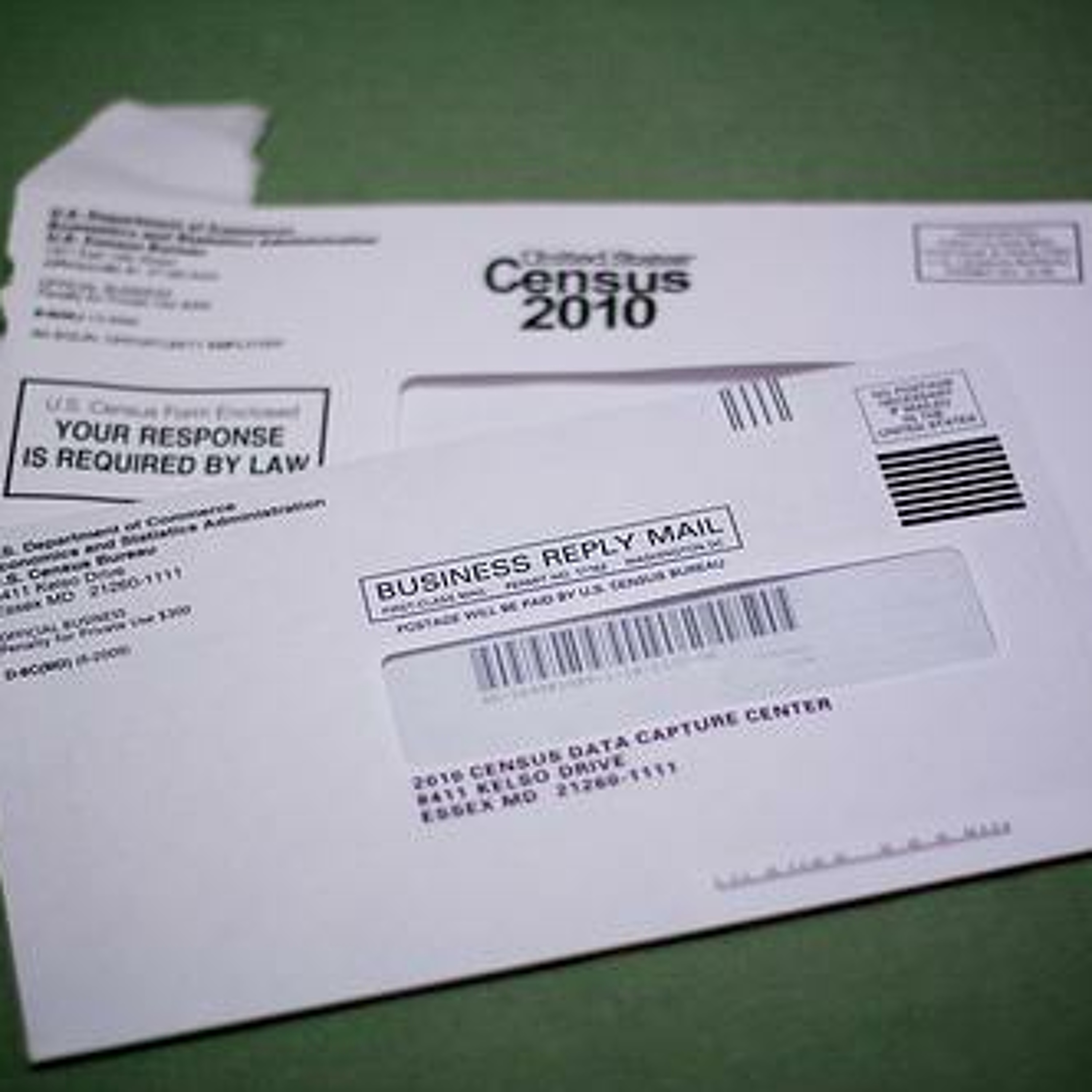
HOST: Census workers are still hard at work to accurately count everyone in America. From now through July 10th, they’ll be following up with the nearly 50 million households that didn't mail in their 2010 census forms. It's important--the count helps determine how over $400 billion in federal funds for programs and services are allocated.
But here's the thing: It takes money to appropriately allocate money. It costs about $57 for each person the census-takers have to try to track down. However, if those people had sent in their forms, it would have cost 42 cents apiece. But, as KALW's Melanie Young reports, some people may not have had a choice.
* * *
MELANIE YOUNG: To reach Americans from all walks of life, the Federal Census Bureaulaunched a $130 million ad campaign urging everyone to turn in their census forms.
The commercials air in 28 languages and speak to the concerns of different communities. For example, a Spanish language ad reassures immigrants that they do not need to prove their legal status to complete the census.
One thing the gamut of ads generally has in common is a visual of the census form and the tag line “it’s in our hands.”
But for many low-income San Franciscans, the forms are often not in their hands. They’re as likely to be in their neighbor’s hands, missed amongst a jumble of unsorted mail on their lobby floor or just lost. That’s because even if the residents of SRO hotels have individual mailboxes, the U.S. Postal Service won’t deliver to them.
NORMAN FONG: If you know how a lot of the SRO’s work, they don’t have full time staff all the time so it’s a free for all. It’s crazy.
Reverend Norman Fong is deputy director of CCDC, the Chinatown Community Development Center--an advocate for SRO residents.
FONG: The postal service says, “we don’t have to deliver it, we just have to throw it on top or throw it on the floor and you guys put it in or whoever the resident manager is.” If you’re lucky.
Roughly 30,000 San Franciscans live in SRO units–and without those places to live, many would be on the streets. Fong says when it comes to serving the city’s poor, the post office simply isn’t delivering.
FONG: It’s terrible, in 2010, in our sophisticated American society with iPads, iPods and all this stuff, all folks want is their snail mail. Come on!
High-speed communications, of course, have cost the post office, big time. The USPS currently faces a $230 billion budget gap. San Francisco may have to close three post office branches. And those issues are trickling down to the poorest customers. San Francisco Postmaster General Noemi Luna has cited fiscal shortages as a reason for cutbacks on service such as SRO delivery. What’s more, the post office claims it is under no obligation to deliver mail to individual SRO tenants, as it considers SRO’s to be hotels rather than permanent housing. Norman Fong says that doesn’t add up.
FONG: Every one knows that people living in the SRO’s are not living in a week by week or day by day basis. What you have is people permanently living and growing up in these single rooms and they deserve the mail like any other apartment.
That’s a view shared by the San Francisco City Attorney’s office. It has filed a lawsuit against the Postal Service saying the SRO policy is discriminatory and illegal. The post office has declined to comment on the policy because of the lawsuit, but it denies the allegations.
Meanwhile, organizations such as CCDC are doing what they can to get SRO residents counted. Census outreach worker Jade Wu and her colleagues at CCDC are reaching out to every SRO in Chinatown.
Today she’s at the home of Zhou Pan Lee. He and his family live in a single room in a 91-unit SRO building. The good news is that he has mailed in a census form. The bad news is, his form was missing from the big box where everyone’s mail is dropped, so he used another tenant’s form--which just pushes the problem along. He says a lot of his neighbors made the same mistake.
Wu moves through the building checking on other tenants. The windowless halls are dark and drab. But there are splashes of color. Nailed by the doorway of several units are neon colored cereal boxes with the tops cut off--ad hoc mailboxes. A grandmother who lives on the second floor collects from the mailman, then sorts through the pile of mail and delivers it to her friends’ cereal boxes when she can. But there are hundreds of tenants in this building and people lose mail all the time--important mail, such as social security checks or census forms. And that’s a costly problem for the city.
DAVID CHIU: Federal funding is tied to how many residents we have in San Francisco.
David Chiu is president of the San Francisco Board of Supervisors.
CHIU: It’s estimated that we get close to $4,000 per person counted. Ten years ago, in 2000 it was estimated that San Francisco undercounted ourselves in the census by close to a hundred thousand residents, and the estimate is that, as a city, we lost $300 million of federal funding because we did not count everyone.
Chiu says it’s ironic how the people who often rely the most heavily on federally funded programs aren’t getting counted. And in tight budget times, that can be devastating.
CHIU: So at this point, in San Francisco, we have to figure out how to cut half a billion dollars from our budget over the next few months. And much of this money are for services that would go to our immigrant families and SRO residents, and we just aren’t going to be able to do it.
During the 2000 census, the State of California spent nearly $25 million for census outreach and education. But hobbled by this year’s huge budget deficit, Sacramento has allocated just $2 million for this year’s census outreach. To help fill the gap, the city of San Francisco, several private foundations and a network of community-based organizations are working together to reach certain communities. So far, their work seems to be paying off in Chinatown. By the April mail-in deadline, Chinatown’s 2010 census return rate was significantly higher than its rate in 2000. And, some 70,000 census outreach workers throughout the state continue to visit non-responding households in the hope of finding someone at home to be counted.
In San Francisco, I’m Melanie Young, for Crosscurrents.