Robots: we love them, we fear them, we laugh at them, and we cheer for them. But if your knowledge of robots ends with a few pop culture references to R2D2 and the Terminator, you probably missed out on the world’s largest Robotics Competition, held each year in the Bay Area. KALW’s Brian Pelletier takes us to Robogames.
* * *
BRIAN PELLETIER: Tony Pratkanis is a tall and lanky young man with glasses. He wears a grey hooded sweatshirt with the word “geek” across the chest. At the age of 18, Pratkanis already has more computer programming experience than many college graduates with their first Silicon Valley job.
TONY PRATKANIS: I got into programming because I wanted to make my own video games. Once I made a couple of games, I figured there were other things I could start programming for so I started writing programming for the web, robots, and I started doing a lot of programming.
Pratkanis lives in Scotts Valley near Santa Cruz, wildfire country. And some of his favorite things to build are robots that fight fires. Pratkanis is good at it, so good that every year he enters the firefighting competition at Robogames.
PRATKANIS: So the fire fighting competition is a competition where there’s a maze, a simulated house and a candle. And there’s a candle in the maze and your goal is to, the robot has to go through the maze all by itself and blow out the candle. And there’s a lot of bonus points for things like going up stairs, avoiding certain obstacles you can have in the house, and coming home after you blow out the candle.
Pratkanis won the firefighting competition for the first time when he was just 13 years old. Now he’s 18 and he’s one of the favorites.
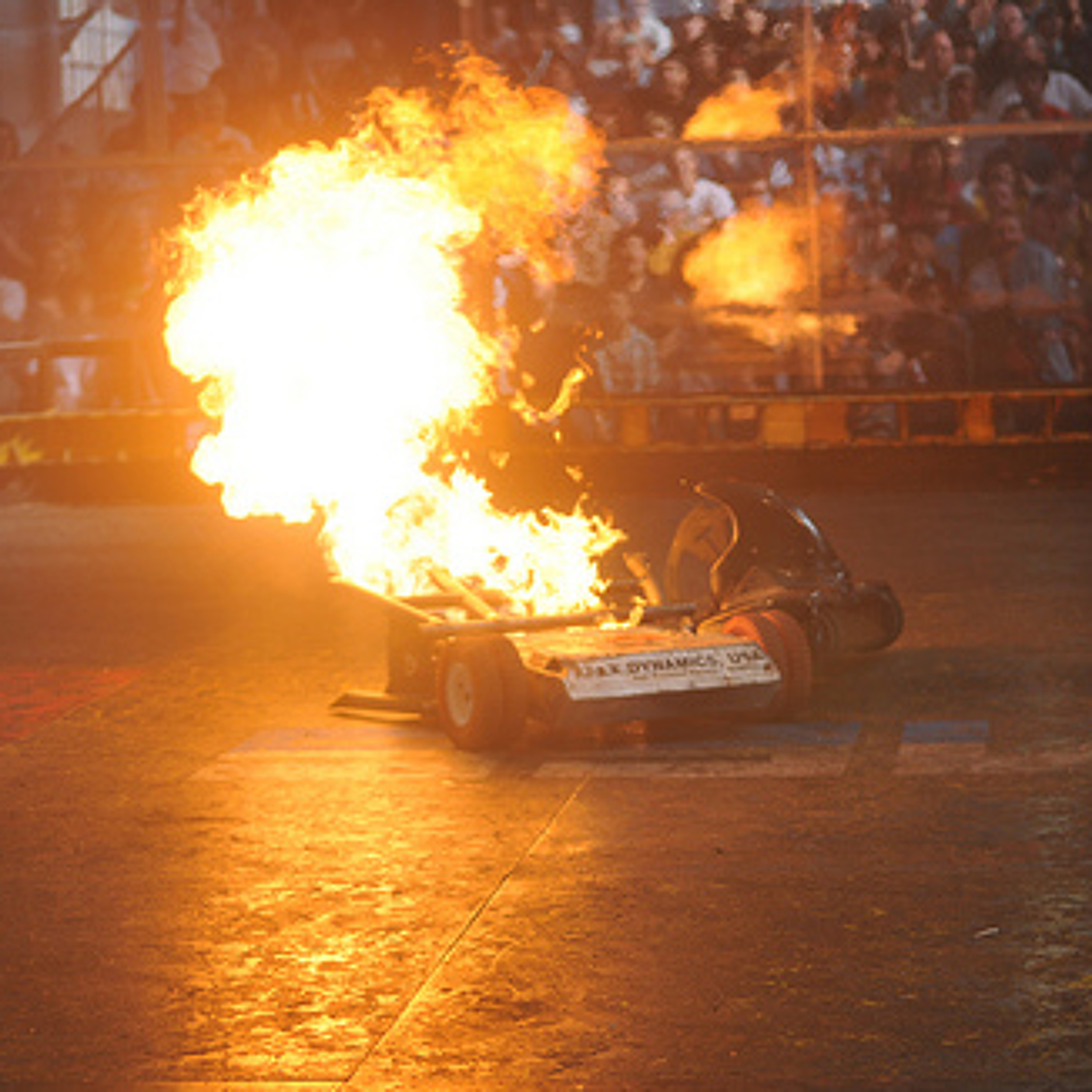
It’s the day of the competition. Loud crashes can be heard from outside the San Mateo County Convention Center. Step inside and you find an arena made of bulletproof glass. You'll see twisted metal, smell charred plastic and burnt out batteries, and hear the roar of the massive crowd gathered for Robogames' most popular event: combat.
Every robot is different. Some weigh five ounces and could fit into a man purse, others are 340 pounds and can throw similar-sized machines to the top of the arena, shoot ultra hot flames, or saw through titanium. Oakland’s Jeffery Orenstein just watched a good battle.
JEFFERY ORENSTEIN: The first clash put them both so they couldn’t fight, but after they were put back again it was a really incredible fight. It was one of the few fights that wasn’t totally decimated by one, it was more equals against equals. Great finish!
A robo-engineer’s work is never done. Between matches, Jim Yeh of Piedmont is fixing one of his robots. He says even the most resilient robo-warrior will break down.
JIM YEH: This robot’s five years old and at some level when you keep getting hit with something, something’s going to break loose, a loose solder or even something down to the microscopic level in the controllers. Something breaks loose and loses the reliability, and with the amount of forces it experiences, you would understand why something like that would happen.
Robogames aren’t all about combat, though. There are other events from soccer skills to an outdoor obstacle course called “Robo-Magellan.” Tony Pratkanis stepped outside his comfort zone to enter that one, building a GPS-guided machine to navigate the course.
PRATKANIS: You spend a lot of time building the robot. Then you spend a lot more time programming the robot and getting it debugged.
Unfortunately for Pratkanis, his robot is still buggy.
PRATKANIS: The problem is we didn’t fully see the cone and we crashed into stuff so we have to figure out why. We have to go look at the software.
That’s pretty common experience for Robogames engineers. But before Pratkanis gets to that, he’s got the firefighting competition.
PRATKANIS: The firefighting robot is looking good. Its not the fastest robot, but its reliable, and its gonna do it every time.
Then, it’s go time.
PRATKANIS: Go!
ANTHONY PRATKANIS: Solenopsis Geminata!
Solenopsis Geminata, of course, is a type of ant that navigates by following straight lines, and it’s also the name of Pratkanis’ robot. Its first run ends with an extinguished candle. But during his second run, Pratkanis’ robot gets stuck and fails to put out the flame. Its teenaged master doesn’t make the podium. But Pratkanis’ dad, Anthony Pratkanis, says winning a medal isn’t really the ultimate goal of Robogames. He says they’re about discovering some of Silicon Valley’s best engineers.
PRATKANIS: To build a robot you need sets of skills and not many people have them all except for very simple robots. And so people get together, you know somebody with hardware, somebody with software, someone with electrical engineering, and everybody’s networking here finding out what kind of skills are available. What can we build next? If I just had this programming skill or whatever…its really a giant incubator for Silicon Valley.
Tony Pratkanis’ robots failed to medal at this year’s Robogames. But by his dad’s standards, he already won. Last year, he parlayed his impressive programming skills into a job at Willow Garage, a robot design and manufacturing company in Menlo Park. As for Robogames 2011, the 18-year old roboticist says he’ll be back.
In San Mateo, I’m Brian Pelletier for Crosscurrents.