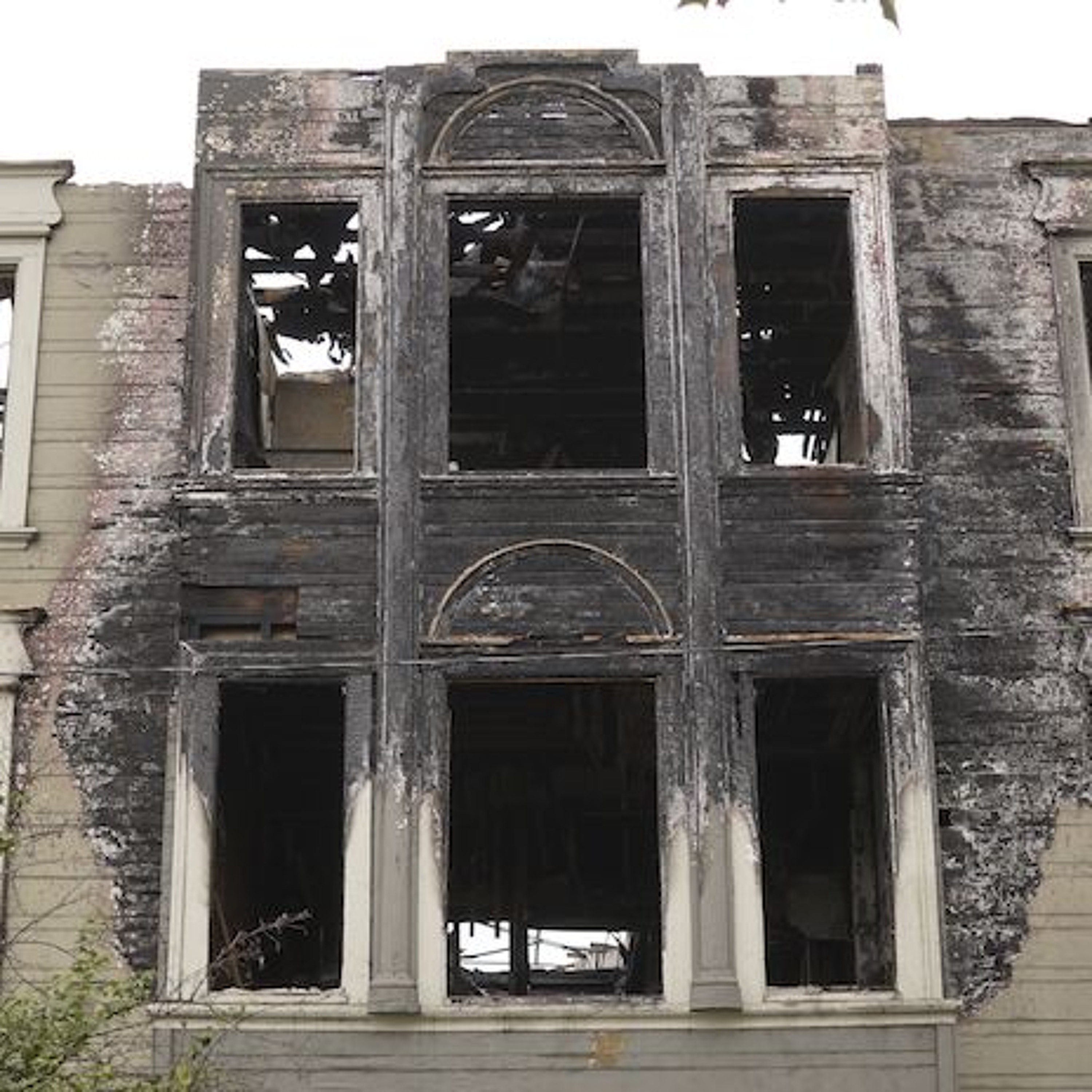
2551 San Pablo Avenue had been getting code complaints for years. After it burned down, some residents had to move onto the street.
The “San Pablo Fire,” as this one is often called, was just one of a string of recent fires that made the news: the Ghost Ship Fire in Oakland, a series of arsons at construction sites around Oakland, apartment fires in San Francisco’s Mission district, and fires at homeless encampments in both cities.
Like the Ghost Ship, residents have scattered since this fire. At least three are in jail. One has died.
But there’s at least one huge difference between the Ghost Ship fire and the San Pablo fire: fundraising. The people who lived in Myers’ building had especially few resources. While residents of Ghost Ship were not necessarily well off, they did get support. Both from their social networks and from a sympathetic public.
After Ghost Ship, where 36 people died and around 20 were displaced, over $2 million worth of donations poured in. After the San Pablo Fire, which saw 4 people die and over 100 people lose their homes, a series of fundraisers brought in a little over $100,000 dollars, Strauss says. That’s twenty times less.
It can be hard to monetize or compare tragedies in this way. But Strauss — who personally started fundraisers for both fires right after each happened — sees an imbalance.
“I think of the two significant disastrous events on the same level,” he says. “The lack of fundraisers and lack of support in the long run is heavily indicative of racism. And there's no other way around it.”
Fire victim Richard “Double R” Myers agrees.
“It has a lot to do with race,” he says. “The majority of people in that building were Black. Specifically African American families.”
He points to a fundraiser he started for himself as an example.
“I set up a GoFundMe page and only raised 90 bucks.”
Other residents raised $20 or $65 online. But individual victims of the Ghost Ship fire were able to raise $20,000 or $30,000 a piece.
Victims of the San Pablo Fire did get around $9,000 each directly from the city of Oakland. Money that the landlord, Keith Kim, is required to reimburse. He hasn’t yet.
Landlords are legally responsible for paying relocation funds when their property becomes uninhabitable. But Strauss says a lot of residents quickly went through that money paying for hotel rooms because they had nowhere else to go.