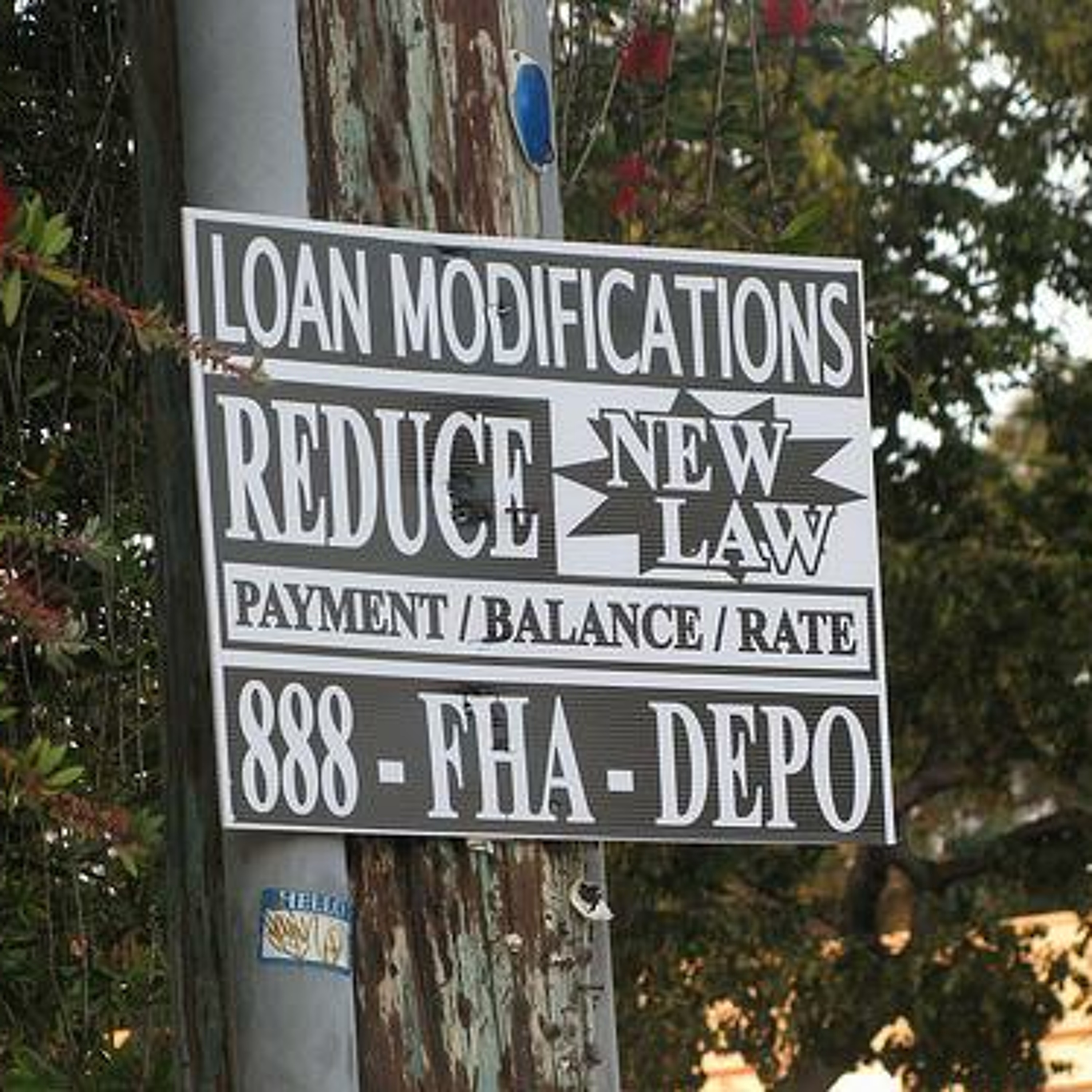
Last year, President Obama announced HAMP, the Home Affordable Modification Program. Its goal: to help 3 to 4 million homeowners avoid foreclosure.
BARACK OBAMA: In some cases, people may have had difficulties because they lost a job, somebody in their family got sick, they may have missed some payments – and in those cases we also want to be helpful and we are putting in place a loan modification program, working with banks, working with services, that will allow other folks who are closer to losing their home in a stronger position in the future.
But so far, many observers say the program isn’t working well enough. If more homeowners don’t get modifications, analysts fear there could be a new wave of foreclosures by the end of this year. KALW’s Zoe Corneli reports on the process of applying for a loan modification – and what’s being done to improve it.
(Note: the name of the borrower in this story has been changed to protect his privacy.)
* * *
ZOE CORNELI: Robert Davis has had steady work as a trash collector in San Francisco for the past 15 years. He signed a 30-year fixed-rate mortgage with Washington Mutual on his 2-bedroom house in the Bayview District. And he never expected to have trouble paying the loan.
ROBERT DAVIS: Everything was going smooth, and you know, watched the news, and I seen a lot of the foreclosure problem going on, and I’d never think it would happen to me.
But then, in April of 2009, Davis’s mother died. She didn’t have life insurance or coverage to pay for a burial, so Davis stepped up.
DAVIS: I did the right thing as a human being and as a son.
But paying for the funeral meant skipping his mortgage payment to Chase, which acquired WaMu in 2008.
DAVIS: I fell like maybe two months or three months behind, and then I was ready to make payments and they wouldn’t accept them.
His mortgage was already considered in default. The foreclosure process was starting.
DAVIS: And then I just went into a panic mode almost, I didn’t know what to do, and didn’t have the knowledge on how to go about getting things happening.
To get help, he came here – to the San Francisco Housing Development Corporation, in the Bayview neighborhood, where Davis lives. For 9 months now, he’s been working with counselor Zack Mack-Westrom, trying to get his loan modified. The payments Davis was supposed to make from the time of the funeral to now total 30 thousand dollars. Mack-Westrom says a loan modification would start by bringing Davis current.
ZACK MACK-WESTROM: The first step they would take is to take his $30,000, add it to his unpaid principal balance.
Then, Mack-Westrom has proposed giving Davis an interest-only loan at a lower rate for 5 years, to allow him to catch up.
MACK-WESTROM: In essence, at the end of the day, he’d have a better loan than he does now.
Mack-Westrom says he thinks it’s a reasonable request. But convincing Davis’s loan servicer of that is not so simple. Today, Mack-Westrom and Davis are calling Chase to check in on the status of the modification request.
TELEPHONE MESSAGE: Welcome to Chase. Please enter the extension of the party you are trying to reach…
Mack-Westrom waits through a series of recorded messages.
TELEPHONE MESSAGE: Please be advised that we are attempting to collect a debt.
A couple minutes pass.
TELEPHONE MESSAGE: We are proud to offer our homeowners loan assistance, including loan modifications, free of charge.
Finally, someone picks up.
REPRESENTATIVE: Thank you for calling Chase, this is Mary, how can I help you.
MACK-WESTROM: Hey, Mary, my name is Zack…
Mack-Westrom starts reading off Davis’s loan number, but the agent cuts him off.
REPRESENTATIVE: What were you calling for?
MACK-WESTROM: I’m calling to check status.
REPRESENTATIVE: Okay that number is 866…
The agent gives him a different phone number to call.
MACK-WESTROM: Okay thank you Mary.
REPRESENTATIVE: Okay, thank you so much. Buh-bye.
Round two. The same messages play again. Someone answers.
REPRESENTATIVE: Thank you for calling Chase, this is [unintelligible], how can I help you?
MACK-WESTROM: ...I’m Zack, I work with the San Francisco Housing Development Corporation. And I was actually given your number by another Chase rep.
Mack-Westrom rattles off the loan number again. But this agent stops him too.
REPRESENTATIVE: Um, wow, was this a WaMu loan?
MACK-WESTROM: It sure was.
REPRESENTATIVE: Give me one second.
It turns out this wasn’t the right phone number either. Mack-Westrom holds again while the agent tracks down someone who handles Washington Mutual loans.
TELEPHONE MESSAGE: At Chase, the right relationship is everything.
MACK-WESTROM: I typically have borrowers call to check for their own status updates, because if I did this every day, I’d never get around to new clients.
Robert Davis says he goes through the process about once a week.
DAVIS: It’s always something new, every time that you call, it’s somethin’ new.
And hundreds of thousands of homeowners across the country are experiencing pretty much the same thing. Mack-Westrom says loan servicers are overwhelmed, and often the so-called “loss mitigation specialists” who answer the phones haven’t been on the job very long.
MACK-WESTROM: These folks on the other end of the line have very difficult jobs. They’re just doing their job, and the turnover rate is very high at mortgage servicing institutions because they deal with a lot!
And in the end, the servicers are not approving as many modifications as the program intended. The Obama administration has taken measures to pick up the pace. But according to the most recent government data, while a total of more than 900,000 trial modifications have started, the number of loans approved for permanent modifications is still only about 66,000 – that’s just over 7 percent. More changes are on the way – come June, borrowers will have to provide proof of income before starting a trial modification. Servicers will also have to follow clearer procedures for converting trial modifications into permanent ones. But Counselor Zack Mack-Westrom is skeptical about the impact those rules will have.
MACK-WESTROM: The proof’s in the pudding, and the pudding is invisible. So, what I mean by that is, until I actually see a substantive change in activity, in all respect, I don’t believe the hype, and I kind of keep my nose focused to the ground on what I can actually do on an individual and case-by-case basis.
While the government is making an effort to keep more families in their homes, several nongovernmental agencies have also tried to streamline the application process by developing software platforms. One of those programs is CounselorDirect. It’s sold by a private company and allows individual borrowers to fill out their information online. The Unity Council, an Oakland nonprofit, is piloting that platform, at no cost to clients.
In a computer lab decorated with colorful Mexican paper cutouts, Unity Council staff members are walking borrowers through the program.
SHERI POWERS: Either they’re not fluent in English, they may be monolingual in Spanish, or they simply have no computer experience, they’re really afraid, so we’re like, well we have a computer lab, come and we’ll teach you how to do this.
Sheri Powers is director of the Unity Council's Homeownership Center.
POWERS: So I’m gonna take you to our new website.
Powers pulls up a page that allows clients to choose their lender and then fill in their income and expenses.
POWERS: This is my favorite part. This probability meter here is going to swing from red to yellow to green, and let the client get a visual immediate check on okay, what’s the probability of success based on, you know, my expenses.
Kind of like when tax software tells you how big your refund will be.
POWERS: So what I’m gonna do is I’m gonna add $80 a month just for a cell phone payment, and watch what happens to the probability reading.
CORNELI: This needle that’s indicating the probability of getting a modification dropped down from 95% to 80%, because the person’s surplus income each month dropped down from over $100 to below $100.
POWERS: What the programmers did was they looked at thousands of loan modifications that were denied and approved for each servicer, and they analyzed the data, and they were able to, through a mathematical algorithm, kind of hone it down to this is the sweet spot for this particular servicer. And if you’re over that or under that, the probability of success is gonna go down.
Clients can use that information to tailor their budgets – say by canceling an expensive TV bill. The Unity Council has been using this program since January. And Powers says it’s already a success, as far as she’s concerned. So far, under the new system, about 75 clients have submitted applications.
POWERS: We would normally do maybe half that number in a month using the old system. So this is huge in terms of improved efficiencies, us being able to help more people with the same amount of staff. It’s just huge.
But the software doesn’t solve the problem of what happens next.
POWERS: On the average, it’s gonna be about 6 to 9 months of waiting and resubmitting documents, so part of what we tell clients is part of the process, like it or not, is you need to have all your documentation ready to resubmit to the lender when they say, we’re missing this, we’re missing this. Even if you faxed it three times before – fax it again.
Back on Third Street, at the San Francisco Housing Development Corporation, Robert Davis’s counselor, Zack Mack-Westrom, has finally connected with the right bank representative.
REPRESENTATIVE: Hello sir, my name is Vicky, I’m with Washington Mutual loss mitigation, I’d be more than happy to assist you today. I just need to take a moment to verify some information with you.
After checking the borrower’s name and social security number, the agent puts Mack-Westrom on hold again – for nearly 5 more minutes. Then she comes back with good news.
REPRESENTATIVE: What we’ve done is that the file has gone back to our back office for the final review and the final approval of the modification.
MACK-WESTROM: Is there any other information that you need from us at this time?
REPRESENTATIVE: No sir, nothing was specified. Everything was properly documented by the negotiator, so right now the best thing to do is just hang in there for a few more days, and hopefully we’ll know something very soon.
It sounds like Davis’s modification is on the verge of being approved. He wipes his brow in an exaggerated gesture of relief.
DAVIS: Everything that they need, they have. And I’m satisfied with that. And we’ve been doing what we supposed to do to make everything happen, so it’s just waiting on the outcome now.
But Mack-Westrom isn’t ready to celebrate yet.
MACK-WESTROM: I’m gonna be straight up with you and say that I have had clients, like that, call back the next week, they’re missing docs, the modification’s not approved. That’s the nature of this industry presently. You can be told one thing by one person one day, and be told the complete opposite the next day, by a different person.
Because Davis has been in default for so long, if his application is rejected, his home could be foreclosed right away. The only thing he can do now is wait.
Correction:
In the audio version of this story, Sheri Powers is incorrectly identified as the Unity Council's executive director.
For Crosscurrents, I’m Zoe Corneli.