On July 19th, during his concert at the Santa Clara Convention Center, Vietnamese pop star Dam Vinh Hung reached down to accept a flower from an old woman. Instead, he got a face full of pepper spray. The old woman was actually San Jose resident, Ly Tong, an anti-Communist provocateur, who has become famous from Orange County to Ho Chi Minh City for his audacious stunts. Once called a "dangerous international terrorist" by the Vietnamese government, Tong has become a hero to a generation of Vietnamese still bitter about the Communist takeover of their country. But as Vietnam moves away from its Communist past, Ly Tong's relevance to a new generation of Vietnamese-Americans is becoming increasingly doubtful. From San Jose, the hub of Northern California's Vietnamese community, KALW’s Charlie Mintz reports.
* * *
CHARLIE MINTZ: Inside the home office of San Jose attorney Tam Nguyen, I meet Ly Tong. Tong is looking sharp in polished black boots, a pilot's cap and full-body flight suit. He looks like someone prepared to be on TV, or have his picture taken for a newspaper--like someone who understands the value of symbolism. He should. Tong is a symbol himself. A symbol of what though, exactly--that's up for some debate.
LY TONG: Uh, my name is Ly Tong. L-Y T-O-N-G. And I’m a freedom fighter.
Freedom fighter. It’s a loaded term, a rhetorical strategy to cast his battle in the noblest light. But to understand what “freedom fighter” means to Tong now, you have to understand what it meant to him 45 years ago.
Ly Tong was a pilot in South Vietnam's army during the Vietnam War. But even the best pilots can't cheat fate forever, and Tong's caught up with him on April 5, 1975. That’s the day he was shot down by Viet Cong missiles, bailed out in time to cheat death and became a prisoner of war.
Six years later, he escaped while on a work detail. For the next 17 months, Tong evaded his captors and trekked more than 1600 miles through five countries, finally reaching safe haven in Malaysia.
From there Tong traveled to the United States, land of the human-interest story. His tale was told in the Wall Street Journal; Reader's Digest published a piece that called Tong's journey "one of the great escape sagas of our time." But the soldier had moved on. He'd enrolled at the University of New Orleans and began planning new missions that would grow his fame, land him in prison and nearly kill him.
TONG: When you fight Communism, you have to know what is Communism. I spent nine years just to better my knowledge so I can fight. Not to have a job and to earn my living. That's my purpose, see.
By 1992, Tong was prepared. And the time seemed right.
TONG: The Eastern Europe have collapsed, so at that time people in my country have aspiration to free themselves, so I took that good opportunity to fly back to drop leaflets so I can appeal to them to rise up to overthrow the Communist regime, see.
With funds from an anti-communist backer, Tong flew to Bangkok. There, he boarded another plane, carrying two suitcases with him. In one suitcase were 50,000 leaflets, written in Vietnamese, urging the people to overthrow their government. In the other suitcase was a parachute. Tong waited until the plane was over Vietnam. Then he hijacked it.
TONG: I have no weapon, nothing, so I bluff them, see. I bluff them that I have bomb, see.
The bomb was nothing more than a pair of binoculars tucked in his pant leg, but it worked. The pilot dumped leaflets out the window while Tong watched. Then Tong stood on the pilot seat and let himself, and his parachute, get sucked out the window.
Tong was captured by Vietnamese police and put in prison for six years. An amnesty deal in 1998 returned him to the United States, where he began planning his next mission: a leaflet drop over communist Cuba on New Year’s Day, 2000.
NEWSCAST: A pilot is under arrest after making a dangerous flight into Cuban airspace. He wanted to take a message to Cuba's people, but he ran into some dangerous firepower and it turns out this pilot is no stranger to danger...
NEWSCAST: He is more than a brother. He is a hero.
And he wasn't through. That November, he returned to Thailand for another leaflet drop. Again, he was arrested. Again, he went to prison.
TONG: I get used to living in prison, so I get out I feel a little bit better but not so happy like other people. The difference between the prison and outside society, outside we can have girlfriend, we can have party, but outside we can't have it. But that's the only difference see.
Tong spent another six years inside a Thai prison, without parties, without girlfriends, before changing politics again delivered his release.
This brings us nearly back to the present, where Tong's lawyer is snapping pictures of the old soldier and his latest journalist visitor. But there's one more incident worth mentioning--this one, in Tong’s adopted hometown.
NEWSCAST: Committee for Little Saigon advocacy marches every Tuesday outside San Jose's city council. Members are protesting city council’s decision to name a group of Vietnam-owned businesses Little Saigon business district. They want to call it “Little Saigon”...
San Jose's Vietnamese population is one of the highest in the United States, with nearly 100,000 residents, and thousands of them came out for the naming decision. The name Little Saigon is symbolically important to Vietnamese. It gives ex-patriots around the country a connection to the homeland they left, before Saigon became known as Ho Chi Minh City in 1975. So, once again, who should take center stage in the controversy but Ly Tong, who demonstrated with a nearly month-long hunger strike.
TONG, FROM NEWSCAST: I'm going to sacrifice my life as the just defender to restore true democracy for San Jose.
The protests resulted in a draw, with the city agreeing to allow privately funded banners reading “Little Saigon” along Story Road in San Jose. Perhaps more importantly, they revealed an older generation's ties to a past Vietnam that no longer necessarily exists.
ANDREW LAM: I think that's the problem with the older generation and all the protests, is that they no longer have a direct effect on Vietnam itself.
Because for Vietnamese who came to United States--their history is not understood. The Communists won, the South Vietnam population lost and got controlled by the Communists. Many people from middle class lost their homes, people lost their lives, re-education camp, economic zones. And now Vietnam has become very prosperous, but a lot of people who were victimized by this ideology were never compensated, and all that deep frustration is not there in terms of being acknowledged by American media. And what Ly Tong represent is this anger, and he's sort of become a symbol of that anger.
So Ly Tong has flown sorties calling for national uprisings. He’s staged hunger strikes to demand civic change. These actions seem fitting enough for a man who likes to call himself the “Vietnamese James Bond.” But dressing up as an old woman and pepper spraying a pop singer--how does that fit in?
TONG: So, my attack him, I give him a pepper spray because he's a representative of the Communist Vietnam, of the Communist party, so when I give him a slap, I spray the Communist party, the Communist government.
But the guy he attacked--Dam Vinh Hung--is a crooner. He sings love songs. Is this the voice of Communism?
LAM: Well he's quite popular in Vietnam. He's one of the handful of young singers, up and coming singers who has an international following, and a lot of them make really good money when they travel overseas.But in terms of Communists, I really don't know whether he has any connection to the communist regime whatsoever. All of this has made Tong's latest act of protest a divisive act within the Vietnamese community.
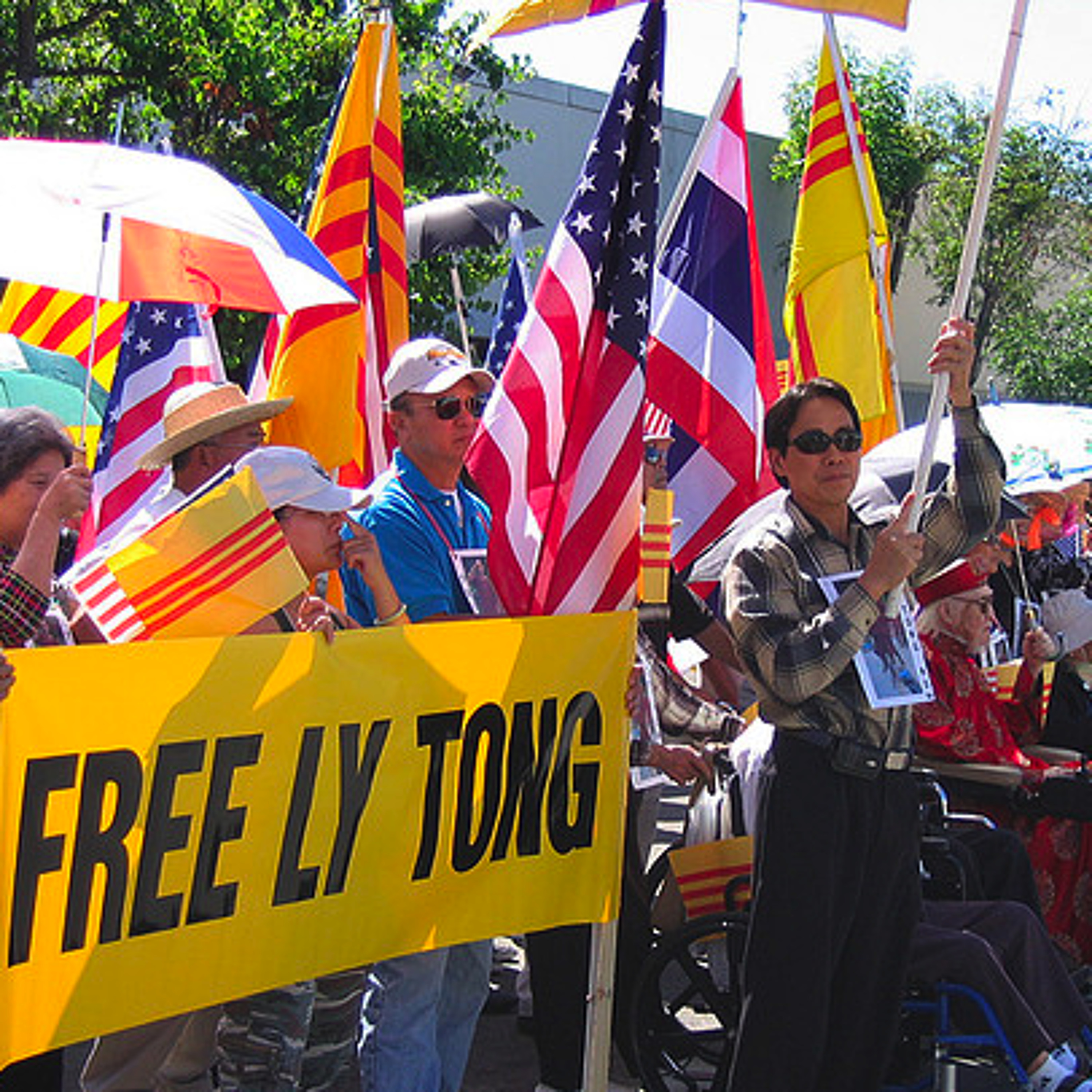
Outside the Santa Clara superior court in downtown San Jose on the day of his plea, Tong's supporters are holding a rally. His supporters are uniformly older, most in their 50s or 60s. I see one wearing a Vietnam veteran’s hat. Several are waving South Vietnamese flags. Just down the street, his prosecutor, Kevin Cogbill, is planning how to put Tong in prison.
KEVIN COGBILL: While everybody has a right to their opinions, and everybody has a right to express their opinions, nobody has a right to physically assault another because they disagree with your opinions. You can't pepper spray someone because you disagree with their politics.
Whichever way the trial goes, Tong may already be losing out in the court of public opinion, at least among a younger generation. I spoke with a handful of young Vietnamese in San Jose. None would let me say their names on the radio, but they were willing to share opinions about Ly Tong.
WOMAN: I think it's not a good thing. It's not what I'm proud of. Becuase to me, he should have done something better. It's not a good job at all. I think, to me, it's too personal.
MAN: From what I know of him, he is not a hero. I don't know one person who agreed with him.
WOMAN: My parents don't care about politics that much, they don't really care. They tell me, “It's the past, it's over, why don't we just let it go, and then we look forward to the future, make it better, make the Vietnamese community better.” You know?
What may be most ironic of all, is that Tong's target, a successful musician, represents a changing Vietnam.
LAM: There's no true communists left in Vietnam, let alone the US. I'm not even sure what a communist is these days because Vietnam has rewritten its constitution to have private capitalism as a general practice which is not communism at all. It’s a single party. It's a dictatorship. But to say communist is kind of bizarre to me.
Ly Tong will have to wait a couple months for his trial. In the meantime he's doing what he's always done so well--playing the lead role in a spectacular performance of resistance. If convicted of all charges, Tong will play that role behind bars. Six years, eight months is the maximum sentence. But Tong isn't worried.
TONG: I never feel scared of anything. So I took it easy for everything, even when I was a prisoner of war, I mess up with some guard and they put the gun at my face, but I just smile... I was born to learn how to be calm cool in every situation. So I get through everything. You cannot control yourself; you cannot do some mission impossible like me, see.
Ly Tong's next mission will be persuading a judge or jury that pepper-spraying a pop star was an act of self-defense. Even if he can do that, he'll still need to persuade a generation of young Vietnamese that his fight is worth fighting. And that might be the real mission impossible.
In San Jose, I'm Charlie Mintz, for Crosscurrents.