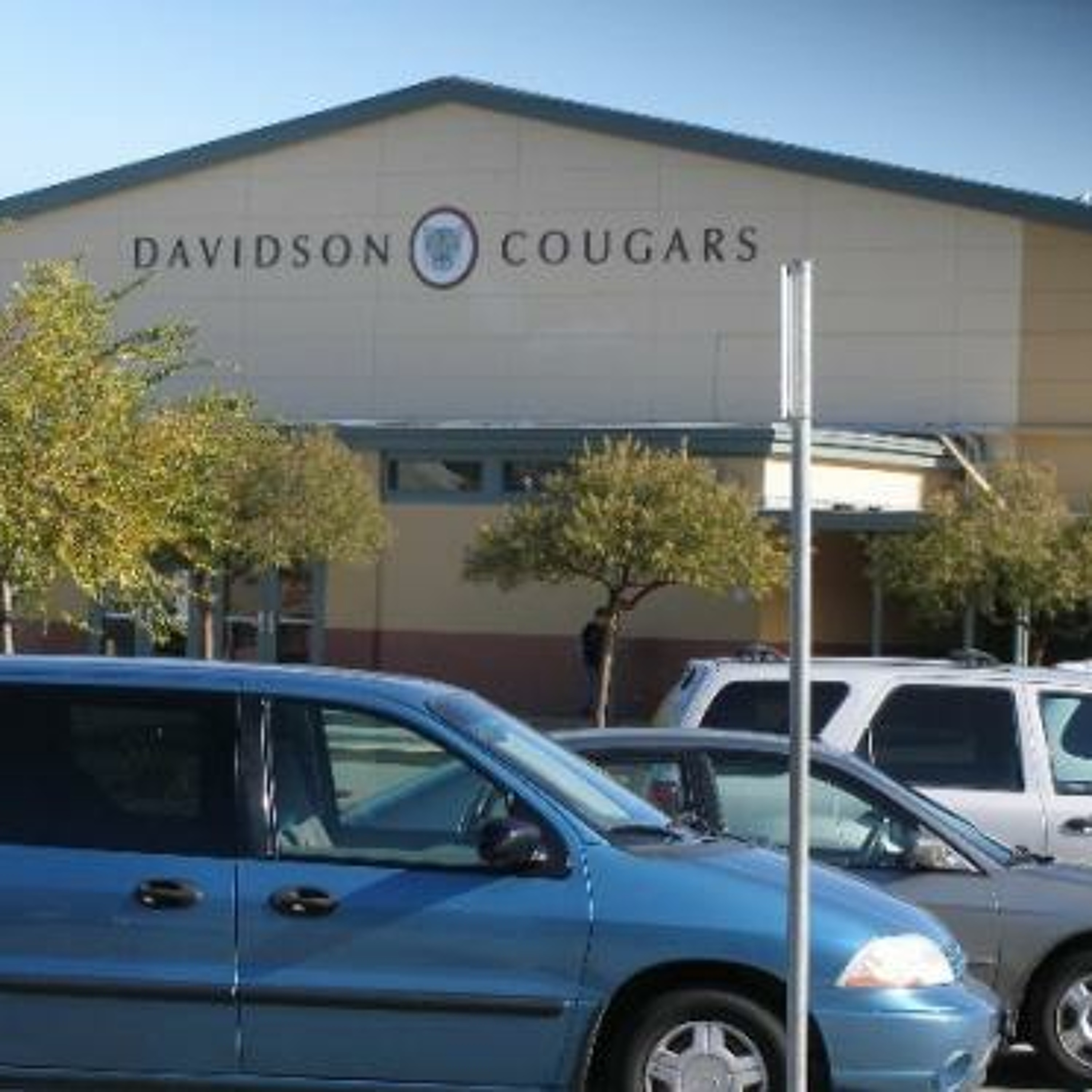
California's public education system is in crisis. School districts all over the state are having to slash budgets because of declining revenue. Last year, federal stimulus dollars helped schools plug some of the funding holes. However, that money was temporary, and it will run out. Educators are calling this a “funding cliff,” because districts will be in an even deeper financial crisis for the coming school year. Today, we’re beginning a new education series, in which we’ll look at the issues facing public education through the prism of three schools in the Bay Area. Education Reporter Nancy Mullane takes us first into Davidson Middle School in the North Bay city of San Rafael.
* * *
NANCY MULLANE: It’s a mid-year parent teacher conference day at Davidson Middle School, and that means early dismissal. But just as the school’s 800 students are being let out, it starts to rain. Hard.
Peeking out of her office window, Dr. Harriet MacLean, the school’s principal, turns, grabs her raincoat, an umbrella and a bullhorn and heads out into the downpour.
HARRIET MACLEAN: Ladies and gentlemen, that’s a fire zone, please pull to a legal parking spot at the far end.
Back in her office, MacLean says she wasn’t hired last year to direct traffic, but now that Davidson is her school, everything that happens here is her business. Back in 2003, long before MacLean became principal, Davidson Middle School failed to meet the Adequate Yearly Progress criteria under the federal government’s No Child Left Behind Act. That meant the school entered something called Program Improvement Status and it needed to do more to meet the educational needs of all students. Five years later, MacLean came in and completely redesigned the school’s master schedule.
MACLEAN: We went from an 8-period day to a 6-period day. We went from not having English language development for anyone but newcomers to having it for every English learner. Which changed the courses we taught, who is able to take electives and who is not. Our whole vision, which is about high expectations for every student, one school community, and increased parent involvement is what drove all those changes.
Davidson Middle School, like San Rafael, its home town, is largely a blend of two very separate racial and socio-economic communities. There are white upper middle- to working-class families, and there are mostly working-class Hispanic families. San Rafael’s elementary schools are somewhat culturally homogenous by neighborhood. But all the kids come together at Davidson Middle. MacLean says when she arrived at the school it was a culture of haves and have nots.
MACLEAN: I just, I was like, yikes. But the good news is those staff saw it too. It was like they needed a leader who could see it and then put them in teams to redesign these systems.
MacLean brought students from different academic levels together in the same classes – so students scoring basic were put together those students scoring advanced, because, she says, they’re capable of working together.
With just a few minutes to eat lunch before the parent conferences start, MacLean picks up her office phone and calls a half dozen teachers for a quick meeting. She wants to jump-start a new math program that will help struggling students catch up.
A few minutes later, they all gather in the conference room around a long oval-shaped table.
The new math program means they’ll have to pull some students out of their regular classes so they’ll get the extra help they need to succeed, and these are the teachers who know how to make that happen.
LISA SHENSON: I love Davidson. I think it is a very good representation of the community in which I live.
Lisa Shenson has been teaching 6th grade math at Davidson for 4 years.
SHENSON: It has far more successes than drawbacks that get media attention.
Last year she received the district’s Golden Bell award for her exemplary contributions to the field of education.
SHENSON: As we become more connected to our students, our students feel respected, they feel loved, they feel cared for and cared about, and they understand that even sometimes whether we push them to be better, it’s because we see their full potential even sometimes more than they see it in themselves.
The meeting ends. Shenson grabs her notebook and heads out into the rain toward the gymnasium. There’ll be no time for lunch today. On her way across the school’s courtyard, she passes Monica McMillan, a long-time parent at the school. McMillan says over the seven years she’s been a parent at Davidson, the school has had three different principals, but now that Dr. MacLean is here, things are shaping up and moving in the right direction.
MONICA MCMILLAN: There’s diversity, there’s rich, there’s poor, there’s athletics, there’s academics, art programs, music programs, electives, foreign languages. So, and it’s kind of whatever kid wherever you are, you will find your niche, your little group of kids here to hang out with.
But, she notes, there are drawbacks. She says the classroom sizes are fine, but with 150 students over the course of each day, every teacher has too much to do because they don’t have enough—
MCMILLAN: Aid support. We don’t have enough funding to have aids in the classroom to help with the three kids who need extra help or correct the extra essays.
And she says, there’s just not enough money around for the extras.
MCMILLAN: For example, you know, can’t buy volleyball shirts for the entire volleyball team because not enough kids have got the money to buy the t-shirt. There’s not enough fundraising going on to buy t-shirts for everybody on the team, those kind of things. So maybe the, I would say the challenges, we kind of look like the bad-news bears all the time.
Budget cuts have also cost the school staff positions. Right now, Davidson’s library has limited hours, and there’s only one guidance counselor for 800 kids.
MCMILLAN: We have one now, but if we had a secondary counselor, full-time, on staff, preferably bilingual, if that would help, I think again, you can just catch things earlier on and I think you prevent kids falling through the cracks.
Inside the gym, parents and their kids are standing around. they’re waiting for their turn to get a mid-year, face-to-face checkup with their teachers.
It’s Isabel Rosales’ first year at Davidson. She’s sitting alone on a chair at the end of the cavernous space waiting for her mom.
MULLANE: Do you like Davidson?
ISABEL ROSALES: Yes.
MULLANE: What do you like?
ROSALES: My teachers.
MULLANE: What do you like about them?
ROSALES: That they are nice with me, um, because they help me.
Rosales isn’t the only student who likes going to school at Davidson. 6th-grader Alex Zurcher steps up to a table with her mother, and sits down opposite her English teacher.
TEACHER: So, Alex has a C for this quarter. She was struggling a little bit to get your assignments in on time, and you’re really helping with on time and putting the stuff on there, and turning it in. And she’s really come through with vocab.
Zurcher’s trying hard.
ZURCHER: But sometimes like if they’re really, really big words or it’s hard to pronounce then I kind of get confused with those, so yeah.
By June, Zurcher says she hopes to have a B average in all her subjects.
Back in her office, Principal MacLean says she hopes all grades go up by June, including the school’s annual scorecard, the Academic Performance Index. Davidson is still on academic probation. The school’s API hasn’t risen enough yet to get out that status. Principal MacLean is well aware of the numbers. But this year’s internal school statistics confirm what she already knows: decreased discipline problems, increased parent involvement, and overall community support. But when the students at Davidson Middle School take the State Standardized Test this Spring, she needs hard proof things have truly improved for all students at her school.
MACLEAN: It’s all happening, and I see it, and I know it in my gut that it’s real. And it’s like a transformed place. But I want to see the scores, I want to see the results in terms of scores.
In San Rafael, I’m Nancy Mullane for Crosscurrents.