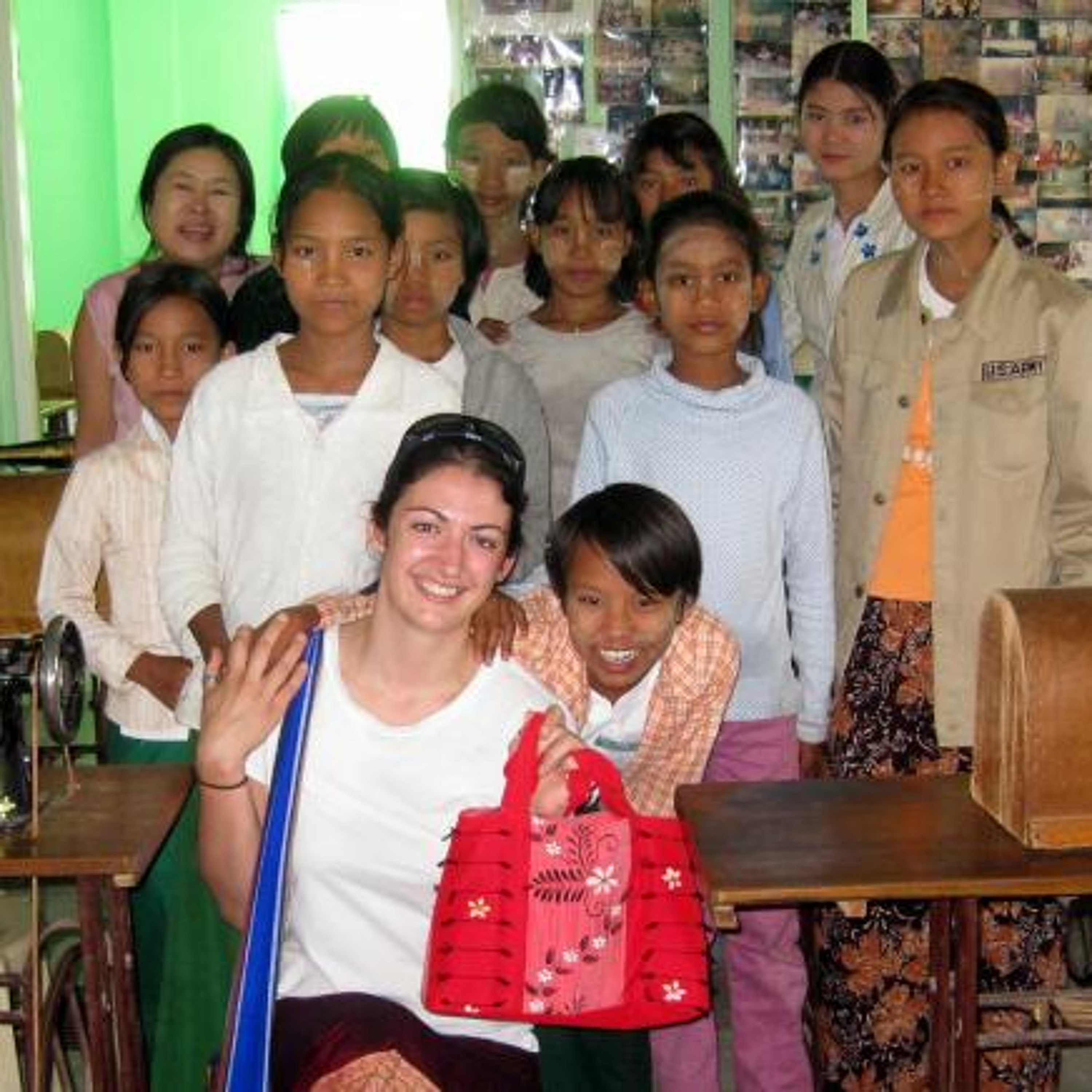
There aren’t a lot of tourists in the nation of Myanmar, also known as Burma. And that's not too surprising. Burma is a military-run state, and worldwide, democratic nations have condemned its harsh policies of suppression.
But for a Bay Area Buddhist teacher like Tempel Smith, visiting Burma transcends politics. It’s personal. Military-run or not, Buddhist principles and practices are deeply embedded in this Southeast Asian country.
Last year, Tempel brought 11 young people with him on a months-long trip to Asia. They traveled to Thailand, Burma and India. In Burma, he wanted them to feel the paradox — the intense beauty of the country’s landscape, people and culture, juxtaposed with the harshness of its political predicament.
On December 1, 2009, the group entered the country on 28-day tourist visas. Some of the Americans had just graduated from high school and were traveling for experience. But 27-year-old Mary Fitzgerald was trying to escape. She had just gotten divorced. Throughout her trip to Burma, layers of difficult emotions would surface, as she sought inner peace in a land of contradictions.
Here’s her story, as produced by KALW’s Judy Silber.
* * *
MARY FITZGERALD: I decided to do the trip to get myself away from my circumstances. I’m getting divorced, and the idea of picking myself up and leaving every easy escape behind was appealing. And I remember when I first got there being scared.
TEMPEL SMITH: My name is Tempel Smith. I’m 42. The capitol of Burma, I mean, the whole country, because of the military dictatorship, many foreign cultures have decided not to invest in Burma, not to develop. So there’s not a lot of outside influence coming in to modernize Burma. And so it feels like a little bit of a step back in time.
PETER NOWELL: I’m Peter Nowell. I’m 19 years old. There’s a lot of old everything in the country. A lot of old architecture, a lot of old culture.
FITZGERALD: The place has kind of a consistent feeling of being run down and old. Underfunded. I was in more than one taxi where there were holes in the floor, where you could see the road underneath.
NOWELL: I arrived with this projection and this feeling that I had just arrived in a military-run country, and I could feel the oppression. And it became quite clear that actually wasn’t something I could feel.
FITZGERALD: It’s a startling fact that there are very few military officials. I saw very, very few guns. I expected to see big guns everywhere, on every corner, and you know, a lot of visible oppression, but it’s not. It’s more of a psychological oppression.
NOWELL: You look in their eyes, and it’s such a beautiful experience connecting with the Burmese people.
FITZGERALD: We made friends with this little boy who was trying to sell sandpaintings, and he was just a hilarious, like a little ham. I have a video of him where he talks about — we tell him he’s going to be a movie star because we’re taking video of him — and he was like, oh no, I’ll make too much money and that will make me unhappy. Like this is the little ways in which their culture is just so fundamentally different than ours.
SMITH: So there were four places we ended up going in Burma: the capitol Yangon, down to this holy site called Golden Rock or Kyaiktiyo Pagoda, then we went to Bagan and after that, Mandalay. And both Yangon and Mandalay were busy, city experiences, very stimulating. And what stood out about Bagan was that it was...
NOWELL: ...this amazing countryside that’s just riddled with — literally, I think — over 3,000 temples and pagodas. And being in a more of a rural environment, we all seemed to kind of settle down.
FITZGERALD: I think that’s when the honeymoon started to wear for me only in that physically, the sort of trauma that had been happening in my life, or crisis in my personal life back in the States, started to come out physically, where I started to feel really overstimulated by sound and light, and that sort of thing. It was an experience that I had never had in my life before. A car horn would hurt my body. And I was really appreciative that this was happening here, in this place, because it was so chill.
DANIEL BAKER: I’m Daniel Baker. I’m 19. One memory that sticks out for me from our time in Bagan was Mary, was talking about where she lives she was afraid to go out at night sometimes. And the horse cart driver just couldn’t understand that. He couldn’t understand that someone would be afraid to go out at night in the place where they lived. And then he sat, and he thought, and he commented on how busy our lives seemed where we’re from. And then he got quiet again, and he said, “In Burma, money is not important, happiness is important.”
SMITH: So we traveled to Mandalay, which is in the central part of Burma, up north from Bagan and Yangon.
NOWELL: It’s probably the dirtiest place in Burma.
FITZGERALD: All of a sudden, we got the smog again that’s in so much of Asia. And the petrol fumes, and the burning, and I remember all of it being really... yeah... I started getting really edgey. And I remember feeling just sort of trapped in this feeling. And when I went to Tempel he helped push me through by kind of telling me to get over myself. That if I started caring about others more, and stressed less about myself, that I would find peace. During the heat of it all, it didn’t go without a lot of tears on my own in my room. And a lot of feeling unable to be out in the world. But after that most intense 24 hours, I did feel a breakthrough. Not immediately in a few moments. But enough progressively, and the whole following month that I spent with my group, I felt very vibrant.
BAKER: Should I talk about the ferris wheel?
FITZGERALD: So the street that was really close to us was having kind of a fair, where there was food — street food — being made. And then this ferris wheel. That ferris wheel was crazy.
BAKER: Like we got on, and I wasn’t understanding why it was taking so long because I didn’t get why it wasn’t working yet, and why it wasn’t moving. And we finally get on, and we’re sitting there, and all of a sudden, we saw a man climbing up to the top, and I was like, “What?”
FITZGERALD: And so it was like a little Burmese acrobat that would climb up to the top in the center, and just sort of...
BAKER: ...jumps down and grabs onto this other one, and starts spinning. It was like the fastest thing I’ve ever been on.
FITZGERALD: We get on the little cart and a whole bunch of kids fill it up with us. Like as many as can fit on. And they’re really thrilled to be on this ride with us. It was just magical between this ride with the acrobats and these little kids that just grabbed onto us. Yeah, that was one of the most amazing nights.
From Mandalay, Burma, the group went on to India where they traveled together for a few weeks before going their separate ways. After the processing she had done in Burma, Mary Fitzgerald says she enjoyed the chaotic intensity of India. And then it was time to go home.
FITZGERALD: I called my ex-husband from the airport in Taipei. I had a 10-hour layover and I called him there. Yeah, I remember sitting on the floor of the airport on the phone with him, and I remember just crying and having this feeling that this was the hardest thing I’d ever done, came back again. But then when we saw each other face-to-face, and we started the process of me moving my things out, I felt secure and confident and at peace with the decision, and what was happening and how it was going. And a feeling of patience. All of which I didn’t really have before I’d left. I didn’t feel this same level of anguish or uncertainty or fear.
I just felt a lot more comfortable with my life. And a lot more faith that everything is going to be okay.
You can also listen to the story of Ashin Kovida, a Buddhist monk and revolutionary from Burma living in the East Bay.