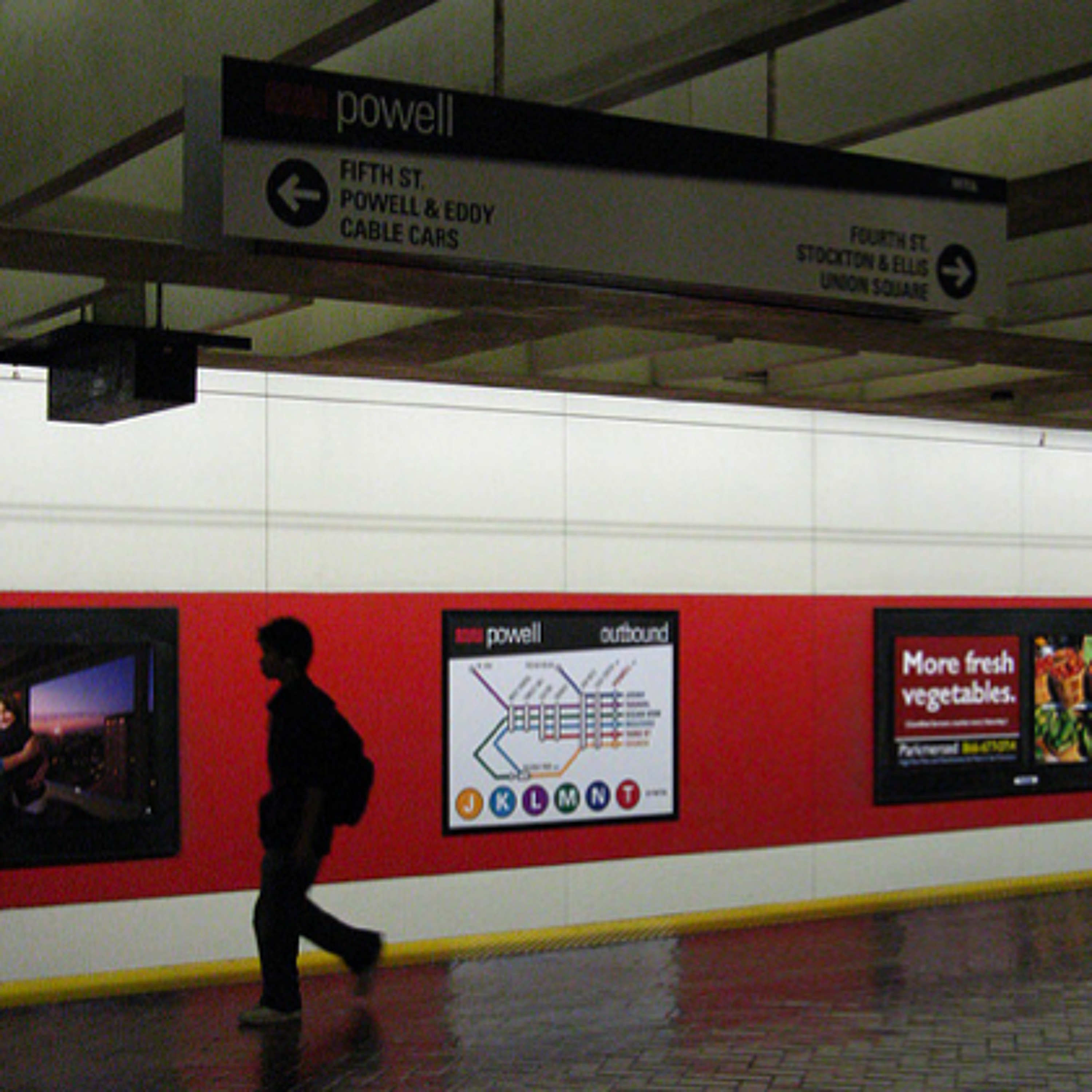
San Francisco’s Muni is facing a good news/bad news situation. The good news is its buses and trains are boarded more than 590,000 times a day. The bad news is, that represents a 4.4% drop in ridership. Do the math over the last fiscal year, and you’ll find about 10 million fewer rides than the year before.
So why are fewer people riding the city’s buses, rail and trolleys? It may have something to do with this scenario:
You’re standing at a Muni stop in San Francisco, transfer in hand, ready to get on a bus. A bus drives right on by. Packed full. Okay, no big deal – you wait for another one, but that one goes by too.
Sound familiar? In a new television ad, District 7 supervisor Sean Elsbernd says he feels your pain.
ANNOUNCER [Clip from "Yes on Prop G" campaign commercial]: Supervisor Sean Elsbernd is tired of waiting. Like you, he’s tired of waiting for buses that don’t show, or streetcars that zoom right by, too full to stop. That’s why Supervisor Elsbernd sponsored Proposition G, to put riders first by ending the wasteful work rules and broken salary formula that contribute to poor Muni service.
SEAN ELSBERND: Are you tired of waiting? Let’s fix Muni now. Vote “yes” on Prop G.
Proposition G backers are appealing to your frustrations. Their solution? Change the way Muni operators are paid. Right now, the city charter guarantees them a set salary: Muni drivers must be the second-highest paid in the country. (Right now, they’re behind Boston.) Elsbernd wants to change that, so they’ll have to do collective bargaining, like the other city unions. Is this really the way to make those buses stop where they’re supposed to?
KALW’s Casey Miner tries to find out.
* * *
CASEY MINER: Ask Walter Scott whether Muni workers’ salaries should be changed, and he’ll tell you definitely not.
WALTER SCOTT: We come to work, we pull our equipment out, we get our orders and we go.
Scott is the secretary-treasurer of the Muni operators’ union.
SCOTT: And we try to move 700,000 people around San Francisco each day safely and efficiently.
Okay. Now ask Sean Elsbernd whether Muni workers’ salaries should be changed, and he’ll tell you absolutely yes.
SEAN ELSBERND: You’re not hearing anybody defend that drivers should receive the second-highest salary in the country.
Elsbernd is the sponsor of Proposition G, a measure on the November ballot that would remove the drivers’ salary guarantee and open the door to renegotiate their work rules. The city charter prohibits the union from striking, so if drivers and managers can’t reach an agreement they’ll have to go to binding arbitration. Other unions have to do that too, but the Muni workers will have an added burden: they’ll be the only union in the city that has to prove their work rules won’t impact service. Add that to the fact that the initiative was largely paid for by city business interests, and – well, Elsbernd’s taken some heat.
ELSBERND: Issues about scapegoating the drivers, issues like this being racist – let’s not forget I’ve been called a racist all over the city – or this being anti-labor, it distracts.
So Elsbernd is embattled, but he’s also got a lot of support. Seventy-four thousand people signed his petition to get the measure on the ballot. That’s almost twice as many as you need.
RACHEL GORDON: There’s a lot of frustration and anger right now that MUNI’s not operating as well as it should, as well as it could.
Rachel Gordon reports on City Hall for the San Francisco Chronicle. She’s been following Prop G for months.
GORDON: What riders care about more than anything is, are buses going to show up on time? Are they going to pass you up when they do show up because they’re so crowded?
Elsbernd’s counting on those concerns helping his cause. And to a certain extent union reps, like Vice President Rafael Cabrera, agree.
RAFAEL CABRERA: There may be some rules that need to be dealt with. There definitely are, and I’m the first one to say it.
But Cabrera also says that the ballot measure doesn’t directly address the things riders complain about.
CABRERA: This measure does nothing to restore service or service cuts. What it does is blame the operators for the failure of management.
Chronicle reporter Rachel Gordon says both sides of this argument have merit. The drivers aren’t responsible for all of Muni’s problems, but they haven’t made any concessions, either. Most other unions in San Francisco, these days, have. Gordon also notes the problems with MUNI are more complex than any one ballot measure can address.
GORDON: It’s got these problems that no one seems to be able to completely solve or get their hands around. Why are buses and streetcars not showing up on time? Why are they covered with graffiti and dirty? How come people are getting their iPods stolen when they’re riding the bus? How come people aren’t feeling always safe when they’re waiting at a bus stop? There are a lot of problems that aren’t Muni’s fault but kind of larger social problems that Muni is at the center of.
And what Muni can control, she says, doesn’t have the same popular appeal as the current ballot measure. For example, if buses traveled just one mile an hour faster, the agency thinks it could save $70 million a year. That’s seven times what Prop G is supposed to save. But it’s a harder sell than demanding concessions from the union.
GORDON: That has a lot to do with management and political will. Because if you speed service in San Francisco, that means that auto drivers might be impacted. You might have transit-only lanes in S.F. that are actually enforced. For riders it might mean you have bus stops further apart, that the bus doesn’t have to stop every one to two blocks but instead every three to four blocks.
Those ideas are in the works – Muni’s been trying to reinvent itself for years now. In the meantime, though, voters will determine the drivers’ fates come Election Day. They may be tired of waiting for buses, but they’ll have to wait to see if their decision makes the system better.
In San Francisco, I’m Casey Miner for Crosscurrents.