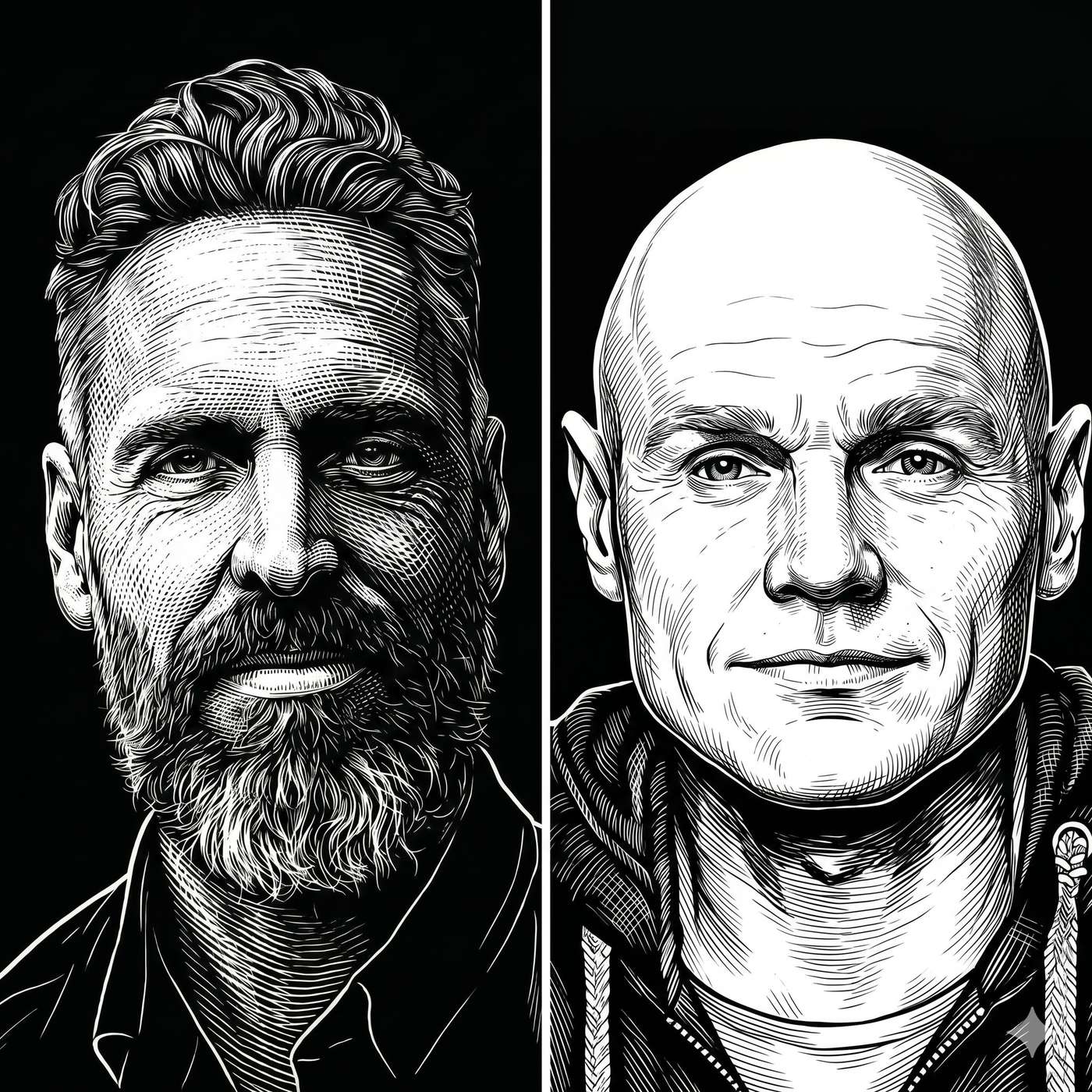
Recorded live on June 8, 2026.
For one week the show turns around: Erik interviews his co-host Guy Sengstock, co-creator of Circling, the relational practice that Erik keeps hearing about from strangers at conferences who learned it "in the so-and-so lineage." Erik admits that after twenty years of friendship (Guy was once his executive coach) he still does not really know what Circling is. Guy starts with a graph: in 1840 the average person spent just under eight hours a day with other people, and by his count the average 25-year-old man today spends less than thirty minutes. Circling, he says, is something like yoga for relationship: a set of concentrated practices for attunement, so that when your mother says the thing that usually sets you off, you wonder where she is coming from instead. The podcast hour gets the history: two friends in San Francisco in the late 1990s who kept noticing "this thing that keeps happening," a two-year training run from Jerry Candelaria's living room by teachers who realized on day one that they had no idea how they did it, and Erik's pointed question of how Guy never became a cult leader (Guy's answer includes "a deep awareness of my own dorkhood"). Then Guy describes a distinction he arrived at only recently: of the four capacities a facilitator draws on (understanding, empathy, compassion and wonder), wonder is the one therapy does without, and the one Circling is built on. That leads Erik to ask why he does not let himself fall in love with everyone, and to a long, open conversation about his late wife Aubrey, judgment, control, and what happens when you finally say the true thing to the person closest to you.
Key Topics
- [00:00 - 02:43] Cold open: the roles swap; Erik on being friends with "a legend," and the Circling practitioners who tell him they learned it in Guy's lineage "as if you're like Buddha"
- [02:43 - 04:21] How they met: about twenty years ago Erik, early in his law-firm career and a trained coach himself, hires Guy as an executive coach and realizes in the first session what the job is supposed to be
- [04:21 - 12:03] Communication without relationship: Circling as a relational practice that started in the Bay Area human-potential world in the late 1990s; Guy's view that the internet "uncollapsed" communication from relationship; the time-with-other-people graph from 1840 to today; "we become people in and through other people"
- [12:03 - 23:50] Yoga for relating: the asana analogy; why the practice spread "despite our bad business skills"; how a course runs (around 30 people, breakouts in pairs, circles of about five with a trained facilitator); circling one person versus "organic circling"; attunement as the capacity Circling develops, the way meditation develops awareness
- [23:50 - 32:28] How people actually try it: relationship as "a participatory sport"; self-study programs; COVID forcing everything online, which "unfortunately worked really good"; the three-hour drop-in; the martial-arts question (a grab bag of moves, or a fixed form?); the noticing exercise and why it trains attention to yourself while you are with someone else
- [32:28 - 40:45] Making the relationship the topic: the usual triangle of me, you and the thing we are talking about; what happens when the topic becomes "me and you right now" ("a different law of physics"); Guy's friend Ron the wine expert and "imagine being the wine"; men and relational attention; Erik on why Guy's coaching was not therapy, advice or consulting
- --- [Act 2: Extended Conversation] ---
- [40:45 - 50:51] Getting started, and why facilitators change: the weekly drop-in on Zoom and why Zoom makes the back-and-forth more intense; weekend intensives with circles over an hour; in-person events; the year-long practitioner trainings in three levels; "to learn how to circle is almost synonymous with developing as a person"; letting go of agenda and identity in order to listen; a Heidegger line on beginning to hear something other than what we already think
- [50:51 - 56:03] The origin story: Guy and Jerry, "the Beavis and Butthead of transformation"; the first two-year training in Jerry's living room and the "pure, awkward terror" of realizing they did not know how they circled; Guy in art school in San Francisco; house-music parties; "there's this thing that keeps happening"
- [56:03 - 1:12:50] Power, mess, and how not to become a cult leader: therapists' licensure versus a practice with "no bylaws in the beginning"; transference as a known fact; being seen only through a role, and the power differential that follows; Guy's outsider background (a grandfather who opened his eyes, parents who got sober when he was 12, mentors from AA); adoration as "a little bit like a cocaine high"; why people do Circling without becoming Circling people
- [1:12:50 - 1:21:54] Admiration versus idolizing: icon and idol; admiration as a clue to your own North star; imitation as how we learn (Erik on watching Kelly Slater); why genuine admiration makes Guy want to pour himself into someone; how the first facilitators learned by imitation, and the years it took to make the implicit explicit
- [1:21:54 - 1:30:17] Wonder, the fourth capacity: understanding, empathy, compassion and wonder; curiosity as hunger, awe as the sunset that shatters your categories, wonder as a door opening in something that has been in front of you your whole life; why therapy can do without wonder and Circling cannot; "there's something about a person that's inexhaustible"
- [1:30:17 - 1:37:47] Why not fall in love with everybody?: Erik's question about his own fear of the responsibility that comes with loving someone fully; judgment as the opposite of wonder; Susan Campbell's line that interpersonal judgment is "the mind's way of managing anxiety"; why a session with a beginning and an end lets Guy go all the way in
- [1:37:47 - 1:53:01] Aubrey: Erik on the traits in his late wife he had walled off; the hospital conversation where she said she would not let her anger go, and the moment he stopped trying to save her from it; Guy on intimacy as the opposite of control; the last two weeks of her life, when "she just suddenly realized you could love anybody at any depth"
- [1:53:01 - 2:03:22] Intimacy and the two drives: Erik asks how to stay alive to a partner's habits rather than writing them off; Guy on resentment as a contraction of the whole person; closeness and autonomy as the two deepest drives, and why intimacy means risking both; "I'm done" as one of the most honest sentences in a marriage
- [2:03:22 - 2:07:28] Leaky and non-leaky self-disclosure: why perfect communication-book language can still be an attempt to control; "the language structure doesn't matter, the intention does"; sign-off and where to find Circling
Hosts
Guy Sengstock is Erik's co-host on Leaking Timeline and the co-creator of Circling, which he and Jerry Candelaria created in San Francisco in 1998. He is founder and co-owner of the Circling Institute, holds a BFA from the San Francisco Art Institute, and co-founded The Arête Center for Excellence and the Bay Area Men's Circle. He came to San Francisco for art school, was mentored by people from AA after his parents got sober when he was 12, still coaches executives, and now spends most of his Circling time leading the Institute's year-long practitioner trainings. Erik Newton is a lawyer, executive and co-founder of the California Institute for Machine Consciousness, and was once Guy's coaching client.
Notable Moments