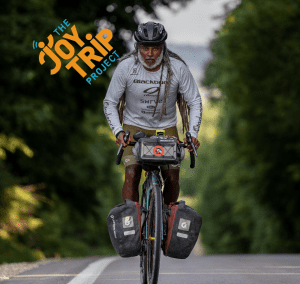
For those of us who really love bicycles, I think what we enjoy most is the sense of freedom we get from travel on the open road under our own power. This mechanical device allows us to engage both our minds and bodies to pedal long distances on just two wheels so that we can explore the landscape of the modern world. But through our journeys over lightly trafficked rural roads, as we roll past obscure old towns and villages, we can also reveal the compelling memories of the not-so-distant past. As a modern-day explorer, there's a man who rides a bike along gravel paths and asphalt highways across time and space and into the pages of history.
Erick Cedeño: My name is Eric Cedeño. Some people know me as the Bicycle Nomad.
JTP: For many years, Eric Cedeño has traveled thousands of miles by bicycle across North America. As a cyclist carrying his own gear from one town to the next, he reimagines the excitement and enthusiasm of human powered transportation toward the end of the 19th century. Back then, even the United States Army thought that the bicycle might change how human beings travel from place to place.
Erick Cedeño: There was a big craze. People were going crazy about the bicycle, the technology, about the bicycle. And the army realized that they needed other methods of transportation to be successful. They only had the cavalry back then, and they knew that bicycles were cheaper than horses. Easier to maintain than a horse. They could go further than a horse could. And also, there were quite in battlefields. So they understood the power of the bikes and they wanted to adapt a bicycle corps.
JTP: In 1896, U.S. Army Lieutenant James Moss came up with the idea to conduct an experiment to see if the bicycle could one day be used to replace the horse. In order to prove the concept, moss recruited a platoon of 20 soldiers.
Erick Cedeño: Fort Missoula, Montana, is where that was formed. Lieutenant Moss approached the Army and says, I have the perfect man to do this experiment. And he did. Luckily for him, he had the Buffalo Soldiers out of the 25th Infantry out of Fort Missoula.
Erick Cedeño The Bicycle Nomad
photo by Josh Caffrey
JTP: At the time, more than 30 years after the end of the Civil War, there were stationed there an all-Black unit of enlisted men known collectively as the Buffalo Soldiers. These men who fought the Plains Wars of westward expansion and sadly participated in the displacement of Native people, were given the opportunity for a peacetime mission into the American heartland. Led by Lieutenant Moss, a white officer. Over the next two years, from 1896 to 1897, the Buffalo Soldier Bicycle Corps would make three expeditions across the West. In 2022, Eric Cedeño retraced the route that they traveled from Fort Missoula, Montana, to Saint Louis, Missouri. The distance of more than 1900 miles. In the retelling of their story through physical reenactment, the Bicycle Nomad takes us on a journey back in time. In his travels following the path of the Buffalo Soldiers, Cedeño not only celebrates the accomplishments of black Americans from our past, but also inspires further exploration of our history that is too often overlooked. I'm James Edward Mills, and you're listening to The Joy Trip Project.
Title photo by Josh Caffrey
Erick Cedeño in Missouri
photo by Josh Caffrey
Erick Cedeño's passion for exploration began at a very early age.
Erick Cedeño: Since I was a kid, I've always loved history. And I have a story where my mom took me to Mexico to see the pyramids of the Mayan and Aztec civilization. We went to Mexico just for that. She hired a tour guide that took us and told us the history. Now, I'm 12 years old. I have read some of that, those books. And to be walking the steps of ancient civilization just changed my world.
JTP: I first became aware of the Bicycle Nomad several years ago as I was following his travels as he retraced the route of the Underground Railroad from the Deep South all the way to the Canadian border. How did you begin to explore history through bicycle and what prompted that first trip?
Erick Cedeño: So about 2009 2010, I decided I wanted to see the whole country by bike. Every single city. Every single town, but every single state for sure. And my first trip was my major trip was from Vancouver, Canada, to Tijuana, Mexico. Then I followed by a trip from Miami to New York City, and they were grueling. Because you're traveling 70 miles a day every single day. And at some point, I needed a carrot. I was like, okay, I need to go to the next city without having this mental in my head, right? So I'm like, why don't I combine two of my hobbies and two of my passions, history and bicycle traveling. So in 2014, I decided to retrace the steps of the Underground Railroad. Not only there was many routes, as you know, of the Freedom Trail, but there was a particular song called Follow the Drinking Gourd and Follow the Drinking Gourd was actually asked to travel to freedom and I said, I'm going to retrace that song. And I did that in 2014. And that's when I was like, you know what? Ever trip now? It's about traveling through history. I just loved it.
JTP: While traveling through history by bicycle, Cedeño was in a place where he could find the events and characters that make up our national heritage. At slightly slower than the pace of life, he's discovering moments in time that some might believe have been lost.
Erick Cedeño: Yeah, I don't know if it's lost because the history is there. We just have to tell the story. And when I started traveling by bike and when I started traveling through history, it was just for me to learn what I didn't learn. But now it's about telling those stories of those freedom seekers, of freedom fighters, because I need to share that. I would love to inspire the next generation of historians or the next generation of explorers that looks like me. And to feel that sense of pride that I have for even though as dark of history of the Underground Railroad is, I love how the tenacity of those people and that they were explorers. They were explorers. They were freedom seekers, and they navigated through this country for freedom. And those stories have to be told, you know, for us to pay homage. For us to feel a sense of pride where we have been. And how strong we are.
JTP: You know, and I think that it's from that story of freedom that ultimately gets us into the Civil War. It begins the introduction of Black men as soldiers in the US Army and the units known as the Buffalo Soldiers who came out of the Civil War, who went on to fight the wars of Western expansion, who fought in the Philippines, who fought with Teddy Roosevelt as part of the Rough Riders. Part of that legacy also carries through to a particular group of Buffalo Soldiers on bicycle.
Erick Cedeño: Correct
JTP: In the 1890s? Yes. So tell us a little bit about the Buffalo Soldier Bicycle Corps.
Erick Cedeño: And they were strong mentally, physically strong riders and explorers. Three expeditions were done. The first expedition was 1896, from Fort Missoula to Lake MacDonald about 125 miles. The second expedition was like, Hey, we need you to go further. And they went from Fort Missoula to Yellowstone and back close to 800 miles. And the last expedition, 1897, the Army said, you got to show us more, because from Montana to Yellowstone, the route almost looks the same. The climate almost looks the same. So, they needed diversity to know if this is going to work. And the diversity was from Fort Missoula, Montana, to Saint Louis, because you go through the elevation of the Continental Divide and then you lower into the lower plains, into Nebraska, into Missouri. When I started my trip, it was like 46 degrees. Three weeks later in Nebraska, it was 105 degrees and they dealt with a similar situation, weather pattern, not even on not only just weather, but also the gravel. The gravel in each state is different to navigate. So yeah. (Correction - the actual location was Mc Donald Lake on the Flathead Reservation in Montana)
JTP: So this particular expedition, June 14, 1897 and that's an interesting thing too, because you are able to tell this story very accurately because there was a journalist that was part of the expedition. What was his name?
Erick Cedeño: His name was Edward Booth. Edward H. Booth.
JTP: And he was the son of a newspaper editor in Missoula, Montana.
Erick Cedeño: And Missoulan newspaper, which the newspapers still around.
JTP: Right. And he's only 19 years old at the time and years old. And so, he was actually able to tell the story of the Buffalo soldiers as they're making their way. And it was a 41-day journey. And you literally have notes, handwritten notes that you can document exactly what happened from one day to the next. And for the purposes of your expedition, as I understand it, was to be able to take that expedition and duplicated right down to the last day in terms of even the distances.
Erick Cedeño: And not only distances. But timing, when they arrived, when they left Missoula, it was so important for me to leave at 5:40 in the morning when they left and arrive into Forest Park, Saint Louis. And not just arrived to Saint Louis and say, I'm here. No, I went to the park where those guys arrived.
JTP: So why is it important to get that degree of accuracy when it comes to reenacting an event like this?
Erick Cedeño: For many reasons. Mainly to tell the story accurately. Right? But also, as an explorer, as a traveler, I want to when I when I travel through history, I want to feel what those travelers felt, those freedom seekers, those freedom fighters. I want to see how hard it was for them. And obviously, I'm traveling 125 years later with different technology than they did. But, you know,