Standard Operating Procedures (SOPs) are the backbone of safety for 99% of nuclear operations. But what happens during the terrifying 1%—the "Black Swan" events—where following the rules guarantees failure?
Key Segments & Takeaways:
1. The "Manifesto of the Last Resort."
- The Core Doctrine: Competence assumes the procedure works; Mastery knows what to do when it doesn't.
- Anchor vs. Shackle: A procedure is an anchor that prevents panic, but it becomes a "suicide pact" (shackle) when the infrastructure assumed by the step (power, air, valves) no longer exists.
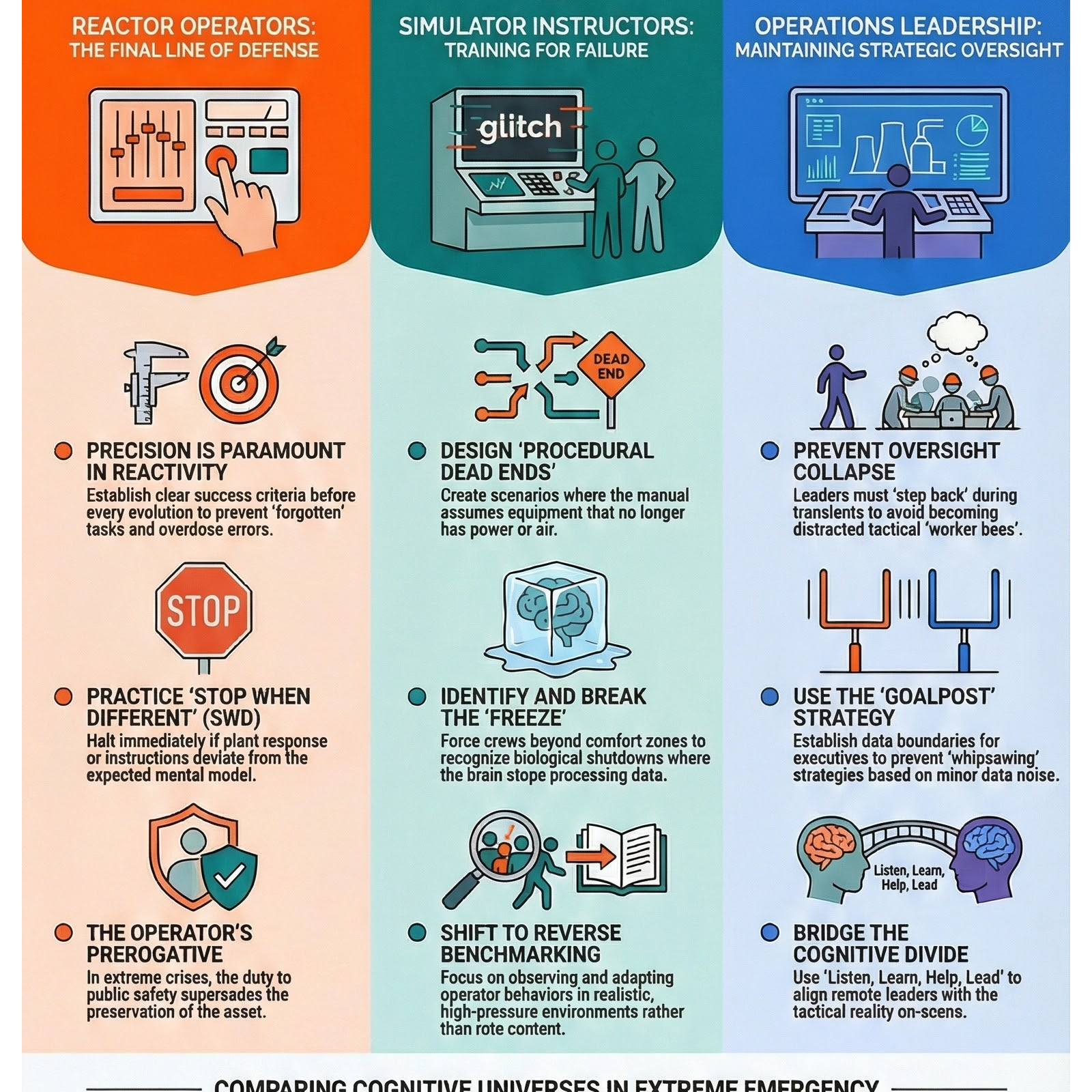
- The Bushido Mindset: When the system fractures, the operator is the person of last resort. The doctrine explicitly states: "Do not wait for permission to save the plant".
2. Case Study: Fukushima (The White Swan vs. The Black Swan)
- "Cement Your Feet": Shift Supervisor Izawa fought the primal urge to flee or act blindly. He ordered his crew to stop operating until the shaking ceased, enforcing routine over reaction.
- Technical Justice: Site Superintendent Yoshida disobeyed direct orders from the Prime Minister and TEPCO HQ to stop seawater injection. He prioritized the physics of the core over the "social justice" of saving face or protecting the asset,.
- Improvisation: When the manual failed (Station Blackout), operators scavenged car batteries and fire engines to power instrumentation and inject water,.
3. Case Study: Browns Ferry (The Candle & The Policy Paralysis)
- The Incident: A candle used to check for air leaks ignited a fire that knocked out the Emergency Core Cooling System (ECCS).
- Policy as a Suicide Pact: The fire raged for hours because plant management adhered to a policy forbidding water on "electrical fires" (Class C), even though the fuel was foam (Class A). The Fire Chief's correct instinct was overruled by the manual until it was almost too late,.
- The Save: Operators saved the plant by improvising a depressurization method using a construction-era backup nitrogen system that wasn't in the standard operating procedures,.
4. The Psychology of "The Freeze" (Deepwater Horizon & Paks)
- Biological Shutdown: Research shows 80% of people "freeze" in extreme crises. Captain Kuchta of the Deepwater Horizon had a perfect record but "froze" because he lacked "scar tissue"—he had never practiced failing,.
- The 12-Minute Blind Spot: At the Paks Nuclear Plant, operators were "flying blind" during a fuel cleaning incident. Engineering knew the water would boil in 12 minutes if flow stopped, but this critical "cliff" was never communicated to the front line,.
5. Tools for the "1% Event"
- The "Dog Bowl" Theory: In a crisis, cognitive bandwidth is limited. Operators must ignore any alarm or phone call that doesn't help "feed the dog" (cool the core).
- The Goalpost Strategy: To prevent "whipsawing" (leaders panicking over single data points), operators should set "Best Case" and "Worst Case" goalposts. As long as data stays between them, leadership must let the data "bake" and leave the crew alone,.
- Training for Failure: The new mandate requires simulator instructors to fail trainees who strictly follow a procedure that leads to a dead end. They must be graded on "technically defensible improvisation".