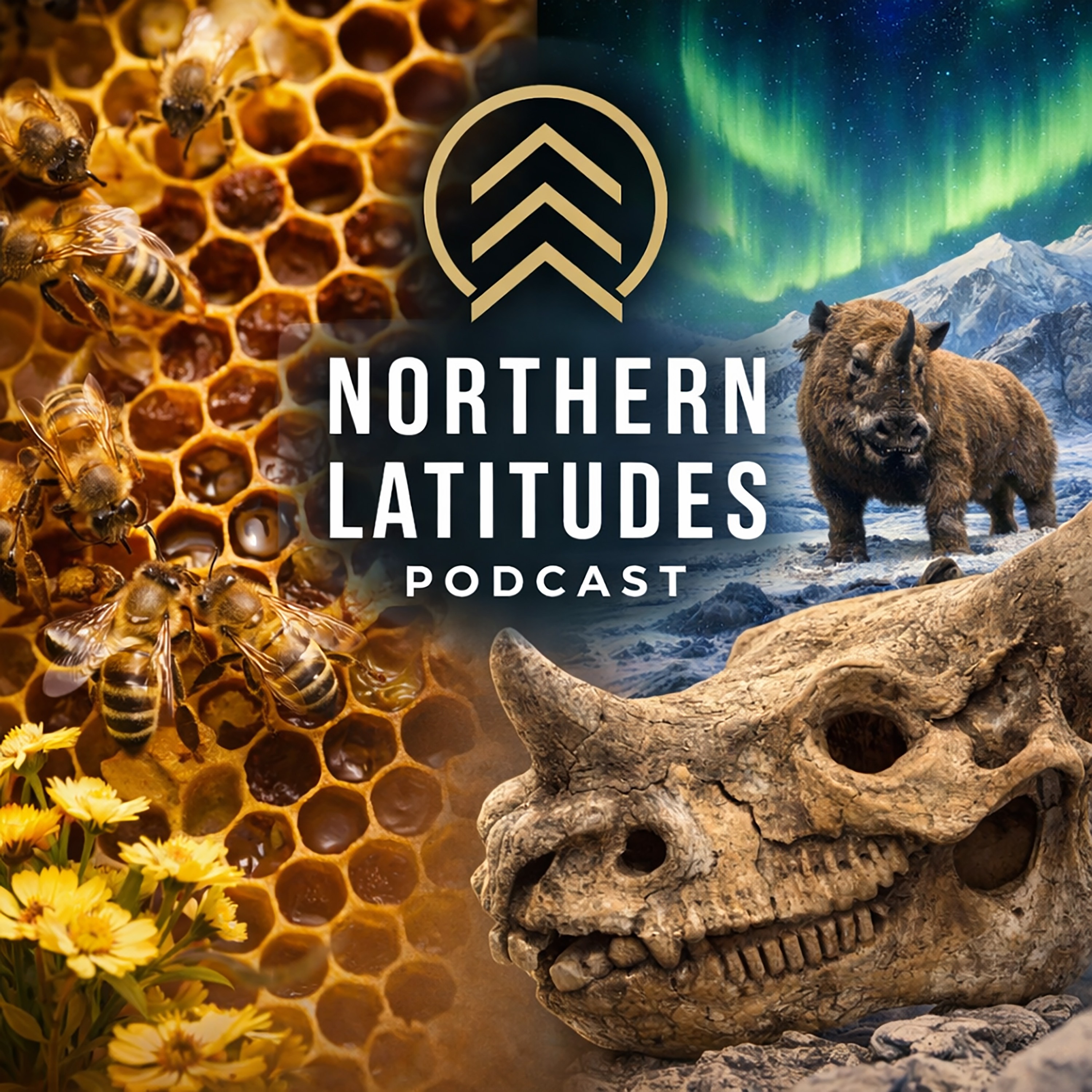
SMALL WINGS, OLD BONES Northern Latitudes — Episode Show Notes
There's a thread connecting this episode that isn't obvious at first. One conversation is about something very much alive — small, social, and in trouble. The other is about something long gone, found frozen in rock on a high Arctic island. But both stories ask the same kind of question: what does an animal's fate tell us about the world it inhabited, and the one we're building now?
Part One: The Science of Bees with Noria Morfin, Assistant Professor, Department of Entomology, University of Manitoba
The University of Manitoba's Honey Bee Lab has been running for over a hundred years — longer than most people have been thinking about colony collapse. Noria Morfin arrived there a year ago, and she came in the way a lot of bee researchers do: through a side door. She was a veterinary student in Mexico when a single course on bee biology changed her direction entirely. She bought her first apiary before she graduated — twenty-five colonies of highly defensive Africanized bees. It was, she says, an education.
In this conversation, we talk about what the lab actually studies (health, behaviour, disease dynamics, and the immune responses bees use to protect themselves), the varroa mite — still the dominant threat to managed colonies in North America — and what it looks like when you lose thirty to fifty percent of your livestock every year and have to rebuild every spring. We also get into the difference between managed honeybees and wild native pollinators, what integrated pest management actually means in practice, and whether there's reason for optimism.
Noria thinks there is. She points to the research effort, the awareness, and a simple human reaction she notices whenever she mentions bees in conversation: people smile.
Part Two: The Arctic Rhino with Dr. Danielle Fraser, Head of Paleobiology, Canadian Museum of Nature, Ottawa
In 1986, a palaeontologist named Mary Dawson collected bones on Devon Island, deep in the Canadian Arctic. It took decades to understand what she'd found: a rhinoceros. Small-bodied, hornless, and 23 million years old — the farthest north any rhino fossil has ever been recovered.
Dr. Danielle Fraser helped name it. The species name comes from Inuktitut — iuk, meaning frosty. Epihippus iuk. The frost rhino.
What makes the find remarkable isn't just the location. It's what the anatomy suggests about origin. This animal looks like rhinos from Europe and Asia that are millions of years older — which means it crossed an ocean to get there. Not the Bering Land Bridge, the one we all learn about in school, but the other ones: two now-submerged connections running from northern Europe over Svalbard and Iceland to Greenland and into the high Canadian Arctic. It was long assumed these were under water by 50 million years ago. This fossil is 23 million years old.
We talk about seasonal ice as a crossing mechanism, what a 75-80% complete skeleton allows a scientist to say that teeth alone never could, how many rhino species once roamed North America (many), and why they were all gone by about 5 million years ago. We also talk about what comes next — a planned field season on Banks Island, the logistics of getting a team of ten into the western Arctic, and what it means to name a new species and make it a type specimen that science will rely on for generations.
Guests Noria Morfin — University of Manitoba, Department of Entomology Dr. Danielle Fraser — Canadian Museum of Nature, Ottawa