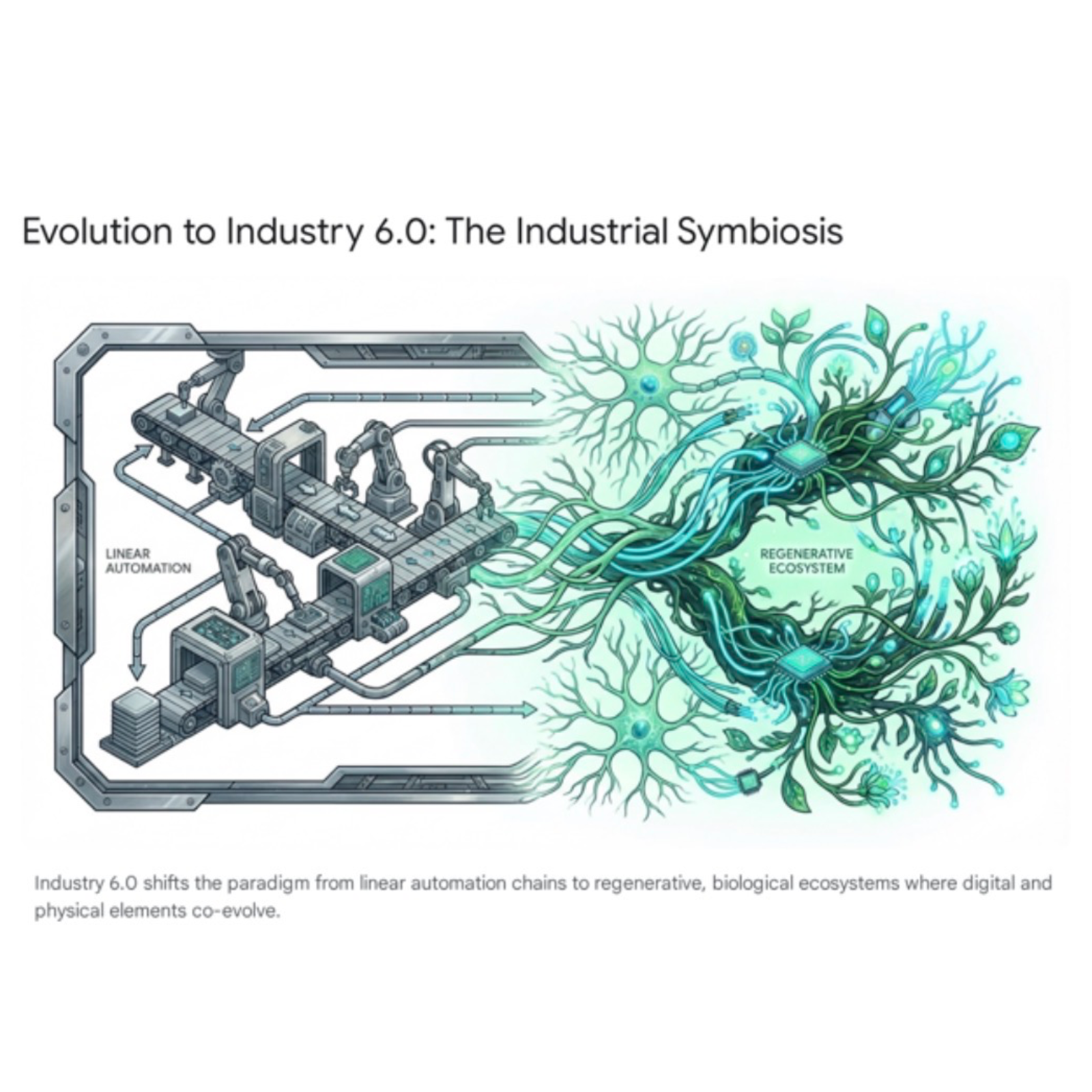
To understand the necessity of this doctrine, we must analyze why current models are failing. Industry 4.0 was built on the metaphor of the computer: centralized processing, standardized inputs, and predictable outputs. Industry 5.0 attempted to soften this with a "human-centric" veneer, focusing on collaboration between humans and "cobots" (collaborative robots). Yet, both remain rooted in linear causality.
In contrast, Industry 6.0 is defined by cyclical feedback loops and antifragility. A linear supply chain shatters when a key link (e.g., a specific port or factory) is disrupted. A biological ecosystem, however, routes around damage. It possesses "redundancy of function" rather than just "redundancy of parts." In the corporate context, this means that if a central AI or management node fails, the local operators must possess the sovereignty and intelligence to maintain system integrity.
Legacy organizational structures, built on centralized command-and-control and punitive error management, are incompatible with this biological requirement. They create "fragile" operators who wait for instructions and hide mistakes. The "March to 'Me'" is the antidote to this fragility. It posits that resilience emerges from the bottom up, driven by Sovereign Operators who are empowered by localized, private AI (Gemini Local) to interpret the environment and act with agency.
1.2 The Three Pillars of the Doctrine
The transition to the Mindset Engineering Executive Operator is built upon three non-negotiable pillars, which will be detailed throughout this manual: