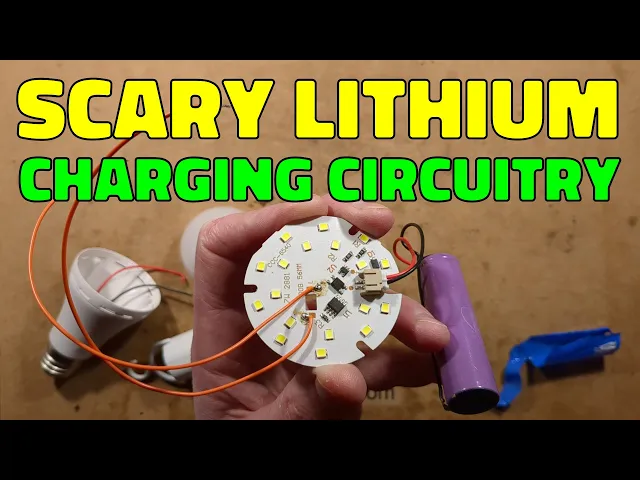
If this video comes across as being a bit abstract and rambly, it's because this circuitry invokes a lot of deep thought due to the way its economy has introduced many variables and significant hackability.
This is one of the emergency light bulbs that operates as a standard bulb (lamp), but in the event of a power failure it can detect whether the wall switch was on or off and illuminate if the switch is in the on position. (It detects a current path through other loads in the house.)
I bought this one to see how the circuitry has evolved, and it turns out that these devices are popular enough to merit a dedicated chip for the emergency feature. Its number is QW2881.
The circuitry in this bulb is cut to the bare minimum. It uses a standard linear regulator to power the string of standard LEDs (Ten 6-chip LEDs) but also uses that current limited supply to charge the lithium cell. The charge current is quite low at about 25mA as supplied.
The maximum cell charge voltage is set by a series resistor chosen to have a specific voltage across it at the main LED circuit's current. Unfortunately, at the full current this unit operates at, I tested the upper charge voltage as 5.15V, which would have been OK if the cell had a protection circuit, but it doesn't.
It's notable that the LEDs are being run at fairly high current, and the linear regulator did throttle the current back after it had been on for a while, and that could theoretically lower the cell charge voltage too, but relying on room temperature to limit the charge voltage of a lithium cell is a bit reckless.
One good feature about this bulb is its hackability. The linear regulator's current setting resistor could be increased from 20 ohms to 47 ohms to lower the power dissipation of the bulb for more stable operation and longer LED lifespan. The 100 ohm resistor could be adjusted to set a preferred upper charge voltage to somewhere like 3.9V, which is a much better charge state for long term standby in something like an emergency light.
The 1 ohm resistor could also be increased to reduce the discharge current in emergency mode. That would result in lower light output, but would extend the run time greatly in the event of power failure. With the 1 ohm resistor the LED current was about 500mA, but that would gradually reduce as the cell voltage dropped during the discharge cycle.
The lithium cell is marked 1200mAh, and tested at a surprisingly close 1207mAh.
I don't really recommend buying this bulb other than as a hacking project. It is also only suited to 220-240V use (although it could be modified for 120V use by bypassing a few LEDs in the outer ring.)
If you really must have one then here's a link to the item on AliExpress (not a sponsor).
This is an affiliate link, but that will not affect the price you pay.
https://s.click.aliexpress.com/e/_c3soDzZj
I paid about £3 for the bulb.
If you enjoy my videos then the easiest way to support the channel is to subscribe and enjoy my videos. But if you would like to contribute a dollar or two for coffee, cookies and gadgets to take apart, you can do so by supporting me on Patreon. I release videos without adverts for critique and feedback on Patreon as soon as they have been made. I also do Patreon live streams, which are much more relaxed and chatty than the busy public ones.
https://www.patreon.com/bigclive
Alternatively, for a single coffee contribution you can use PayPal:-
https://www.paypal.com/paypalme/bigclive
#ElectronicsCreators
...
https://www.youtube.com/watch?v=DAl0EbhZWjI