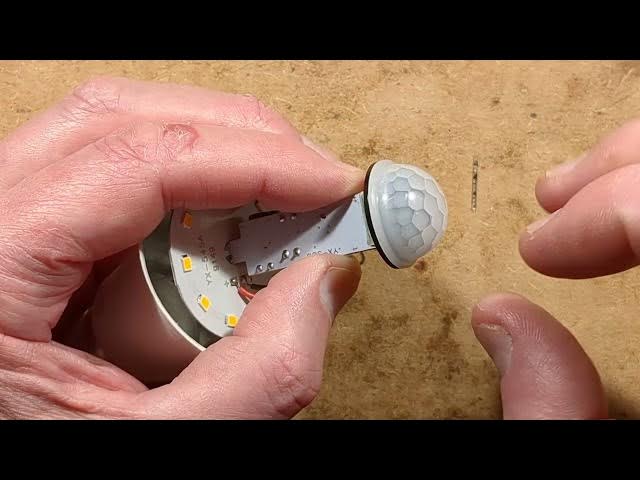
It's a while since I've looked at one of these motion sensing PIR bulbs (lamps). These devices have a Passive Infrared Sensor in them that can detect the movement of warm objects to trigger the light.
The circuitry in this one is a good demonstration of how a functional unit can be made with clever use of standard components. It has a Bright Power buck regulator for the 60V LED panel, and the built in rectifier is also used to power the PIR circuitry via a simple resistive dropper.
The dedicated PIR chip then switches the LED driver by pulling its overvoltage protection pin high.
Normally the overvoltage protection pin has a threshold set on it by a suitable resistor, and will turn the driver off if it detects an abnormal voltage across the LED array that it is driving. In this case it has the secondary function of allowing other circuitry to control it. This is mentioned in the official datasheet for the chip.
The PIR sensor has three pins and is powered by a regulated 3.3V supply. It has two pyroelectric/ferroelectric. Normally these two sensors will be exposed to an average amount of infrared energy in a space and that will cancel out due to them being wired in reverse series. But the polyethylene lens (chosen to pass longwave IR) creates moving hotspots of infrared when a human or animal passes, and as these hotspots pass across the two sensors they cause an imbalance which is buffered by a FET transistor to create a small signal on an output pin.
The PIR control chip amplifies the filtered signal from the PIR sensor and has three parameters that can be set with pairs of resistors acting as potential dividers. The three variables are sensitivity, timer duration and light level, detected by an LDR or photodiode/transistor in series with a resistor.
When the light level is low enough the control chip can be triggered by movement detection and will switch its output high for the programmed time. If more movement is detected within that time it resets the timer to keep the light on continuously.
While the output is on the light sensor is disabled as it is exposed to the light from the LEDs.
In some instances this means that PIR activated lights in busy areas can stay on even when other lighting is in use, until they get a chance to time out and enable the light sensor again.
I couldn't find a pinout match for the 8-pin PIR control chip. There were plenty of similar chips, but with different pinouts. I've noted the pinout on the schematic in the video.
The design of this PIR bulb is quite refined. It does appear to be universal voltage.
If you wish to buy one to experiment with then here's a link to the item on AliExpress (not a sponsor).
Note that this product may not comply with your local standards regarding safety and RF noise.
This is an affiliate link, but that will not affect the price you pay.
https://s.click.aliexpress.com/e/_c4VMZsAZ
Guide price 3 space-credits or less.
Note that despite the listing stating that it's a microwave/radar bulb it is a classic PIR unit, with the advantage of greater stability and not detecting through walls, windows and floors.
Note that if you open this unit then the loose PCBs can short against each other.
If you enjoy my videos then the easiest way to support the channel is to subscribe for more good video content. But if you would like to contribute a dollar or two for coffee, cookies and gadgets to take apart, you can do so by supporting me on Patreon. I release videos without adverts for critique and feedback on Patreon as soon as they have been made. I also do Patreon live streams, which are much more relaxed and chatty than the busy public ones.
https://www.patreon.com/bigclive
Alternatively, for a single coffee contribution you can use PayPal:-
https://www.paypal.com/paypalme/bigclive
This video description may contain affiliate links to support the channel.
#ElectronicsCreators
...
https://www.youtube.com/watch?v=ELXlKXYzhyA