A verb is a word that takes the action of a sentence. In English the infinitive is the name of the verb plus the word “to.” It is considered to be the most basic form of the verb...to eat, to drink, to sleep.
In Spanish, the infinitives end in -ar, -er, or -ir.
I personally think conjugating verbs is like solving a puzzle. Once you have learned and mastered the conjugation of present tense verbs, you’ll be able to conjugate millions…slightly dramatic, lots of Spanish verbs.
Believe it or not we conjugate words everyday in English, we have been doing it for so long that I think we just don’t realize that we are doing it. For example, take the verb in its infinitive form…”to talk.”
Verb Infinitive form: to talk
Singular, 1st person: I talk
Singular, 2nd person: You talk
Singular, 3rd person: He talks, She talks, It talks
Plural, 1st person: We talk
Plural, 2nd person: You all talk (y'all talk)
Plural, 3rd person: They talk
Spanish follows a similar pattern, except each person has its own unique ending; these endings are used for all regular, present tense verbs.
Step 1: Find your stem.
Spanish verbs have 2 parts: the ending and the stem. The endings are -ar, -er, or -ir. The stem is everything before the ending.
Step 2: Attach the new ending.
In English we use our subject pronouns to identify who is doing the action. I walk, I talk, you run, we swim... In Spanish, each person(1st person singular, 2nd person singular...) has their own ending. Once you learn the endings as they correspond to the subject, conjugating verbs will be easy.
ENDINGS
Verb Infinitive form: -ar
Singular, 1st person: o
Singular, 2nd person: as
Singular, 3rd person: a
Plural, 1st person: amos
Plural, 2nd person: áis
Plural, 3rd person: an
Example...
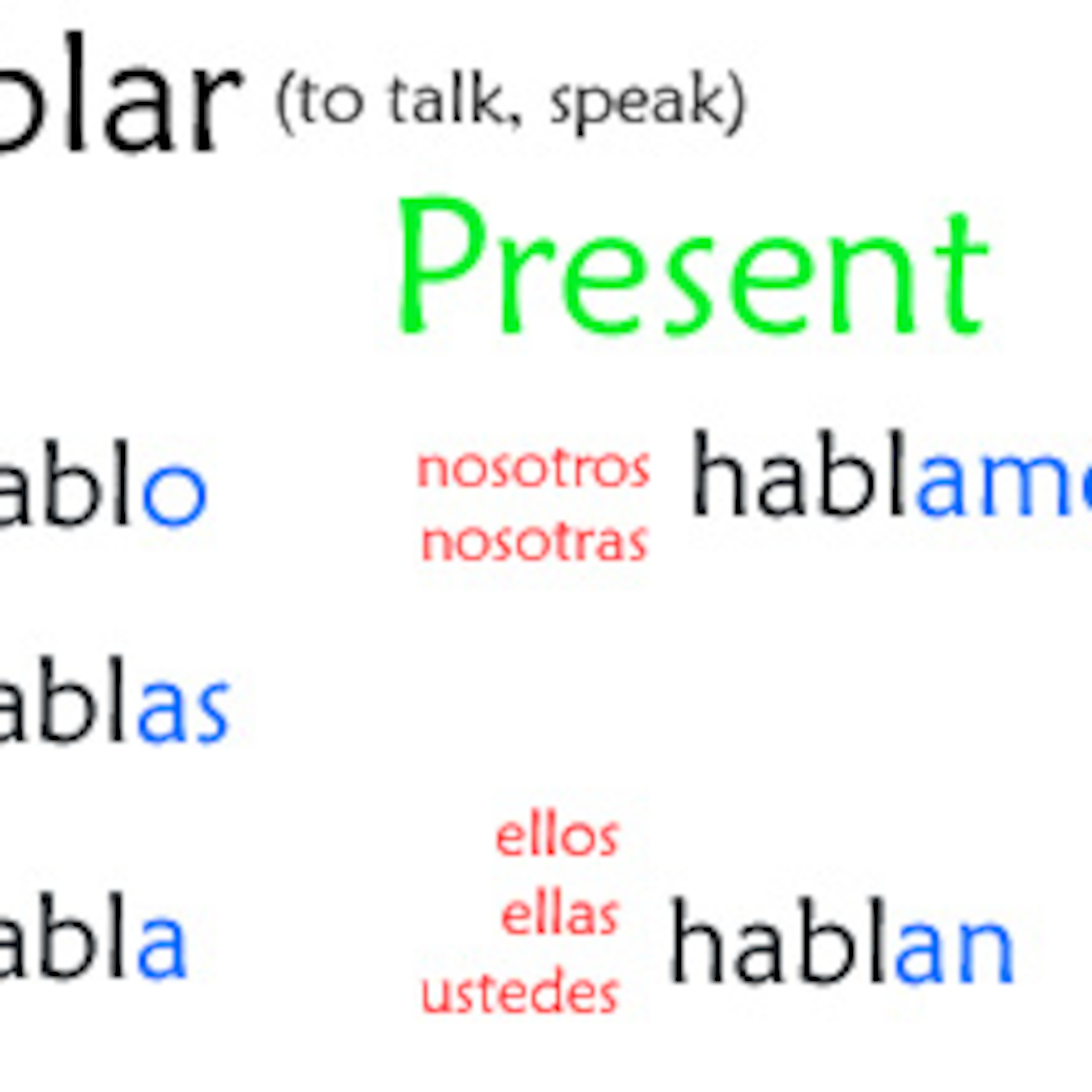
Verb Infinitive form: hablar - to talk
Singular, 1st person: hablo - I talk
Singular, 2nd person: hablas - You talk
Singular, 3rd person: habla - He talks, She talks, It talks
Plural, 1st person: hablamos - We talk
Plural, 2nd person: You all talk (y'all talk)
Plural, 3rd person: They talk
Remember when you are conjugating verbs that the subject pronouns aren't always needed because the ending tells the subject. Hablo mucho. The "o" ending = "yo", therefore "yo" isn't needed in this sentence. However, look at the following sentence.
Habla mucha. Who is doing the action?
So for 3rd person singular and 3rd plural you need the subject pronouns or the subject to clarify.
Sally habla mucho. Ella habla mucho.