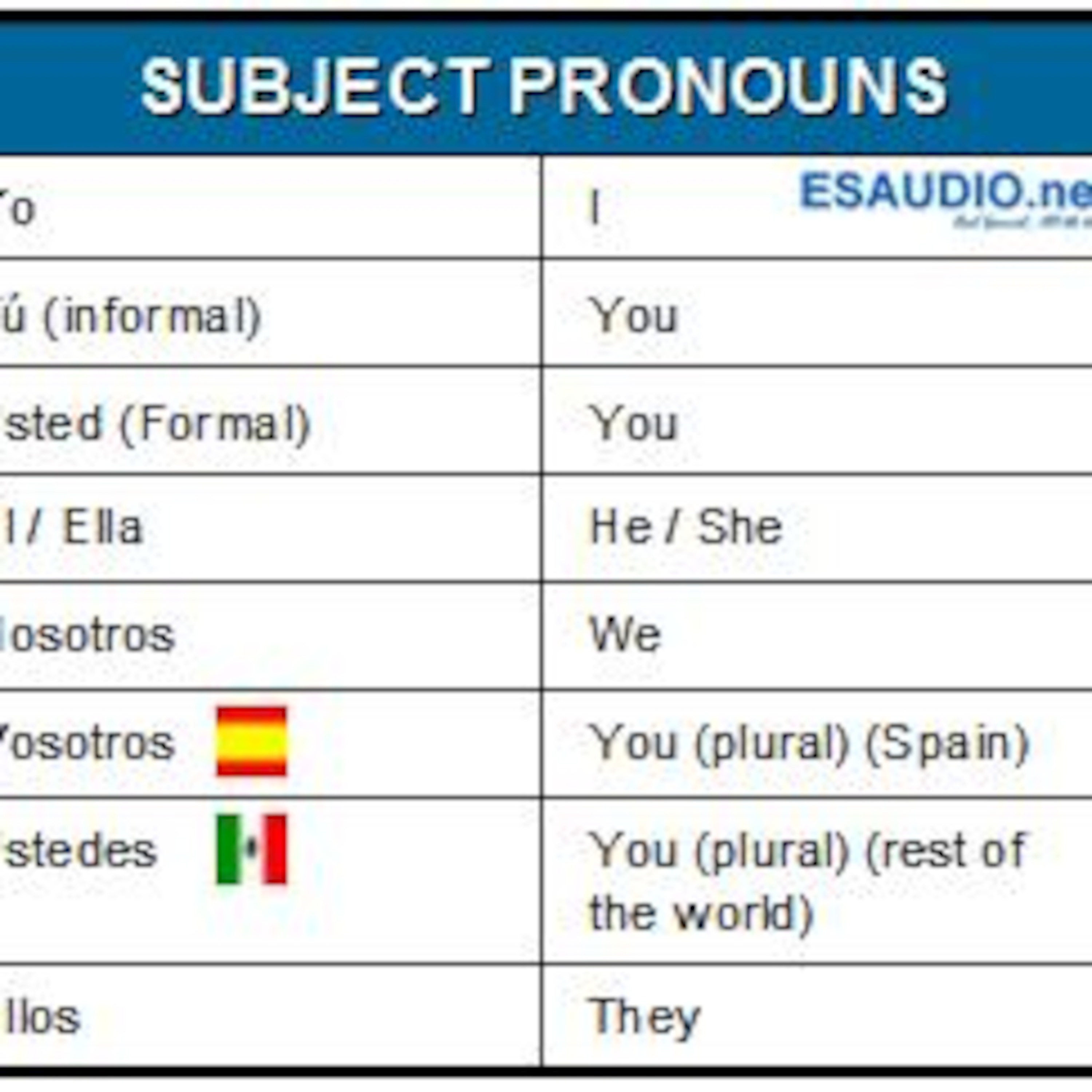
SUBJECT PRONOUNS
The subject of a sentence, the noun, is the person or thing which performs the action. The Subject pronoun replaces this person or thing, the noun. Before you can fully understand how to conjugate verbs you must understand subject pronouns.
English 1st person singular I
Spanish 1st person singular yo
English 2nd person singular You
Spanish 2nd person singular *tú
English 3rd person singular He/She/it
Spanish 3rd person singular él/ella/*usted (Ud.)
English 1st person plural we
Spanish 1st person plural nosotros/nosotras
English 2nd person plural you all (y'all)
Spanish 2nd person plural *vosotros/vosotras
English 3rd person plural they
Spanish 3rd person plural ellos/ellas/*ustedes (Uds.)
* The Spanish distinguish between the informal and the formal "you." The informal is used for friends, family, and people close in age. The formal is used to show respect or to indicate the person is unknown to the speaker.
SINGULAR, INFORMAL tú
PLURAL, INFORMAL vosotros/vosotras
SINGULAR, FORMAL usted (Ud.)
PLURAL, FORMAL ustedes (Uds.)
FORMAL
Vosotros/vosotras are used only in Spain. In Latin America, ustedes is used to refer to both the familiar and the formal “plural you”.
In Spanish the subject pronoun is often omitted from sentence because the verb form indicates the subject of the sentence.
Voy a la playa.
Voy = I am going, therefore the ‘yo’ is not needed
Necesitamos mucho dinero.
Necesitamos = We need, therefore the ‘nosotros’ is not needed.
However, subject pronouns are used for emphasis, clarification, or contrast.
Es inteligente.
Who is ‘es’ ? Es = he is, she is, it is…
Ella es inteligente.
Necesitan una mesa grande.
Who ‘necesitan’ ellos, ellas…
Ellos necesitan una mesa grande.