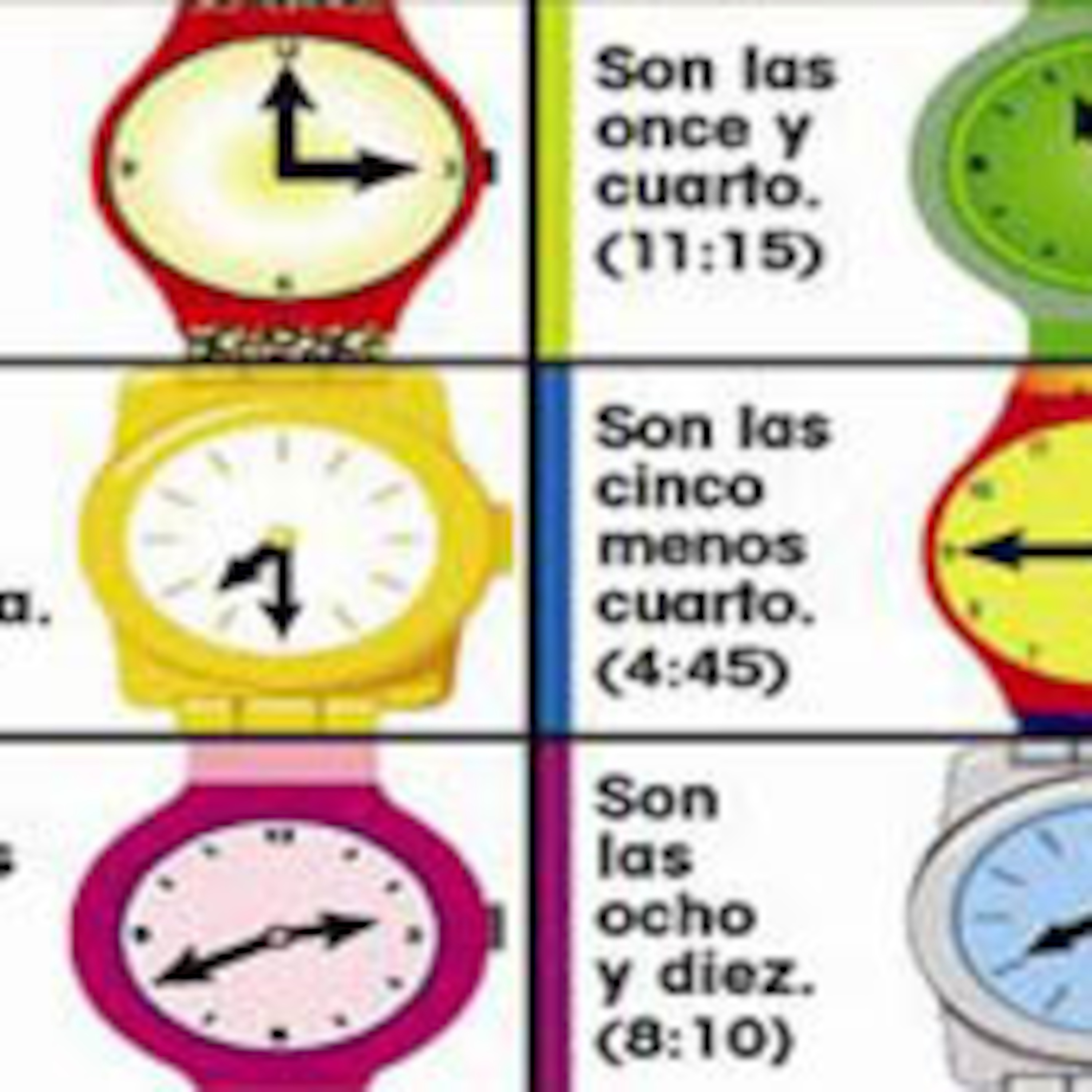
Telling Time
The verb “ser” is used when referring to time. The following word order should help you:
Es la/Son las + Hour + Y/o/menos + Minutes
Es is used with una …1:00 – 1:59
Son is used with all of the rest of the hours.
La and las are used because they refer to “hora” which is feminine.
Es la una. It’s 1:00. (It is 1 hour.)
Notice***gender and number agreement
Son las tres. It’s 3:00. (It is 3 hours.)
Minutes can be added to the hour using “y”.
Es la una y diez.
It’s 1:10. (It’s 1hr and 10 minutes. Or, it’s 10 after/past 1.)
Son las dos y veinte.
It’s 2:20. (It’s 2hrs and 20 minutes. Or, it’s 20 after/past 2. )
Minutes can be subtracted from the hour using “menos”.
Es la una menos diez.
It’s 12:50. (It’s 10 minutes to/till 1hr.)
Son las diez menos cinco.
It’s 9:55. (It’s 5 minutes to/till 10hrs.)
To say something occurs at a specific time, use “a + la(s) + time”.
¿A qué hora es la clase de español? At what time is Spanish class?
A las nueve de la mañana. At 9:00 am.
A la una de la tarde. At 1:00 pm.
To differentiate between a.m. and p.m. use
“de la mañana, de la tarde and de la noche”.
When no specific time is mentioned use
“por la mañana, por la tarde, and por la noche”.
Estudio por la noche. I study at night.