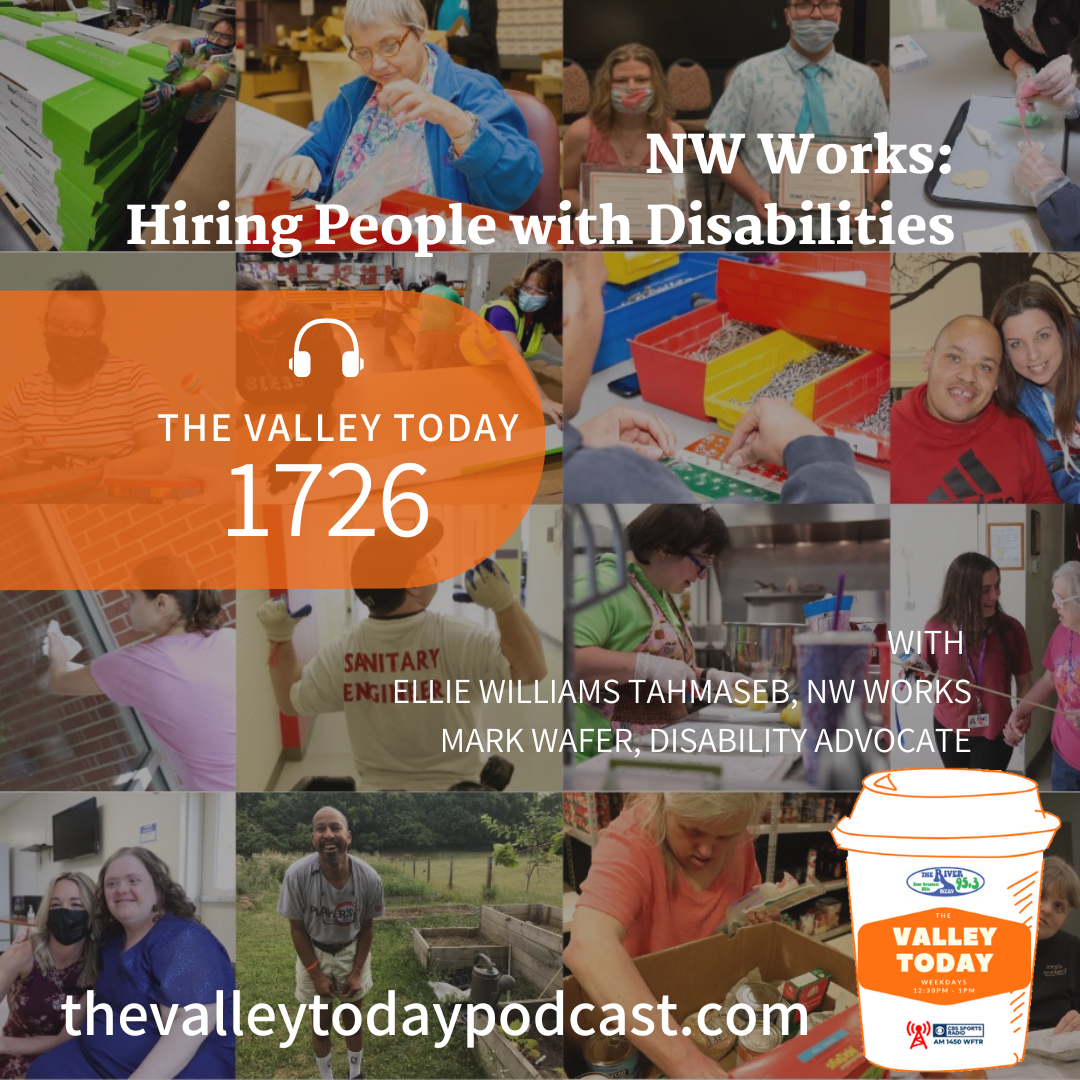
We recorded part of today's conversation on Thursday, September 22, 2022, with Ellie Williams Tahmaseb, Marketing and Public Relations Manager at NW Works, and Mark Wafer, a disability advocate and former owner of 14 Tim Horton restaurants. Mark was slated to be the keynote speaker for a disability employment conference on Monday, October 17, 2022, hosted by NW Works. The conference was canceled on Tuesday, September 27, 2022. The conversation we originally had is full of great information, so we decided to keep as much of it as we could. Today's show is a combination of that conversation as well as an additional chat that took place with Ellie on Wednesday, October 5, 2022. In addition, I've included the entire transcript of our conversation below as well. Reach out to NW Works via their website: https://nwworks.com/ and follow them on Facebook.
janet: Hello and welcome to the Valley today. I am your host, Janet Michael, before we jump into the weeds with our conversation today, I wanna give everyone who's listening a little bit of background, so we recorded part of today's conversation a couple of weeks ago. I'm on the screen for a second time because she's so gracious to give me more of her time. Ellie Williams Tahmaseb is here with me. She's the marketing and public relations manager at NW Works.
We talked a couple of weeks ago, Ellie, you joined me on the screen along with Mark Wafer. And Mark is a disability advocate and one of my favorite things, former owner of 14 Tim Horton restaurants, which makes him very near and dear to my heart. We were talking because he was going to be coming to town for a conference, a disability employment conference that NW Works was putting together that was supposed to happen in a couple of weeks. That has changed, but I felt like this information was still valid, good information that we needed to get out to employers and to the community.
So thank you for coming and talking about it. Outside of conference terms, I appreciate your time.
ellie: Very happy to be here, Janet. Thanks for being flexible as we kind of figure out this, new path forward.
janet: and you were telling me before we just started recording that October is National Disability Employment Awareness Month. So of course we had to make sure we were able to use this conversation in some way shape or form.
ellie: very timely. That's what we strive for.
janet: you're not having the conference now, but that doesn't really change anything from the perspective of the services that you offer and the need for employees that are available through NW works through a whole host of other types of organizations that offer employment opportunities for people with disabilities?
ellie: Definitely. Even with the conference being canceled, we still see a huge need in our community, both on the employer side, so many people are hiring right now, and on the adults with disabilities side, we have, One in four Americans practically has a disability of some sort.
In Virginia that's a little bit lower in West Virginia, that's a little bit higher. but really, so many of us know adults with disabilities, children with disabilities, adolescents with disabilities, and the services that we offer at NW works really focus around employment, community engagement, and ensuring that adults with disabilities have an opportunity to build a meaningful community-based life, whether that's through employment and working for local businesses, or that's through community engagement, volunteering with local nonprofits and things like that. But really just making sure that folks are integrated and have as many opportunities as they want because. Just like anyone else, adults with disabilities deserve to have as many opportunities as possible.
janet: It was a really good conversation that we had with Mark, and that's gonna be interspersed throughout the conversation that we're having now. But there were a lot of things that he said that I knew, but coming from him. It made so much more sense. It really was an eye-opening conversation that we had with him.
ellie: Absolutely. I think there are a lot of myths around disability employment, right?
People think that adults with disabilities might not be as productive, attendance will be an issue, transportation, and also just people are sometimes uncomfortable around disability. They don't know how to talk to folks with disabilities. They might feel afraid, they might feel shameful about the fact that they feel uncomfortable.
And so these were all things that we were going to be addressing in our conference. And we still want to make that available to folks. So we're sort of figuring out a path forward in terms of getting that information out to folks. But, our agency does this year-round, We don't just do it in October. Although we would love for more folks to get involved in National Disability Employment Awareness Month, there is such a need in our community. And like I said, these services are available year round. We offer information for employers. We offer information for families.
We offer information for individuals with disabilities. We offer job coaching, which is a no-cost solution for employers who perhaps don't know how to interact with folks with disabilities or for individuals who need a little bit of extra support on the job. And so that's something that we offer, and again, it's no cost to the employers.
So really there's nothing but benefits when they choose to hire folks through our agency or agencies like ours.
janet: Mark, we won't keep you, I promise you can get back to your conference.
mark: Oh no. I'd rather stay here. Trust me. I love your background there with all the coffee.
janet: Thank you. I thought with your background at Tim Horton's, you of all people would appreciate my coffee background.
mark: Actually, coffee has been a topic of discussion all day today because in the morning break, the hotel forgot to put coffee out. So we got 450 delegates, who really did need caffeinating and, no coffee, so that didn't go over too well. So it has been a topic all day.
janet: I catch a fair amount of grief from people for the amount of coffee I drink, and when I go to things that are all day, they get a little annoyed with me that I have to leave to go get more coffee if they don't provide it throughout the day.
So Ellie, let's start with NW Works. For someone who isn't familiar with the organization here in Winchester, tell me a little bit about NW Works and the services that you provide.
ellie: NW Works as a nonprofit organization here in Winchester. We've been around since 1970 and our goal all along has been to help adults with disabilities to gain and maintain meaningful employment. That has shifted over the years from in-house work here at our location to now most of the folks that we serve actually work in the community at what we call competitive integrated employment, which is a fancy term for just employment that anybody else would hold. Working in the community alongside disabled and non-disabled individuals with no barriers, no stigma, and being paid fairly just like everybody. So that's really our focus and we've been doing that, like I said, since 1970 all over Winchester, but also more broadly through Virginia, West Virginia, and Maryland.
janet: And you serve a wide range of people with disabilities, Male, female, young, old, it runs the gamut.
ellie: We serve folks predominantly with intellectual and developmental disabilities, but we also work with individuals who have physical disabilities. Folks who may be blind or vision impaired, folks who may have spinal injuries. If you have a disability, we wanna find a way to help you.
janet: Tell me why this conference, the disability employment making the business case, was something you felt like NW Works needed to bring to the public.
ellie: We've been doing this since 1970, we really have seen the whole range of responses from society about disability, employment, and really disability inclusion in our society. We know that about one in four Americans has a disability and really we're sort of all on the path to, at some point in time, having a disability of some form, as we age, accidents happen, things like that. So this is a huge portion of the population that's being left out of the workforce, whether that's intentionally or unintentionally. And a lot of these folks want to work just like anybody else. So we really recognize that there is a huge barrier and part of that barrier is that employers may feel uncomfortable or may not know how to interact with individuals with disabilities. They may be nervous about interviewing a candidate. They don't know how to act, they don't know how to talk about disability. and we really want them to understand that those fears, concerns, can be alleviated.
We also want them to know that there are so many different incentives to hire individuals with disabilities, from tax incentives, from the government to, job coaching and free vocational rehabilitation services. Again, through the government, through agencies like NW Works. So there are plenty of ways that folks can actually make those hires and include folks with disabilities and they don't have to be huge, costly endeavor.
janet: Mark, when you participate in conferences and meetings like this, what are some of the big misconceptions that people ask you about over and over again that you wish you could just address and they wouldn't keep coming back up again?
mark: That's a great question because we do see the same concerns come up, the same questions, based on fear. It's all based on fear. So Ellie, very eloquently, spoke about the fears that business owners have. It's real. 25% of the population, globally is disabled. And you look at the unemployment rates it's as high as 70%. Most countries have statistics around 50% but that doesn't include anybody who has not had marketplace attachment. So if you've never worked, if you've never paid taxes, you can't be counted in unemployment numbers. So that number anecdotally is probably closer to 70%. You put that into perspective, the highest that the unemployment rate went through North America was 1933 during a Great Depression, and it was 24. So here we are, people with disabilities.
One in every four people in North America living a perpetual depression because they can't find work. And that comes down to stereotypes, the myths and misperceptions that business owners largely believe in wholesale. People with disabilities, they are gonna be slower, take more time off, they're gonna be sick more often.
Expensive accommodations. Businesses believe that it costs 15 to $20,000 to accommodate somebody with disability. No, it doesn't. Most people with disabilities don't even require an accommodation, and the average cost is somewhere between four and 500 if they actually need it. What we need to teach employers is that you're already accommodating everybody.
Everybody, every person who worked for you, accommodating them in some way. So its not this big mystery, but what we have to do is we have to change the approach. Up until recently, the approach, especially for people with intellectual disabilities has been one of charity.
You approach an employer, you target their heart strings and they find a job for person. That's not a sustainable plan. In some jurisdictions, like where I live here in Ontario, we have an accessibility act. And so sometimes we look at policy and say to employees, Oh, by law you have to hire people with disabilities, that doesn't work.
But if we can appeal to employers into something that they understand, which is profitability, which is bottom line, if we can appeal to them on that, then you've got a chance of opening the door. And what I mean by that is appealing to the cost cutting. Ellie mentioned incentives. There are some incentives, but those are American centric. You won't see that elsewhere in the world.
But use the statistics from my business, statistics from companies in the United States like Pepsi, DuPont the paint maker, who have built capacity of people with disabilities. And so they have these statistics now. For example, absenteeism rates are much lower if you have workers with disabilities, they're sick less often. They take less time off. They're late less often. The reason for that is because it takes so long for them to get a job. The job is now precious and they'll do everything they can to make sure that the boss doesn't think I'm coming in late every day.
mark: The safety rating increases. If you take a person like me, deaf, I've been deaf since birth. I'm more aware of my surroundings. Of course in the workplace, that means I'm a safer worker. So when you build capacity, safety ratings, get better. And of course there's a cost associated with that. Innovation factor. You got an innovation factor. People with disabilities like myself, I do things differently every day. You probably wouldn't even notice it, but there's certain nuances of what I do that's different and it's different problem solving skills that creates innovation, not just hiring smart people. People who have different problem solving skills.
mark: So if you built capacity in your business with that, then you have a more innovative workforce. And then for some employers, especially retail, who want to get a big savings is employee turnover. If you built capacity with people with disabilities, you typically have a much lower turnover than somebody in the same business who hasn't. For us, it was a difference. So 100% in a typical, coffee shop to 40% in our coffee shops, and you can imagine, $4,000 to replace one entry level person and how much money I saved by having an inclusive workforce. And it's infectious too because, I've employed 250 workers with disabilities in 25 years, but at any given time, about 50 of my 250 workers had a disability.
The 200 who didn't have a disability, they're turnover rate was 55%. So still half the norm because people, even people who are not disabled, wanna be included. They wanna be working in an inclusive environment, so it has a huge overall, improvement all around.
So when we speak to employers like that, we say to them, Hey, you wanna make some more money today. Have you made enough money this week? Of course they're gonna say, tell me more. That's how you get them interested in, inclusivity.
janet: I've had several conversations in the last few months with many of the economic development directors in and around our area talking about workforce development, talking about labor shortages, and a lot of things that they're hearing from employees and employers is not always about the paycheck, but it's some of the things that you're talking about here. Inclusivity. They wanna work for an employer that they feel like includes everyone. This checks so many boxes that could eliminate other problems down the road.
mark: We also have to eliminate the myths and misperceptions in the stereotypes. one of the things we did about 10 years ago is that – this is before everybody got a smartphone - we sent out a survey to 40 CEOs, and we asked them a series of questions. One of the questions was how large is the disability community in Canada?
The real answer is 23.4%, the average number that came back from those 40 CEOs, the average number that came back was 1%. Here are people who set the tone and set the intent within a corporation who believe that only one in a hundred people in the community has a disability. So we've gotta knock down those misperceptions.
It's the same with the one I told you about with accommodation. $15,000 when the reality is about 400 bucks if they actually need that. Touching on the labor shortage, most developed nations in the world have a very serious labor shortage. Some countries more than others.
mark: In Canada, we were heading for this for the last 15 years, so the pandemic has just made it worse, but it was inevitable. We've got an aging population. We have a small population. Population of Canada is about the same as the population of California, for example. We have a vast country. We don't have very many people in it. The infrastructure to bring people from other countries – immigration - we can't go beyond 275,000 people year yet we have almost a million and half jobs that can't be filled. So we've got an untapped labor force. We've got 5.6 million Canadians who are disabled. At least 70 to 75% of them can work, but they're not working only because they have a disability. So we've gotta change those attitudes.
janet: Ellie, I think here in our area, it would really kind of have a snowball effect. When you have three or four businesses like Trex for example, that brings in a group of disabled workers and talk about it. I think that's where we sometimes fall down. They're doing it, but they're not telling anybody about it and how easy it was and busting some of those misconceptions. You need more people to do it, and then more people to talk about how seamless it was.
ellie: Absolutely Janet, Trex is already doing this work and are able to talk about this. Because we know that our business leaders, our hiring managers, our HR professionals, they wanna hear from their peers. Mark is one of their peers. He is a former business owner. He gets it. He understands the turnover rates and the needs and the cost of hiring and things like that. His case is gonna always carry a little bit more than ours as a nonprofit will. And I totally understand that. And Janet, one thing I do wanna add is that when Mark and I talk about disability in this context, we're talking about it in the Americans with Disabilities Act framework as opposed to the Social Security framework.
So these are not necessarily folks that are receiving disability benefits from the government, but who have a documented disability by a medical professional. So that's just a little clarification.
janet: I think that's one of the confusing parts as well when you're talking to employers is they're not even sure what the actual definition of a disability is and who they can and cannot hire if they were willing to do so.
mark: Employers learn. Employers learn. You learn by making mistakes and that's okay. In Canada, you're not allowed to ask if they have a disability. It's against the law. If you're doing an interview and a person has not self-identified as having a disability, by law, you can't ask them.
But what we used do, we used to say in the first interview, we used to say, "You are going to be working with a large group of disabled workers. How do you feel about that?" So the response, typically, the response typically is, "Oh, that's great. my brother's in a wheelchair, my aunt's blind, my sister, my, my cousins …"
And so you really get a sense of whether that person is gonna fit, be part of the family in the restaurant. We do the same again when we're promoting because we normally promote from within. And most of my managers started off as entry level positions, "You are going to be managing people with a disability. How do you feel about that?" And it's so rare that we would have a negative response. We did, but it was very rare that somebody would give you a negative response. That's the tone and that's the intent. I'm setting it. I'm the owner of the business. I'm setting that tone of intent so everybody in that management team knows this is how we operate.
To your point about a snowball effect, we had a tremendous amount of success even by the late nineties. We had a tremendous amount of success and we were getting quite a bit of media attention for what we were doing. And I received a phone call from a gentleman who owned an independent grocery store in a small town, about an hour away from me, and he says, "Mark, I saw what you're doing.
I can't get staff. The town he lives in is sort of a resort town, and so people only came in the summer or Christmas, and so he couldn't find workers for this store. He says, "How do I go about hiring somebody with disabilities?" So I put him in touch with a local agency similar to what Ellie and her people do.
mark: He hired one person. After a couple months, that person was his best employee. He started hiring more people with disabilities. It became so important to him that he started talking about it. He's a golfer and every time he played golf with local business people, he would say, "You need to do this." So the hardware store, the liquor store … so that's what happens.
The other point that's important, and Ellie touched on this, my voice carries more than Ellie's does on this subject at the business level because businesses speak to each other. They speak the same language, peer to peer. I'm just a small business owner, but I could sit in a room with the CEO of General Motors, for example, and we could have a conversation that would make sense where with the social service sector, that's really not gonna happen. Businesses like mine are scared of people like Ellie. Not really Ellie. But yes, we're scared of people like you. Cause we don't know. We don't understand. We don't know what makes you tick. And when you come to meet with us and you've got these ideas - which are brilliant – we're just thinking what's this gonna cost me? I don't trust this person. But when it comes from me, oh, this makes sense. Mark's talking about making more money. Wow. I really have to listen to this. So that's why it's so important that when Ellie put this conference together, that she's bringing in someone like myself or others who have done this and talk about it from a business point of view.
janet: And this isn't something that is only meant for large companies and large industries. I know Trex was going to be someone who spoke on one of the panels that you were intending to have, but it's not just companies the size of Trex. There are a wide range of businesses in our community right now that are employing people with disabilities.
ellie: Absolutely. We have everything from Acorn Behavioral Health has our folks there. We have folks with Martins. They have been a great partner for us. Monoflo Melnor, Oak Stone Pizzeria has a young gentleman working there. Pho Bistro in Creekside, which actually used to be Firefly, so it's a perfect pairing; they've had a gentleman who worked at Firefly working at their location since they opened practically, so really it's not just the big names, but everything from small mom and pop shops to large organizations can benefit from employees with disabilities.
janet: Do you find, Mark, that you have to talk to your smaller businesses in a different way than you would some of your larger businesses and industries like Trex? If you are talking to a mom and pop place that maybe only has 10 employees or even five or six, do you have to come at that from a different angle or with different information?
mark: Not really. The conversation is the same. The conversation about the value that a person with a disability brings to the workplace is the same. But the changes they can make much quicker in a mom and pop. For example, I can have a meeting with my manager and say "You know what? Monday morning we're gonna start this. This is what we're gonna do Monday morning." And on Monday morning it happens. When the General Motors CEO says "We're gonna start this Monday morning." That's not gonna happen, right? So the conversation doesn't necessarily change, but the speed in which you can see change. What we're looking for here is a culture shift, looking for a culture shift within the workplace. And we're seeing it already.
mark: When you go back 20 years, 30 years to when I first started my business, and I hired the first person with a disability - someone with Down Syndrome - I was a franchise business. The franchise, my area manager, they said "What are you doing? What are you doing? The customers are gonna, the customers are not gonna like this. This is crazy. And you hire somebody with Down Syndrome, how could he possibly sweep the floor and do it right?" and I said "Watch. Watch. Think about who you're talking to. Cause I'm disabled." But they hadn't thought about that. And that young man that I hired, Clint Spurling, the first one was the first day I was in business. He was by far my best employee by far. He came to work early, he wouldn't take a break and we couldn't get him to go home. He always had his uniform on on the bus so that everybody knew he worked at Tim Horton. Those are very valuable stories. But then when I tell people that, when I tell employers, "Hey, I made more money too." Wow. Okay, now we've got an audience.
janet: And Mark brings up a good point. Ellie, when you talk about the public facing part of this. For several years, NW Works, operated the Firefly Cafe, in Creekside. I can't ever remember in all of the times that I was there for breakfast or lunch or to grab a coffee, anybody ever being uncomfortable with the staff that you had there. I think that's a misconception that is way blown out of proportion on the public side to an employer side.
ellie: Absolutely. I think that the Firefly Cafe is a perfect example, Janet. We had folks there with all manner of disabilities, visible and invisible. And the folks that were coming, our customers, they knew that about us.
So they were sort of, in a sense, self-selecting, right? They were comfortable. They supported the work we were doing. But my favorite time was when people who had absolutely no idea who we were would stop in. Probably because they were looking for something to eat, they'd just gotten off of Interstate 81, and they just happened to walk into the restaurant.
Those were the folks that really would contact us, leave reviews saying, I'm so grateful you're doing this. I had no idea. but I think that gives us a really good indicator that the public is comfortable with this or is more comfortable than employers perhaps think that they are. They want to support businesses that are diverse and inclusive.
I think there's a huge cultural shift going on right now with a focus on diversity, equity, inclusion and belonging - these buzzwords that are going around so many major companies - and disability is diversity and it's not something we always think of. But it really is, I think a societal attitude. There are certain facets of disability that we have societally deemed acceptable, right? You're wearing glasses, Mark is wearing glasses. I'm wearing contacts. I can't really see without my contacts - that impacts my daily living. That could be in the grand scheme of things, a disability, but we socially don't consider it.
We've made it acceptable to wear glasses, even people who don't need glasses wear glasses. So really it just takes that cultural shift and I think that what companies will see is more consumers are happy to hear about these things. They're happy to know that the companies they support are inclusive and are giving back to the community and are giving people an opportunity who absolutely deserve it.
janet: Mark, you were talking about bottom line and decreased cost. Marketing is a huge piece of some businesses' bottom line. And when you are making a shift like this and people want to see it, and they're behind you a hundred percent, you're gonna get more customers, you're gonna get more sales, you're gonna have more people frequent your business if it's retail or food service because you are doing something they believe in. So it's a whole 'nother dollar sign when you're looking at that pros and cons list.
mark: Absolutely. Marketing and merchandising is huge. When I'm speaking, in my presentation to business owners in that room, they would say, Well, you know what, my, my restaurant, I don't see disabled people. I don't think I need to spend the time with this." Even though it's one in five, heading to one in four, you still have those business owners and I see them reaching for their phone before I'm finished and all that.
And I hit them with this statistic. If you take the 23% of Americans, that have a disability, and you add in a direct family member, so mom, dad, brother, sister, a son, daughter, you're at 68% of the American population. 68% of Americans either have a disability or they have a loved one at home with a disability, and that's a number that no business can ignore. You see them in the room pick up their phone.
I'm just finishing up and they go, "Hey, wait, what? Wait, hold on. Ok. This changes everything," because they realize when it comes to sales and transactions that seven out of 10 people coming into my store are either disabled or to have a loved one at home that's disabled, this is impactful, maybe I really should have a ramp into my restaurant. I make more money. yeah, it's important.
janet: And that statistic doesn't even include people who have friends who went to high school with somebody. All of the ancillary connections that we have that are not in our immediate family, you're probably pushing that statistic closer to maybe 80 or 90%.
mark: probably a hundred. Yeah, probably a hundred. I mean, who, who amongst us doesn't know somebody unless you've been living in a cave for the last 25 years, we all know somebody. Even famous people, you know somebody on TV who has a disability. Everybody knows somebody.
janet: Ellie, in a perfect world, give me a list. You don't have to call out specific business names, but tell me who you would love to fill a room.
ellie: Anybody who's making a hiring decision, whether that is a hiring manager or somebody in HR. Because if you are in HR and you are screening individuals, if you're not reaching candidates who have disabilities. If you're not intentionally saying that in your job applications - that you are a company that values diversity and includes and invites individuals with disabilities to apply - you're missing a huge portion of the population.
So really anyone who's involved in hiring we want to give you the training. We wanna give you the tools to be successful ultimately. We're just one agency. There are competitors of ours that serve other folks in our area. I don't care. I want you to come to us or go to Blue Ridge Opportunities or to go to Echo or First Choice or any of these other agencies in the Commonwealth because the ultimate goal here is to get more meaningful employment for folks with disabilities.
janet: Mark thank you for taking some time out of your day to have this conversation with me. I do appreciate it.
mark: My pleasure. Thank you. Thank you, Janet. Take care Ellie.
janet: So for someone who's listening and is thinking that a lot of what they've heard today makes a lot of sense. What is the next step? How do they start the process?
ellie: If they are in the Winchester area, they can contact us and we would be happy to talk to them about what their needs are as a business and who we might have available to partner with them. If they're not in our area - you've got listeners further down in the valley - there are other organizations similar to us. So really what you want to look for is an employment service organization. You can also search for things like disability, employment organizations. Those terms will really help you find an agency.
ellie: If you still can't find anything, you can always reach out to the Department of Aging and Rehabilitative Services, DARS, because they are one of the agencies that we work very closely with. They're all over Virginia, so no matter where you are, they can help you out.
janet: it's an easy process. I don't think we can say enough how simple it is. It's probably more simple than it is to actually hire someone that doesn't have a disability.
ellie: Absolutely. You think about how much money you spend in the hiring process, between interviews, the amount of time it takes to get that position filled, how much you spend when the position isn't filled. And then how much it costs when you make a bad hire and you have to do it all over again. The benefit of working with an organization like NW Works is that we know the skill level of the individual. We do assessments ahead of time to make sure that they are able to do the work that you need them to do.
And then again, we provide that job coach. So if you as a hiring manager are saying, I need this person to have skill A, B, and C. One, we can make sure that they have those skills. And two, we can make sure that they are doing the job the way you want it to be done. And we can make those adjustments in real time instead of saying, okay, I've got this employee now that I'm stuck with that doesn't know how to do this, doesn't have training.
And we can even give training to companies to make sure that their hiring managers, their employees understand how to work with these individuals. Because really this is a relationship that we wanna build with our partners. It's not just that we're gonna drop in somebody and you're gonna be stuck with an employee that doesn't know what they're doing. They're gonna get training and we're gonna give you training as well.
janet: I think the other part of that training is invaluable because like you mentioned earlier, so many times we all have our own preconceived notions or we are uncomfortable. I've talked to several guests when they've come from Blue Ridge Hospice.
For me, it's talking about death. I don't know how to do it. I don't know if I'm being disrespectful. It just ties me up in knots when I used to have to talk to somebody from Blue Ridge Hospice and I have managed to get over that now, but they had to help me figure out how to talk and what to talk about and put those fears aside.
It is exactly the same thing and the fact that you're willing to do that on the other end I think is just incredible.
ellie: Absolutely. And we know that this is a barrier in place for people. And I think, when we talk about disability inclusion, it's not that different than any other form of diversity, equity, and inclusion work, in the same vein that you might need education and training about how to talk about and with members of the L G B T Q I A population, it's the same thing. Do I say this person is disabled? Do I say they have a disability? Do I say they're living with a disability? There's all these different kinds of interesting terms.
And like any community, the disability community is incredibly diverse. Different parts of the community are gonna have different preferences around person first language, identity, first language, things like that. So really the training from our end is making sure that you as the employer know and feel comfortable in those situations - what information might be needed, what kind of accommodations might be needed.
And so really that's what we want is that education for folks, because whether you hire through us or you hire a different person with a disability that doesn't go through an agency like NW Works, it's a win. That's success either way. There's a need for inclusive, competitive employment.
ellie: That's the goal. So whether you go through us, you go through a competitor, I'm happy because now somebody is getting an opportunity for real work, real wages.
janet: How do they get in touch with you? How do they reach out to NW Works?
ellie: So Janet, if somebody wants to reach out to us, they can reach out via our website, which is NWWorks.com. They can send us an email through that or reach out to us on social media to get involved. That's gonna be the best way to contact us.
janet: Thank you for meeting up with me a second time to fill in the blanks for what, hopefully now is a completed radio show!
ellie: Absolutely. Thanks so much for your patience, Janet. I know it's been a, an interesting trip with us.
janet: And it's a good opportunity for me to also remind everyone who's listening now that what you hear on the radio isn't always all of the conversation.
So a lot of times, I have to edit because the radio has a limited amount of time that I am allowed to have on the air. The podcast doesn't have that limitation, so sometimes I don't always remember to mention because when I'm recording, I don't always know at the end of it whether I'm gonna run short on time.
So this is a great opportunity to be able to remind people the entire conversation is on the podcast at thevalleytodaypodcast.com. You could go there and hear all kinds of things. There's probably stuff this past last week that didn't make it on air that you'll be giggling about because I thought, ah, maybe I shouldn't say that on the radio.
That happens a lot, a lot more than people might think.