https://tommyshutter.com
Briefing: The Precarious State of OpenAI
Executive Summary
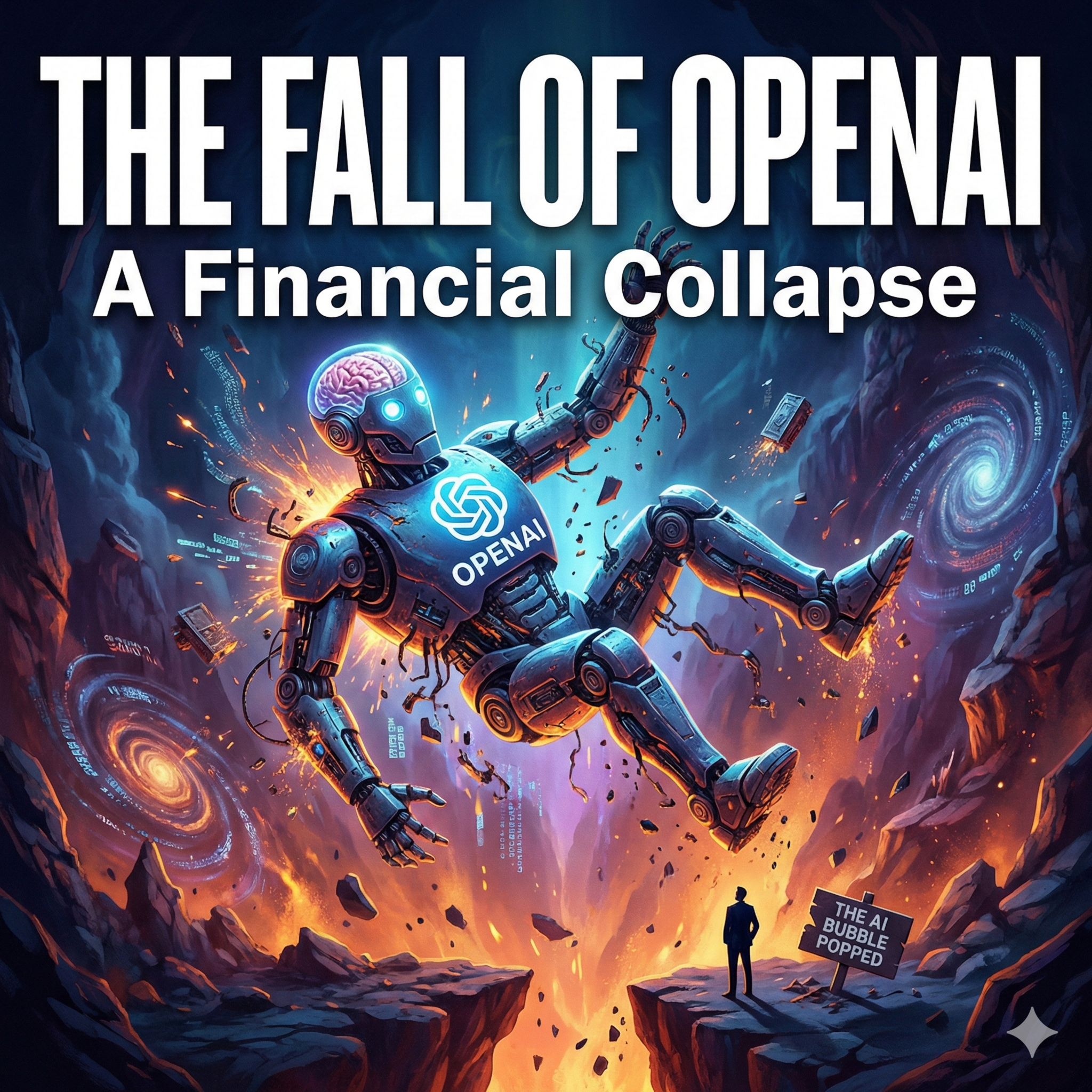
This document synthesizes an analysis of OpenAI's current operational and financial state, revealing a company in a severe crisis. The core findings indicate that OpenAI is facing an unsustainable financial burn rate, with losses accelerating far beyond initial projections, potentially leading to insolvency by mid-2027. This fiscal instability is compounded by significant technological stagnation, where newer AI models like GPT-5 have failed to outperform predecessors, exposing a reality of diminishing returns despite exponentially rising costs for compute and power.
Externally, OpenAI's aggressive infrastructure acquisition has triggered global hardware shortages and price inflation for consumers in RAM, GPU, and SSD markets. Competitively, the company is losing ground to rivals like Google's Gemini, leading to internal "code red" alerts and declining user traffic. The organization is also plagued by internal turmoil, marked by a high-profile exodus of top executives and mounting legal pressures, most notably a multi-billion dollar lawsuit from Elon Musk that is proceeding to trial.
Prominent investors have declared the "AI hype cycle is peaking," labeling OpenAI as "chaos dressed up in a $500 billion valuation." While the company's leadership projects confidence, their statements are contradicted by the overwhelming financial data and even their own admissions of investor overexcitement. The broader societal and environmental consequences of the AI race—from massive energy consumption to the potential for a catastrophic economic bubble—further underscore the precariousness of OpenAI's venture.
--------------------------------------------------------------------------------
1. The Financial Crisis
Analysis of OpenAI's finances reveals a company with an unprecedented cash burn rate and a business model struggling for viability against colossal expenditures.
Unprecedented Cash Burn and Unsustainable Losses
OpenAI is experiencing severe financial hemorrhaging, with losses escalating at an alarming rate.
* Accelerated Losses: The company incurred a net loss of $13.5 billion in the first half of 2025 alone, a figure that was originally projected for the entirety of 2026. This indicates that actual losses are far outpacing forecasts.
* Quarterly Deficit: According to Microsoft's fiscal disclosures, OpenAI lost $12 billion in a single quarter.
* Projected Insolvency: Reports state that at its current rate, OpenAI could run out of cash by mid-2027, within 18 months.
* Future Expenditures: Projections show the company burning through $8 billion in 2025 and an estimated $40 billion in 2028.
* Daily Operational Costs: The video generation model, Sora, costs an estimated $15 million per day to operate. Its lead engineer admitted the economics are "currently completely unsustainable."
The Viability Gap
A significant gap exists between OpenAI's revenue-generating potential and the capital required to realize its vision, casting doubt on its long-term sustainability.
* Revenue vs. Infrastructure Costs: To achieve its long-term vision, OpenAI needs to spend an estimated $1.4 trillion on data centers.
* Bain & Company Analysis: To make this business model viable, Bain & Company estimates OpenAI must generate approximately $2 trillion in annual revenue.
* Best-Case Shortfall: Even under the most optimistic cost-cutting and revenue scenarios, OpenAI is projected to cover only $1.2 trillion of the required $2 trillion, leaving a massive deficit.
* Historical Scale of Losses: Deutsche Bank analysts estimate the company faces $143 billion in cumulative negative cash flow before turning profitable, bluntly stating, "no startup in history has operated with losses on anything approaching this scale."
2. Technological and Infrastructural Headwinds
The company's financial struggles are exacerbated by a slowdown in technological progress and the immense, escalating costs of the required infrastructure.
The Plateau of Progress and Diminishing Returns
Despite massive investment, OpenAI's technological advancements are showing signs of stagnation.
* Failed Upgrades: Large training runs in 2025 reportedly failed to produce models superior to prior versions.
* GPT-5 Disappointment: The launch of GPT-5 was met with "widespread disappointment," with users calling it "underwhelming and horrible." OpenAI was forced to restore GPT-4o within 24 hours due to user preference for the older model.
* The Math Problem: Investor George Noble articulated the core issue of diminishing returns: "It's going to cost five times the energy and money to make these models two times better." This is linked to the slowing of Moore's Law, where each incremental improvement now requires exponentially more compute power and resources.
The Infrastructure Bottleneck
The physical infrastructure required to power OpenAI's ambitions is a source of immense cost and logistical challenges.
* Massive Power Demand: AI's computational needs are growing more than twice as fast as Moore's Law. This is projected to create 100 gigawatts of new power demand in the U.S. by 2030, and nearly 200 gigawatts globally.
* Data Center Costs: This power demand could necessitate $500 billion in annual spending on new data centers.
3. Market Disruption and Competitive Decline
OpenAI's market strategy has caused significant negative externalities for consumers while its own competitive position has weakened.
The AI-Induced Hardware Scarcity
OpenAI's actions are cited as the catalyst for a global shortage and price inflation of critical computing components.
* Market Impact: The company's deal with RAM manufacturers SK hynix and Samsung to acquire a huge percentage of RAM wafers kickstarted a "vicious cycle of hoarding" among other corporations.
* Consumer Consequences: This has led to severe price increases for consumers across essential hardware, as detailed below.
Component Market Impact
RAM A 64GB DDR5 kit that once cost 200-300 now exceeds $1,000. Micron estimates the shortage could last until at least 2028.
GPUs Prices are heavily marked up, with a "5090" model cited as costing $5,000, up from a previous $2,000 price point. Nvidia and AMD are reportedly warning partners of further price increases.
SSDs Top manufacturers are cutting NAND production. An executive from Kioxia stated, "the era of cheap one terabyte SSD is over," reporting their supply is sold out through 2027.
Losing the Competitive Edge
While struggling internally, OpenAI is also losing ground to increasingly powerful competitors.
* "Code Red" Alert: In December of the previous year, CEO Sam Altman sent an internal memo declaring a "code red," telling employees to "drop everything because Google's Gemini 3 is eating their lunch."
* High-Profile Defections: Salesforce CEO Mark Benioff publicly abandoned ChatGPT for Gemini after using it for only two hours.
* Declining User Engagement: ChatGPT traffic fell for a second consecutive month in November 2025, while competitor Gemini jumped to 650 million monthly active users.
4. Internal Instability and External Pressures
The company is facing a crisis of talent retention and navigating significant legal threats that add to its precarious position.
Leadership Exodus and Corporate Turmoil
A significant number of key personnel have departed from OpenAI, signaling deep internal problems.
* Executive Departures: Those who have left include CTO Myra Murati, Chief Research Officer Bob McGrew, Chief Scientist Ilya Sutskever, and President Greg Brockman.
* Team Disbandment: Half of the AI safety team has also departed.
* Allegations of Abuse: Multiple executives have reportedly cited "psychological abuse under Altman's leadership" as a reason for their departure.
Mounting Legal Challenges
A major lawsuit from an early, high-profile backer threatens OpenAI with substantial financial penalties.
* Elon Musk Lawsuit: Elon Musk is suing OpenAI for up to $134 billion.
* Basis of the Suit: Musk provided $38 million in early funding based on assurances that OpenAI would maintain its nonprofit structure. The suit alleges this promise was broken.
* Legal Outlook: A federal judge has ruled the case will go to a jury trial, and the source notes that the case currently appears to be favoring Musk.
5. The Peaking Hype Cycle and Investor Sentiment
Skepticism is growing among investors, who see a widening gap between AI's promise and its reality. This sentiment is contrasted by public statements from company leadership.
A Scathing Investor Assessment
Investor George Noble provided a harsh critique, summarizing the negative outlook on the company and the broader AI market.
* Central Thesis: Noble stated in all caps, "OPEN AI IS FALLING APART IN REAL TIME," adding, "I've watched companies implode for decades. This one has all the warning signs."
* Peak Hype: He asserts that "the AI hype cycle is peaking" and "The diminishing returns are becoming impossible to hide."
* Valuation vs. Reality: Noble concludes that "the gap between promised revolution and delivered reality has never been wider" and describes OpenAI as "chaos dressed up in a $500 billion valuation." This is supported by Google Trends data showing interest in "AI" and "ChatGPT" trending downwards from their peak.
Leadership's Conflicting Signals
OpenAI's leadership maintains a confident public facade, though some statements betray underlying concerns.
* Public Bravado: Sam Altman challenged naysayers, stating he would "love to tell them they could just short the stock and I would love to see them get burned on that." Microsoft CEO Satya Nadella, a key investor, praised OpenAI's "unbelievable execution."
* Private Acknowledgment: In a moment of candor, Altman himself admitted that investors are "overexcited about AI," followed by the stark warning: "Someone is going to lose a phenomenal amount of money." This admission undermines the confident public posture and aligns with critics' warnings.
6. Broader Societal and Environmental Consequences
The pursuit of AI supremacy by OpenAI and its competitors carries significant negative externalities for the environment, the economy, and society.
The Environmental Toll of the AI Race
The resource consumption required for large-scale AI is immense and environmentally taxing.
* Resource Depletion: The AI industry is "overtaxing our electrical generating and transmission capacity," appropriating "hundreds of millions of gallons of water," and driving "unprecedented levels of silicon and rare earth mineral mining."
* Climate Impact: One source warns that the proliferation of massive AI data centers will have a severe effect on the global environment, potentially dwarfing other contributors to global warming.
The "Catastrophic" Economic Bubble
The sources draw a parallel between the current AI investment boom and the 2008 housing market crash, warning of a potentially more severe outcome.
* Systemic Risk: The industry has integrated itself into "critical infrastructure and national security."
* Inevitable Bailouts: It is predicted that when the bubble bursts, these companies will demand federal bailouts, which they will likely receive due to their systemic importance, socializing the losses of a speculative gold rush.
Negative Societal Impacts
Beyond economic and environmental costs, the proliferation of AI is linked to numerous negative societal trends.
* Degradation of Information: The technology facilitates the spread of misinformation and deep fakes.
* Ethical Breaches: Generative AI functions through the use of stolen artwork for training data.
* Decline in Quality: The technology leads to "bloated" software (e.g., Microsoft Windows), and its output is often "far worse than what humans can output."
* Erosion of Human Skills: The reliance on AI is seen as diminishing critical thinking and problem-solving abilities.