As you think about your own leadership, I’m curious if you give yourself the kind of scrutiny you may give your own team members?
In other words, are you allowing the kind of self-reflection where you first identify your own areas of needed growth before asking others to grow?
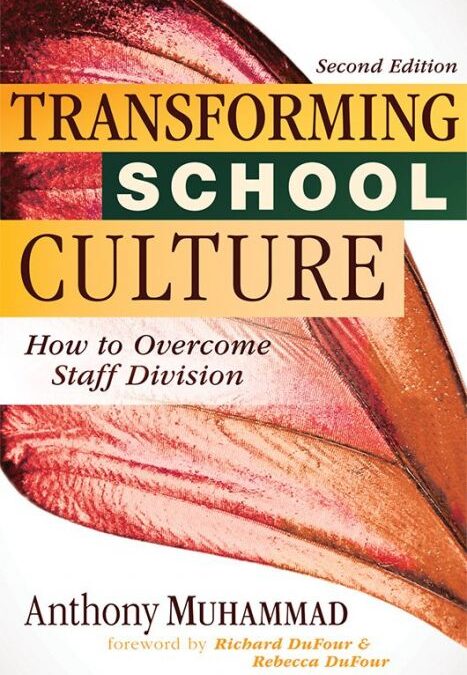
These are the thoughts and questions I had in mind as I finished Dr. Muhammad’s book, Transforming School Culture: How to Overcome Staff Division (Leading the Four Types of Teachers and Creating a Positive School Culture), available now in its 2nd edition from Solution Tree Press.
In this week’s podcast episode, Dr. Muhammad discusses takeaways from his book as well as his reflections on current events, including responses to racism and COVID-19. Listen to the podcast version for full context and feedback in this important conversation!
Anthony Muhammad, PhD, is a much sought-after consultant. He currently serves as the CEO of New Frontier 21 Consulting, a company dedicated to providing cutting-edge professional development to schools all over the world. His tenure as a practitioner has earned him several awards as both a teacher and a principal. When he was principal of Levey Middle School in Southfield, Michigan, his school was recognized as a National School of Excellence, as student proficiency on state assessments more than doubled in five years.
His work has allowed him to work with schools across all U.S. states and throughout the world. Dr. Muhammad is recognized as one of the field’s leading experts in the areas of school culture and organizational climate. He is the author of several books on school culture and education leadership.
WDP: As you study school cultures across the U.S., what do you see as a solution for struggling school systems?
Dr. Muhammad: A great book, Tinkering Toward Utopia: A Century of Public School Reform Revised Edition by David B. Tyack and Larry Cuban, is an analysis of the American public school system from its inception. The infrastructure is solid. It doesn’t need to be dismantled; it needs to be improved. Although many students have great opportunities, those same options are not available for all students. What are the barriers keeping all students from having access to those options? This is where school leaders need to confront the systemic biases that often keep disablied students, second-language students or other margenalized populations pathways to those same opportunities.
WDP: Could you give listeners a quick overview of the four types of educators you identify in your research and the effects they have on school culture?
Dr. Muhammad: How can schools with the same challenges end up with such different outcomes in reaching goals or failing to overcome obstacles? The answers are mainly sociological. The competing ideologies are seen in the cultures and sub-cultures within schools. Who carried the weight of influence determined who had the outcome. Healthy versus toxic cultures depend on four kinds of people:
A fundamentalist can be very skilled but if he or she is selfish, this undermines the goals of the entire school.
WDP: How does a leader move forward when he or she is aware of these types of members on his or her team?
Dr. Muhammad: You must devote time for change. This includes support and accountability. First, you must make sure your team members have the kind of support it takes to change and improve. Second, once you are convinced proper support is present, you hold members accountable for their behavior. Then break this down into three questions:
Once you’ve answered these questions and you still have resistance, then you have authority to require others to move forward together and have enough courage to make it uncomfortable for those contributing to toxic behaviors. When you do, these resistors either change or they will leave. Believers have an obligation to rally together in standing their ground in expecting others to step up and not show sympathy when others refuse to collaborate.
WDP: What reflections do you have personally or professionally in response to the conversations happening in the U.S. and globally about how inequality and racism are affecting our school communities through the lens of your work on school culture?
Dr. Muhammad: Calling for fair treatment is not a new fight. A society that promotes equal protection should not be called extraordinary. It is only reasonable that we expect our government shows fairness to all people. As people are fighting for justice, each community must also work for its own self-efficacy. Petitioning government is one part but so is volunteering, fundraising, etc. Self-respecting communities respect themselves first. Frederick Douglas said, “Power concedes nothing without a demand.” This first begins with ourselves. As self-respecting individuals, we can demand respect from others.
WDP: Any final words or thoughts, and how can listeners stay connected with you?
Dr. Muhammad: COVID-19 has given us all pause to reflect. Don’t waste this moment of introspection. It has made us reevaluate what is important, and it has made us all equal. The same level of compassion we experienced during closure is the same unity we need to bring back to school. Ask yourself how you can make the world better, and take that action.
As you think about your own leadership, where do you fit into the categories of Believer, Tweener, Survivor, or Fundamentalist? Identify your own areas of needed growth, and then through that lens, assess the kinds of categories that exist on your school teams.
As Dr. Muhammad suggests, invest the appropriate time and support to build capacity in others. Then commit to the necessary measures to hold others (and yourself) accountable to the mission of reaching all students.
If you want to stay connected with Dr. Muhammad’s work and resources, check out his website at www.newfrontier21.com.
The post PMP202: Transforming School Cultures with Dr. Anthony Muhammad appeared first on Principal Matters.