Touchpoint maps are often confused with journey maps, much to the frustration of CX professionals. In fact, the word “touchpoint” is so frequently misused, that many CX professionals have an aversion to it altogether. That said, a good customer touchpoint map can serve an important purpose. These maps help teams understand how a customer interacts with a brand. They can be useful complements to journey maps, as touchpoint maps can serve as a the link between the outward-looking perspective of the journey map and the inward-looking perspective of a process map or service blueprint.
First off, it’s important to understand the concept of a customer touchpoint, and how this differs from a customer experience. Touchpoints are the conduits for experiences throughout the journey. They are the channel or mode of interaction, not the interaction itself. For example if a customer is on a journey to get medical treatment and one of the experiences is calling their health insurance company to check on the status of a claim, the experience is calling in, and the touchpoint would be call center. To take things a step further, one could break down the specific touchpoint components within the call center like the IVR system, the agent and maybe even the phone connection itself. These would also be considered touchpoints.
A customer journey is the series of events or experiences that a customer has as they are trying to fulfill some need in their life. Sometimes this need is referred to as a “job to be done”. A Journey map is the visual representation of this series of experiences, presented from the customer’s point of view. (If you are at all unsure about the definition of the terms touchpoint, experience or journey map, be sure to check out episodes 14, 15 and 16, which cover these concepts in detail.)
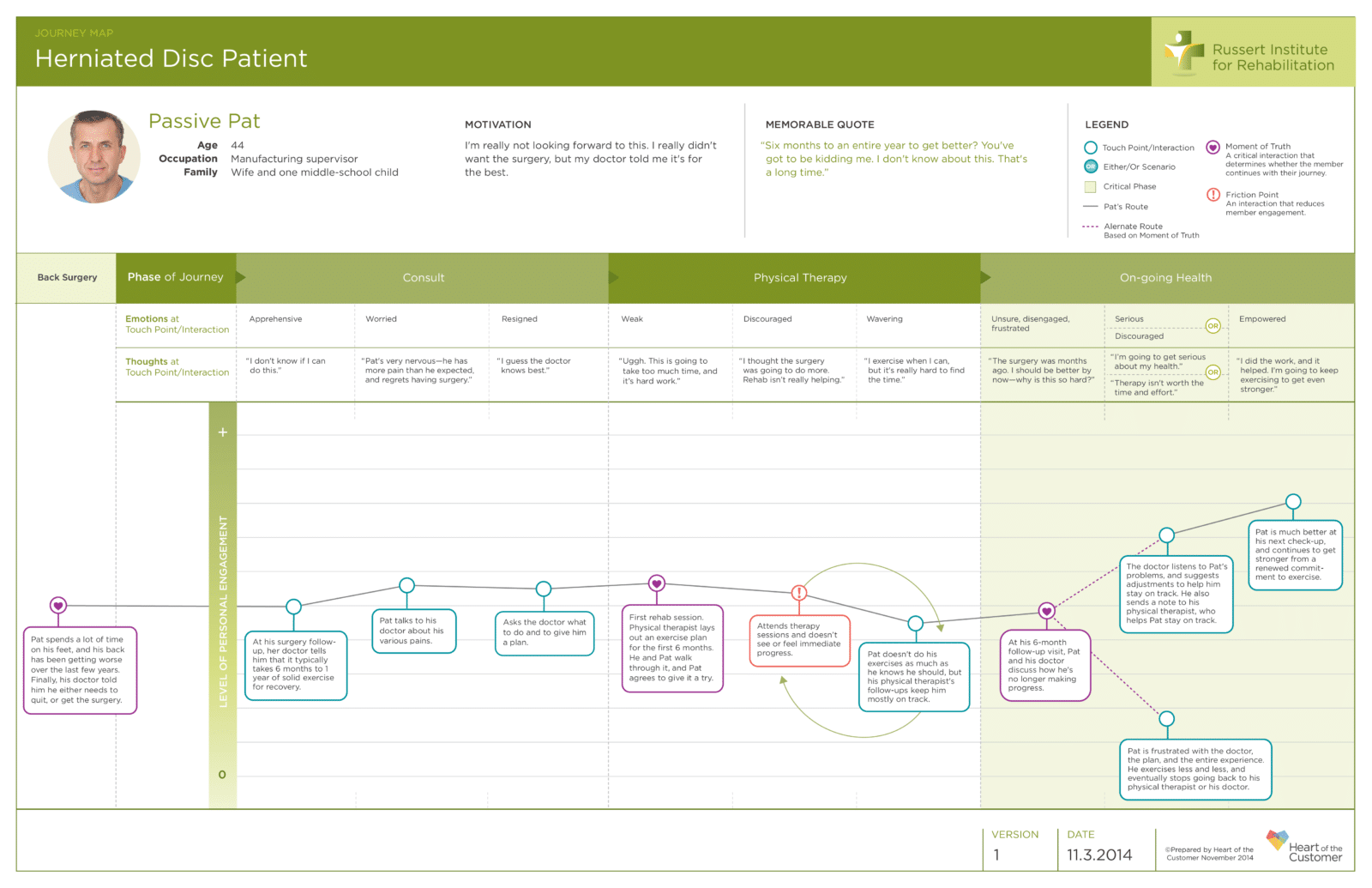
Example Journey map (Source: Jim Tincher)
A touchpoint map is a visual representation of the channels of interaction that a customer interfaces with throughout their journey. To understand the touchpoints you have to first understand the journey. And the touchpoint map is the representation of a customer persona’s journey, not all the possible touchpoint possibilities out there (which would be more of a touchpoint matrix). It’s also not the touchpoints that you want the customer to interface with (which would probably be considered a touchpoint design).
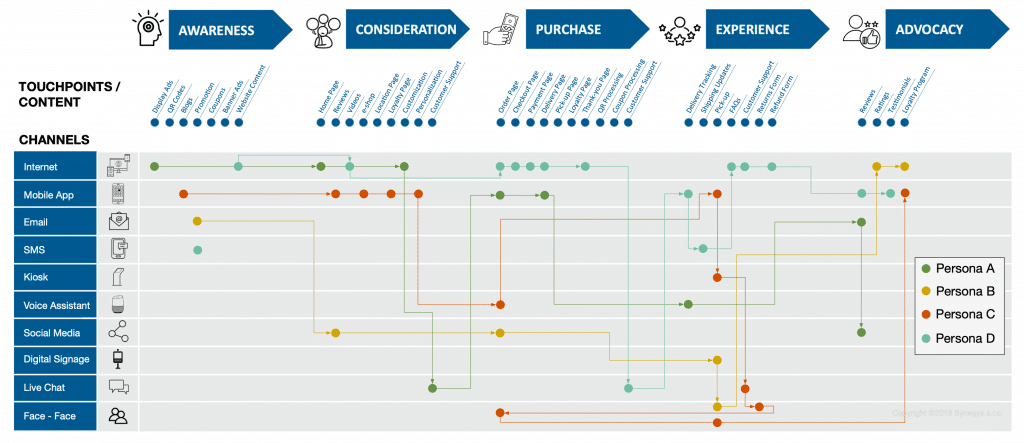
Example touchpoint map (Source: Synegys)
It’s easiest to think about the touch point map as a byproduct of the customer journey map. A team will be best-positioned to build a touchpoint map only after they’ve crafted their journey map. Once the journey map is built, a team can then create an overlay of the touchpoints that a customer interacts with, delving into deeper levels of detail as needed.
When considering possible touchpoints, keep in mind that customer journeys don’t happen in a vacuum, they happen in the real world and so they are rarely isolated to interactions with just one brand. As a result, you may want to include touchpoints that aren’t in your control. In the example of the call to the health insurance company, the customer’s phone is an important touchpoint in the journey, even though that isn’t something that the health insurance provider can control.
Touchpoint maps are surprisingly versatile tools, though most frequently when used in conjunction with other CX artifacts like journey maps and service blueprints. Here are just some of the ways they can be used by CX professionals.
Prefer to read? Here’s the transcript.
Welcome to Decoding the Customer, a podcast about customer experience and how to realize customer-centric change in today’s dynamic business world. I’m Julia Ahlfeldt, certified customer experience professional, business advisor, and host of this program. Thanks so much for tuning in. If you’re new to the show, welcome.
If you’re a returning listener, thanks, and it’s great to have you back. This episode is part of my CX Mini Masterclass series here on Decoding the Customer. These weekly episodes are published each Thursday and designed to be punchy, bite-size overviews of key customer experience concepts and ideas for how you can help your organization thrive through customer centricity. Whether you’re new to the field of customer experience, are preparing for the CCXP exam, or are a seasoned professional looking to brush up on a few basics, this series will help you improve your knowledge, skills, and performance to stand out as a CX professional.
And an added note to those who are already CCXPs. The Customer Experience Professionals Association is now recognizing CX podcast listening towards certification renewal credits. So be sure to jot down which episodes you’ve listened to so that you can submit these towards your continued education requirements. This is episode 82, the fifth episode for April 2020.
This month’s podcasts have taken us on a journey exploring everything from CX maturity to ROI and voice of customer. The last two CX Mini Masterclass episodes have focused on strategies for understanding customers, a critical component to any customer experience management program. And today, I’m going to round out the month with an episode exploring one of the many ways that you can use voice of customer data once you have it. And that’s touchpoint mapping.
Touchpoint maps are often confused with journey maps, much to the frustration of CX professionals. This mix up is so common that I’ve had clients show me what they thought were journey maps, only to have to be the one to tell them that what they actually had were touchpoint maps. As frustrating as it can be to see these concepts confused, touchpoint maps do serve an important purpose. Touchpoint maps help teams understand how a customer interacts with a brand.
They can be a helpful complement to journey maps, since touchpoint maps serve as part of the link between the outward looking view of the journey map and the inward looking view of a process map or service blueprint. CX professionals should be able to distinguish between these two different types of maps and understand each one’s place in the CX toolbox. So, if you’re interested in learning about touchpoint maps, their role in customer experience management, and tips on how to build one, then stay tuned. As always, if you’re out and about while listening to this, and here’s something you’d like to remember later, don’t worry about writing it down.
You can find an overview of the key concepts we’ve covered today in the show notes for this episode, which are on my website, juliaahlfeldt.com, or decodingthecustomer.com. Some of my first CX Mini Masterclasses focused on the clarification of terms like customer experience, customer journey, and touchpoint. These words get batted around in the business world, and when they’re misused, it makes it harder for CX professionals to do their job. If you are at all unsure about these definitions, be sure to go back and check out episodes 14, 15, and 16.
But in essence, a customer journey is a series of events or experiences that a customer has as they’re trying to fulfill some need in their life. Sometimes this need is referred to as a job to be done. A journey map is the visual representation of this series of experiences presented from the customer’s point of view. Touch points are the conduits for experiences throughout the journey.
They are the channel or the mode of interaction, not the interaction itself. So for example, if I’m on a journey to get medical treatment, and one of my customer experiences is calling my health insurance company to check on the status of a claim, the experience is calling in, and the touch point would be the call center. If you wanted to get really granular, you could break down the specific touch point components within the call center. Things like the IVR system, the agent, and maybe even the phone connection itself.
A touch point map is a visual representation of the channels of interaction that a customer interfaces with throughout the journey. To understand the touch points, you have to first understand the journey. The touch point map is the representation of one customer persona’s journey. Not all the touch point possibilities out there, which would be something more of a touch point matrix.
It’s also not the touch points that you want the customer to interface with, which would probably be considered something like a touch point design. When considering possible touch points, keep in mind that customer journeys don’t happen in a vacuum. They happen in the real world, so they’re rarely isolated to interactions with just one brand. As a result, you may want to include touch points that aren’t in your control.
In the example of my call to the health care insurance company, my phone is an important touch point in the journey, even though this isn’t something that my health insurance provider can control. So how do you build a touch point map and when are these useful? I think it’s easiest to regard a touch point map as a by-product of a journey map. After you map the journey, go through each phase or step of the journey and tease out the touch point that’s used.
If you don’t know, go back to your data or go back to the customer and ask. Create an overlay map that just includes the points of interaction. As mentioned before, you can use this map to take things one step deeper and call out more granular touch points that would be way too much detail on a full journey map. Touch points are where the customer interacts with the company which often creates a data trail.
So touch point maps can be really helpful for validating the volume of customers who are having a specific experience. You can then use this to prioritize journey improvements, quantify impact or make the business case for a specific customer experience intervention. You might also use a touch point map to help with your root cause analysis of customer experience pain points. Perhaps the common denominator of several journey pain points is a faulty touch point that just isn’t supporting the experience as it should.
Or maybe you identify that a touch point outside of your immediate control is the source of customer experience issues later on in the journey. Either way, these maps can be helpful diagnostic tools because they strip out some of the complexity and let you hone in on one facet of the experience. A touch point map can also serve as a helpful reality check for business leaders about how many touch points exist and the variation of experiences through different channels. In the corporate world, touch points are frequently managed by different teams, which can result in inconsistent experiences across the journey.
A touch point map can be used to help plan for consistency across channels, maybe by bringing in some standards or experience principles for all touch points. When I interviewed the CEO of Ivoclar Vivadent back in episode 65, he shared that their journey mapping had yielded more than 200 touch points. So as you can see, it’s common to have a lot of touch points, and it’s important to manage these. Finally, when it’s time to start implementing changes to the journey, a touch point map can also be used to start flushing out a service blueprint or the other process maps that support customer experiences.
Again, since touch points represent the channels of interaction, it’s a nice place to start building the understanding of how an organization supports experiences. Each touch point is likely to have a web of teams, processes, and technologies behind it. So as you can see, the touch point map can be a useful link between the outward-looking view of the customer journey map and the inward-looking view of how an organization manages and improves the customer journey. You can use these maps to build the story about the impact of customer experience, to engage with leaders, build plans for delivering the journey, and to vet experience improvement opportunities.
And that’s probably just the tip of the iceberg. If you found another helpful use for touch point maps in your organization, please let me know. I’d love to hear about it. If you’re looking for help turning voice of customer insights into experience improvements, please get in touch.
I’d be happy to explore how I can help. You can reach me via email, tweet, or LinkedIn message. My handle is at Julia Ahlfeldt and my full contact details are also listed on my website, juliaahlfeldt.com or Decoding the customer.com. I hope that you’re enjoying the show.
Please share with others who might be interested or head on over to iTunes and rate the podcast. This helps others find the show. I’ll be back next week with another episode. See you then.
If you’d like to checkout more of these CX Mini Masterclasses or listen to my longer format CX expert interviews, check out the full listing of episodes for this CX podcast.
Decoding the Customer is a series of customer experience podcasts created and produced by Julia Ahlfeldt, CCXP. Julia is a customer experience strategist, speaker and business advisor. She is a Certified Customer Experience Professional and one of the top experts in customer experience management. To find out more about how Julia can help your business achieve its CX goals, check out her customer experience advisory consulting services (including CX strategy, voice of customer and culture change) or get in touch via email.
