 Have you been looking for real Memory Palace examples that will actually show you how this learning technique works in the modern world?
You’re in the right place.
I’ve used the Memory Palace technique to pass university exams, master foreign languages, and even lecture in German while teaching Film Studies at the University of Saarland.
My TEDx Talk, delivered entirely from memory, has been viewed millions of times. I’ll show you exactly how I built it along with a graphic of the exact location.
In fact, you’ll even get a Memory Palace walkthrough filmed inside my own home, so you can see how to structure your journeys for better focus, creativity and long-term recall.
Everything you’re about to learn comes from personally testing more than 300 Memory Palaces for accomplishing many different learning goals. And many interviews I’ve conducted with the most accomplished memory experts in the world.
Ready for the most empowering Memory Palace examples so you can achieve your learning goals?
Let’s dive in.
https://www.youtube.com/watch?v=STlYIiF9RzI
Now that you’ve watched the walkthrough in the video above, let’s take a moment to more closely define the Memory Palace technique.
Seeing this ancient technique in its fullest possible context will help you use this unique learning approach better.
The first thing to understand is that the Memory Palace technique was taught theoretically for a very long time. Ancient guides like Rhetorica ad Herennium had to illustrations.
At best, Aristotle gave a visual example of the stations in a Memory Palace using the alphabet. I show this page in my video tutorial on Aristotle’s Nuclear Alphabet.
Later, during the medieval period, Hugh of St. Victor was said to stand in front of an illustration of Noah’s Ark to help his students understand how to use it to remember aspects of theology. You can read about this history and see illustrations in The Mystic Ark by Conrad Rudolph.
Also note that the Memory Palace technique is sometimes called the Method of Loci. Other people call it the Roman Room technique. Searching these terms can help you find even more examples.
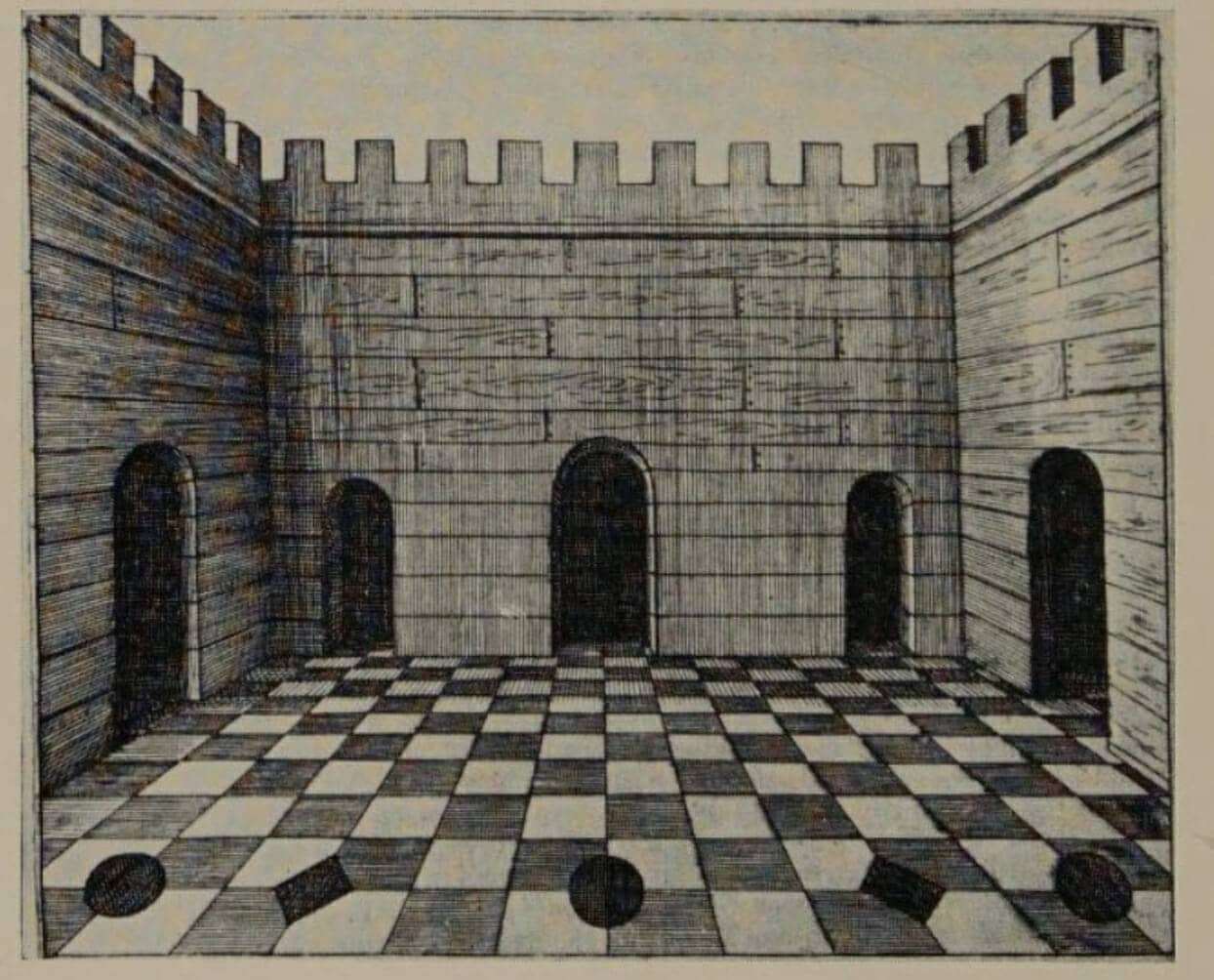
“Memory theater” too, which was one of Robert Fludd‘s preferred terms. Here’s what one of his illustrated Memory Palaces looked like:
No matter what you call it, the technique is based on layering associations along a journey based on locations you remember.
That’s the key.
You’re not memorizing locations for use as Memory Palace. You’re harnessing memory spaces that are already in your memory.
Please pay special attention to this point. Many people think they have to go out and memorize locations in order to use them.
That’s just not true and in fact creates the cognitive load using Memory Palaces helps reduce.
For more details on how to select and develop these learning tools optimally, please refer to my foundational Memory Palace tutorial which goes in-depth on its history and a number of important considerations for getting the most out of the technique.
With these principles in mind, let’s look at our first example.
https://www.youtube.com/watch?v=rWd1KaWFBm0
This kind of Memory Palace involves looking down and through the roof on a building.
You can use:
Just about any location will do.
The basic idea of this approach is to experience the Memory Palace as if you’re looking down at a floor plan.
To create your first Memory Palace in this style, I suggest you quickly sketch it out.
As you can see, I’ve drawn this Memory Palace based on one of my Berlin apartments by hand:
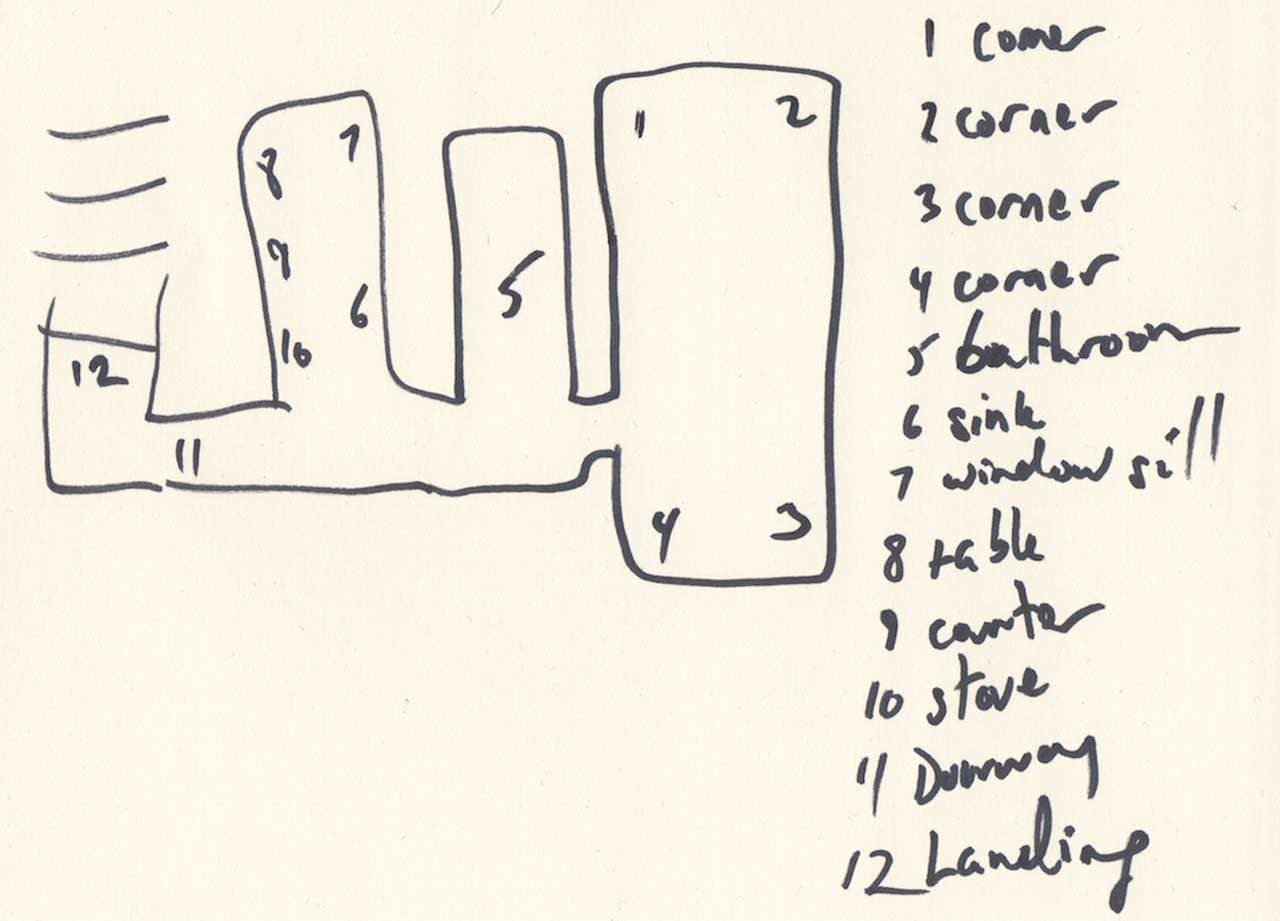
Drawing each Memory Palaces is important because it trains your brain to think about the journey through the building you’re assigning.
A bit of preparation in the beginning will ensure that you can use the Memory Palace much faster once you’re ready to use it to memorize anything, including vocabulary, or an entire speech.
I’m not the only one who draws Memory Palaces.
As you saw above, Fludd illustrated one of the theatres he used.
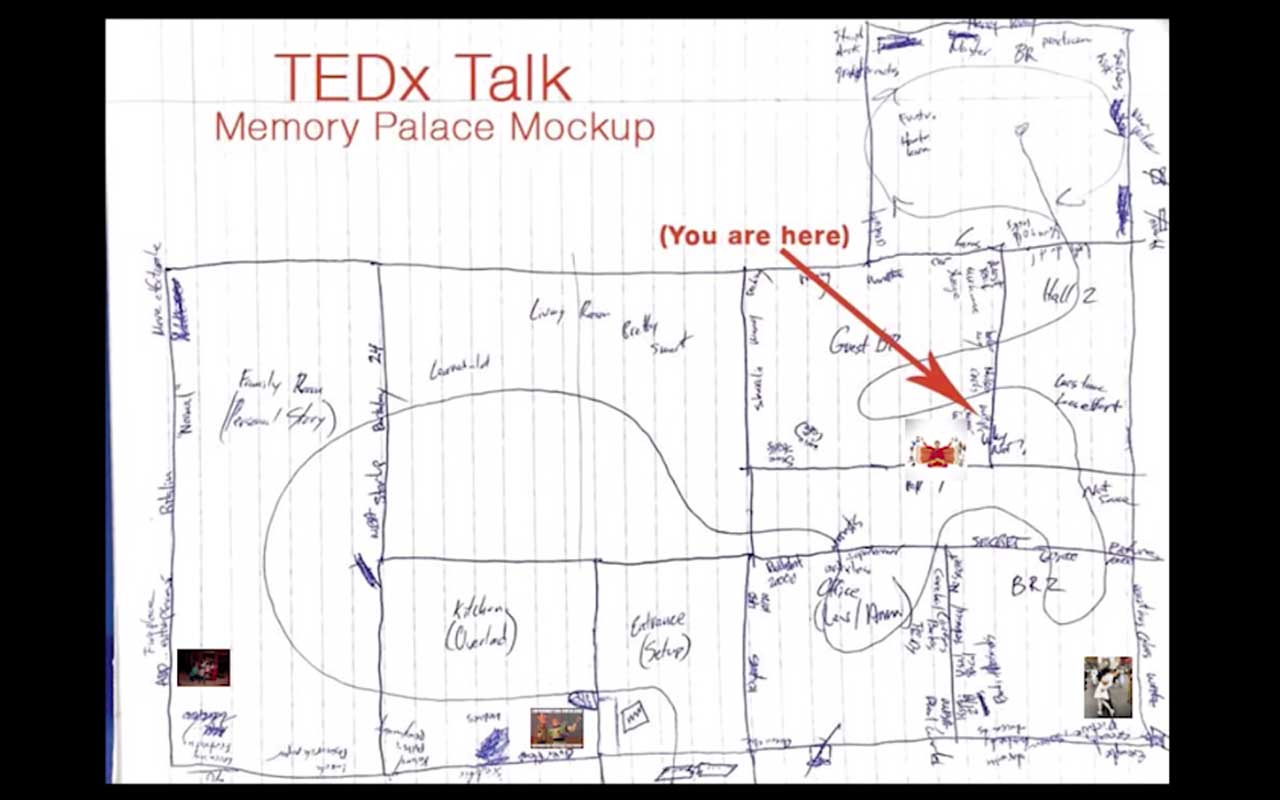
More recently, my friend and fellow memory expert Jonathan Levi shared his hand drawn Memory Palace mockup after I showed him some Memory Palace best practices.
He even showed the Magnetic Memory Method-style Memory Palace he drew from the top-down perspective in his TEDx presentation:
In sum, the process is simple:
If you’re stuck on what locations to use, I have created a giant list of Memory Palace ideas that will help get you started.
If you need help with creating the mnemonic images, these elaborative encoding exercises should be useful to you.
In this kind of Memory Palace, you use an entire university campus.
I found this kind very useful when studying for my PhD at York in Toronto, Ontario, Canada.
And that’s not just because the multiple buildings gave me lots of space with which to work.
It’s also linked to something called context-dependent memory. It shows that you remember more when you closely associate what you need to remember with locations and other aspects of life.
Since I still use York’s campus from time to time, I’ve used an old campus map I saved to craft this detailed video tutorial for you:
https://www.youtube.com/watch?v=z1GwODwffCc
If you want to use the example from my York Campus video tutorial but have never been there, it’s easiest to use the top-down view.
Or you can imagine watching yourself walking from station to station as if seeing the journey through your own eyes and imaging that you’re there.
Let’s explore that option further in our next example.
When using a first person approach, here’s what happens:
You imagine yourself in the Memory Palace, literally seeing the journey as if through your own eyes.
Or, you can pretend to be a character in a video game or movie and see through the eyes of that character.
For example, using an outdoor Memory Palace, I once imagined being this Giordano Bruno statue and navigated parts of Rome that I had previously developed into a small set of Memory Palaces:

Personally, I find this approach draining. But assuming the viewpoint of a character definitely works.
One reason why it works is that you’re using imagined experience as an additional hook.
The best part is that you can switch in and out of this approach while using top-down Memory Palaces.
You can also rotate between multiple roles.
For example, when I memorized the hiragana and other aspects of Japanese, I switched from pretending I was Ezra Pound to Homer Simpson.
This is based on a Magnetic Memory Method Principle I call the Bridging Figure.
Virtual or Imaginary Memory Palaces are usually fictional. This means that they are not based on real locations.
In other words, they are purely imagined, either by yourself or based on novels, movies or video game locations created by someone else.
This approach is not for everyone.
I personally find invented Memory Palaces more difficult than they are worth for my learning projects. Since my goals with Latin and Sanskrit involve a lot of moving parts, I prefer standard Memory Palace for activities like language learning.
But if you want to give imaginary Memory Palaces a try, I suggest listening to memory competitor Idriz Zogaj for some wisdom on using this kind of Memory Palace. You might find his comments useful.
In the meantime, I’ve recorded all my best suggestions for the virtual Memory Palace approach in this detailed video tutorial:
https://www.youtube.com/watch?v=myN7wCWDWCI
This kind of Memory Palace combines a number of mnemonic systems.
At its core, you still take a location you know well and mentally assign specific pieces of information.
But unlike other approaches, you develop well-formed Memory Palaces that do not lead you into dead ends or waste time and mental energy by crossing your own path.
An illustrator helped me visualize my TEDx Talk Memory Palace with this picture so you can see how direct and unfettered a Magnetic Memory Palace can be:

What additionally sets the Magnetic Memory Palace apart are the additional tools I teach in the Magnetic Memory Method Masterclass. Such as:
With these additional techniques working in combination, using each and every style of Memory Palace feels like a game as you usher any information you want to know into long-term memory quickly.
I’ve fielded many questions about this technique over the years.
Here are some of the most frequent with quick answers.
The key to memorizing things faster with this technique is to deliberately train for speed.
Typically this is done by setting goals, benchmarks and using a timer.
It’s also important to embrace all of your sensations while placing associations within your Memory Palaces.
Although the technique is often attributed to Simonides of Ceos, we know from scholars like Lynne Kelly and Tyson Yunkaporta that it’s much older.
Personally, I believe that our species collaborated on the technique and we continue to develop it together. For more on this view, I suggest reading The Knowledge Gene. You might also consider my conversation with Andrew Mayne about the Memory Palace technique in the age of AI.
Not at all. I use locations I haven’t seen since I was 9 years old perfectly well.
That said, some people find it useful to touch the walls of the locations they will use, especially when starting out.
This tactile tip is very old. You can find examples in medieval memory manuals of Peter of Ravenna and Thomas Aquinas.
At a bare minimum, I suggest 26, one for each letter of the alphabet.
At more advanced levels, you can add a second Memory Palace Network to fill out your PAO System.
You can go further still by explore Memory Wheels, an older example of the Memory Palace technique that you might enjoy exploring.
Yes, and a core feature of the Magnetic Memory Method is that I show you exactly how.
By combining methods you can learn more at a faster rate and retain it much longer.
There are many benefits.
For one thing, you get the process out of your head and onto paper.
A lot of people underestimate how draining it can be to work out an optimal journey purely in the mind.
But by sketching out your Memory Palaces, you’re able to chart the journey quickly, logically and in a way that saves you time later. You know exactly where you’re going as you use the technique.
Additionally, you can store your journeys for review in notebooks or on index cards. I draw many of my Memory Palaces on cards so I can easily alphabetize them. Here’s one example of a Memory Palace sketch based on a bookshop in Cairo I use often:
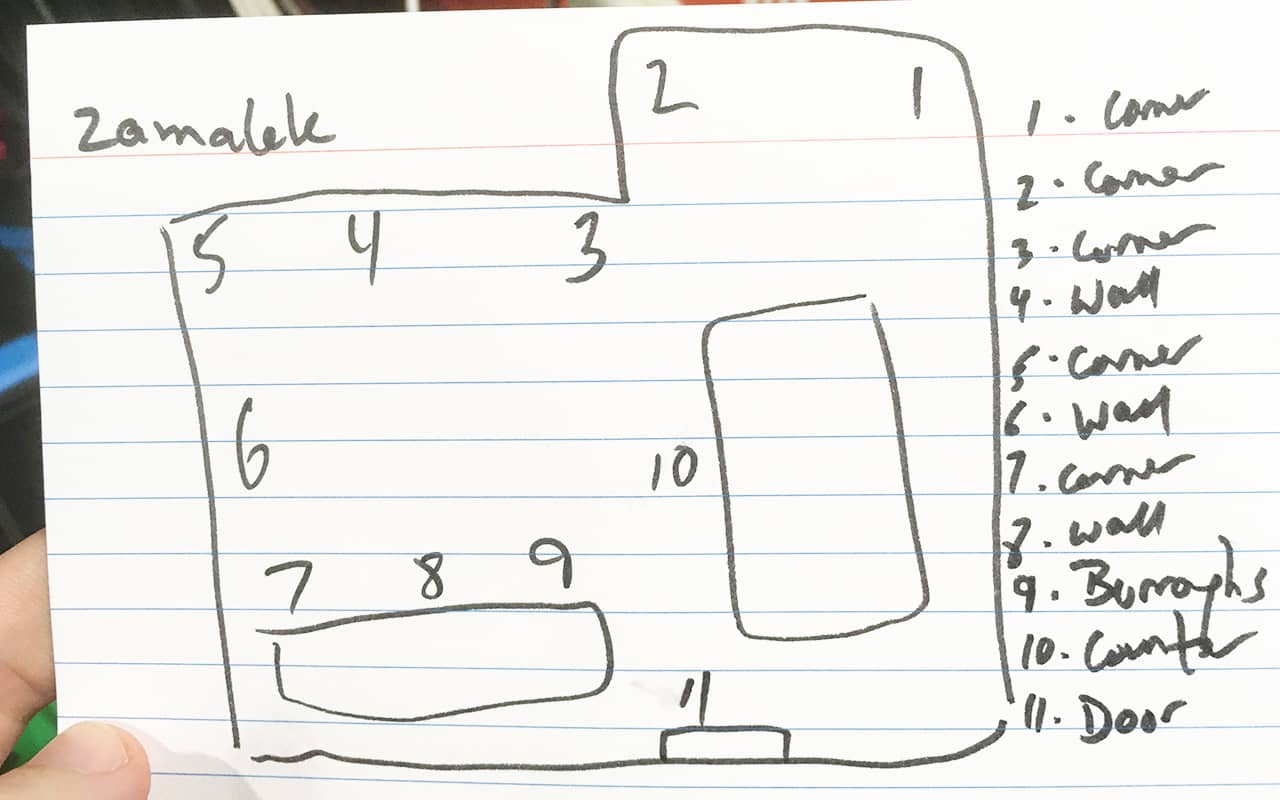
The key is that the location is in your memory and you can easily move from what I call the “terminal station” to an exit.
If you watch the Memory Palace walkthrough video at the top of this page, I show you the logic of why this works so well.
When following these principles, you’ll find that nearly any location that you remember will serve as a perfectly suitable learning tool.
The only exception is that some locations may carry unpleasant personal memories. I’ve talked about this problem in The Victorious Mind and it is possible to cleanse these locations.
But in general, it’s best to choose neutral locations or places you feel positive about.
I suggest that you avoid starting with just one location.
Rather, use the alphabet to help assign a variety of locations you can link with information easily.
I call this approach the “Memory Palace Network.”
You literally develop one Memory Palace per letter of the alphabet.
To give you a quick example, I have a few ‘A’ Memory Palaces. Two of them are based on the homes of friends I know named Adam (once from elementary school, another from university). Another is based on my favorite Apple Store in Brisbane.
I often use my friend Brad’s house for words that start with the letter ‘B.’ I also use the local bakery as another B Memory Palace.
And when memorizing a poem recently that starts with the letter ‘W,’ I used a Woolworths supermarket.
This approach is an advanced form of linking, a technique well worth learning as you develop your mnemonic skills.
And if you’d like more help, feel free to grab my free memory improvement course:

It gives you four clear video lessons and three Memory Palace worksheets to fill out.
For now, the five Memory Palace examples and the full Memory Palace walkthrough video above demonstrate that this technique isn’t some fantastic notion from the past.
It’s a tried and true technique, a living skill that many people still use to this day. I’m talking about everyone from these memory athletes to the many students of mine who have sent in their testimonials.
Adapt the Memory Palace technique for yourself, expand on the core principles through practice and you’ll not only improve your recall.
You’ll change the way you think, learn and interact with information.
An incredible journey awaits.
Enjoy and please let me know how it goes. You next breakthrough is just one well-formed Memory Palace away!