A Memory Palace is a mental map of a physical location (like your home) that helps you recall information with extraordinary accuracy.
It’s a technique used by learners, memory champions and was famously depicted in Sherlock.
Also known as the method of loci, the Memory Palace technique allows you to rapidly memorize names, words, numbers, physics equations, and even images, both concrete and abstract.
Some people even use the Memory Palace technique to help them remember step-based procedures, such as moves in chess.
How does the technique work?
You simply start by:
This simple process creates a “magnetic” link between the place you know and the new information you want to keep, allowing you to retrace your steps and recall the memory perfectly.
Because I know that simple doesn’t always mean easy, I recorded this Memory Palace walkthrough in one of my homes. In a detailed example using something complex I successfully memorized using this location, I show you exactly how the technique works:
https://youtu.be/STlYIiF9RzI
Now that you’ve taken a tour of a real Memory Palace used for multiple learning goals, let’s get you started with how to use the technique.
Personally, this technique saved me during my PhD.
During the dark Canadian winter of 2003, I found myself suffering clinical depression, anxiety-induced memory loss and was so overwhelmed, I nearly dropped out of my graduate program.
But thanks to learning use Memory Palaces properly after a brief period of confusion created by reading books written by memory competitors, I passed multiple language exams, both my field exams and my dissertation defense.
I did so well that I not only graduated. I also won a Mercator Guest Professor aware and wound up getting to teach Film Studies in Germany.
I’ve since taught the Memory Palace technique to thousands of people. From students memorizing scripture and speeches to professionals mastering vocabulary and entire books, it’s been a blessing to show others the way.
Not only that, but as I told journalist Rebecca Barry when she interviewed me for the New Zealand Herald’s Viva Magazine, the Memory Palace is far more engaging (and more effective) than rote memorization.
Sure, modern tools and “apps” can store information for you. But they can’t help you recall complex information when it counts. And using technology instead of your imagination can get quite boring.
That’s where the Memory Palace excels. It’s endlessly entertaining in addition to being incredibly effective.
So if you’ve ever blanked on an exam, forgotten a name, or wished your mind were sharper, you’re in the right place.
Let’s look deeper at how to apply this special learning technique to any topic you want to master.
https://youtu.be/c4J5ZUzCxZY
As you’ve seen, the basic idea behind the Memory Palace is simple. You associate pieces of information with locations that you are very familiar with.
Let’s look at the process in greater detail along with a number of illustrations, examples and case studies based on my personal use and those of my students.
Many people base their first Memory Palace on their home.
But you can also build Memory Palaces based on:
It’s also possible to use parks, highways and other outdoor locations. This outdoor approach is sometimes called the journey method.
Generally, I advise that beginners start with buildings. I make this suggestion because the walls, hallways and other features of buildings give your mind a kind of scaffolding to hang onto. This is especially important for people new to using visual memory techniques.
You might not be used to imagining things, so giving yourself the solidity of an actual building you’re familiar with will reduce the cognitive load involved in using the technique.
You can also approach the Memory Palace in a non-visual way, as shared in this tutorial.
As you’ll discover by going through the steps, variety is the key.
For example, some of my Memory Palaces are based solely on interior locations. Others are exterior.
The Memory Palace I used for my TEDx Talk was built from both interior and exterior locations, all based on the fundamental steps you’re about to learn.
Try this simple exercise:
Close your eyes and picture a room in your home. Your bedroom or a living room like the one you see pictured below is a great place to start.
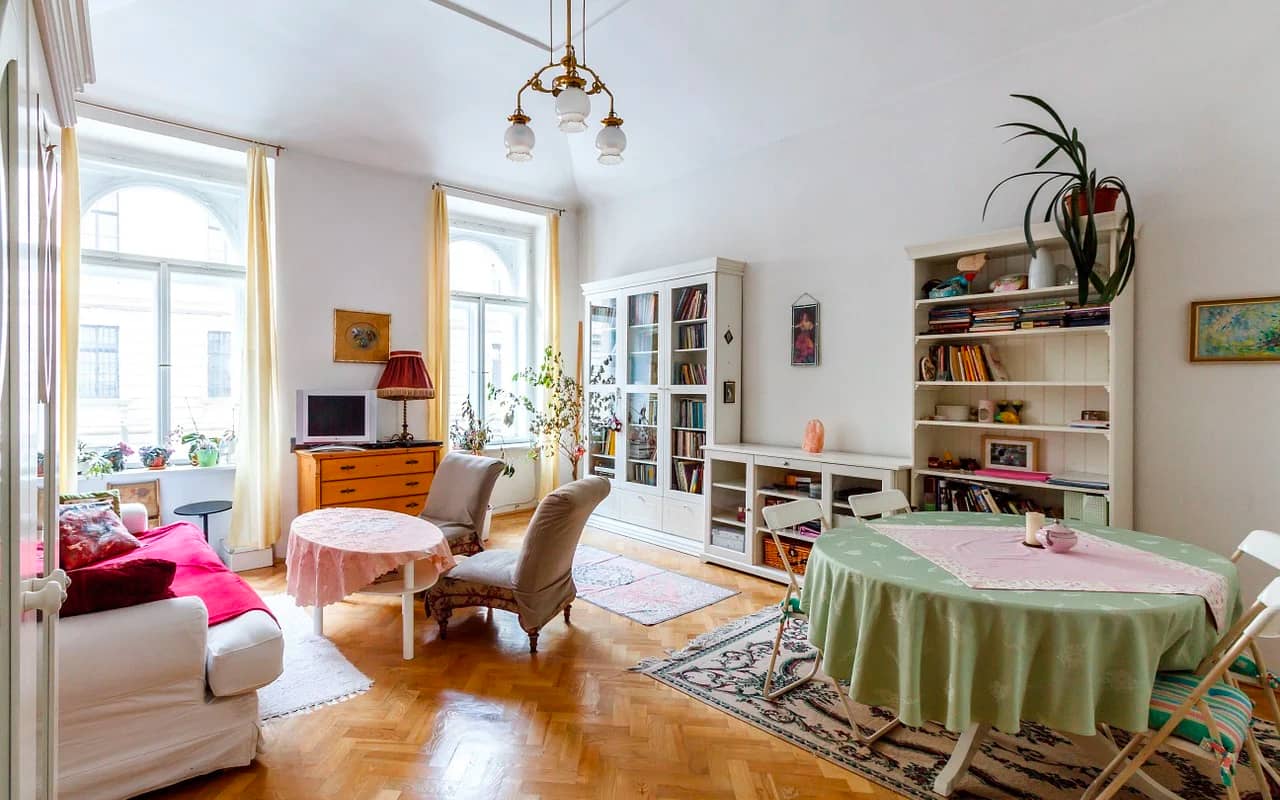
If you’re like most of us, you can probably picture your home with a decent amount of detail. You know where the furniture is found, what colors the walls are, and even where small objects are placed.
Congratulations! You’ve just started the first step of developing your very own Memory Palace. You can start assigning a journey through your first Memory Palace.
To give you a clearer idea of what such a mental journey looks like, here’s a picture of me in a Memory Palace I used to memorize some song lyrics. By following a linear path based on the location of the walls and furniture, it was easy to place associations that helped me recall the words of the song.
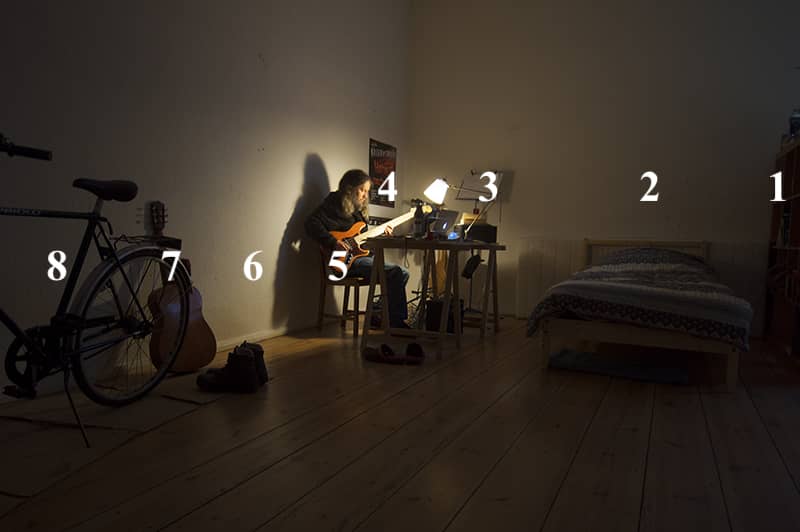
When just starting out with the Memory Palace technique, I suggest that you draw out a simple journey through the first location you choose by hand.
This simple step will help you quickly decide exactly how you will move through the Memory Palace in order to place associations. It will also reduce the cognitive load that you might experience if you’re new to using techniques like this.
Planning like this also draws upon Abraham Lincoln’s well-known wisdom:
Give me six hours to chop down a tree and I will spend the first four sharpening the axe.
This is exactly what I’m suggesting you do: spend a few minutes planning out your Memory Palace in detail by sketching it out and you will save time later when you use it to encode information int your long-term memory.
Finally, drawing or sketching out your Memory Palaces will help you avoid “Memory Palace renovation” later.
So that you know what I’m talking about, here’s an example based on one of my many personal Memory Palaces (here are several more Memory Palaces examples if you like):
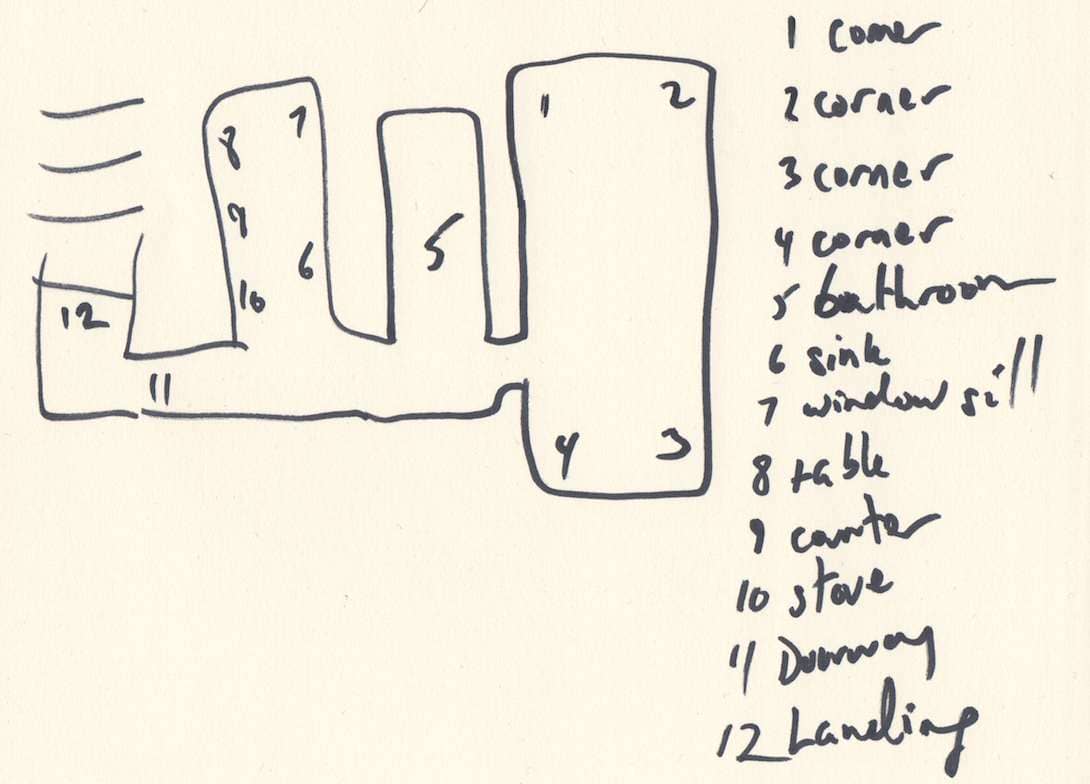
The kind of Memory Palace plan above takes most people only a minute or two to sketch out. Please note that it really is just a sketch. We’re not talking about artistic skill. Just a quick sketch that will save you a lot of time because you won’t have to fix things later if you realize that you’ve accidentally led yourself into a dead end.
Now, over the years, people have emailed and explained that for health reasons, they’re not able to draw Memory Palaces. If that’s the case for you, here’s a detailed tutorial with suggestions on how to build a well-formed Memory Palace if for any reason you can’t or don’t want to draw them out.
It’s easy to go overboard when designing a Memory Palace.
To avoid issues, I suggest that you use only the parts of the location that are clear to you. It’s okay to leave out entire sections of a location.
In other words, if you’re murky about how a basement looked, I would suggest leaving that part of the building out of the design. Less is more when using this technique.
To make things even simpler, set up a linear journey that lead from the first station in your Memory Palace to the final station without crossing your own path. Just as you wouldn’t confuse yourself while walking through a real location, you want to follow a logical path in your mental version of the location as well.
When crafting my Memory Palaces, I like to number the stations for two reasons:
The final option is an intermediate/advanced memory skill. But there’s no reason you can’t prepare to be able to use it as a beginner starting now.
Here’s another example of a numbered Memory Palace I prepared for one of my long-form Sanskrit memorization goals:

Before putting information into your Memory Palace, navigate it a few times.
Exactly how many times is up to you, but I’d suggest at least five times so you’re really familiar with it.
As a best practice, find a quiet area. Close your eyes and start at the first station.
Move in a deliberate way from station to station in the Memory Palace to make sure each station is clear to you.
It’s okay to refer back to your drawing while practicing. That’s yet another reason why I strongly recommend you go through the simple planning phase. The exact journey you decided upon will be there for you to refer to if you need it.
As you’ve learned, the Memory Palace helps you associate information with specific areas within a familiar location. Laying out your associations is done using mnemonic images.
As you mentally walk through a location you’ve prepared, exactly how you place pieces of information and link them to associations simply involves using your imagination. Later, when you want to recall the information, you revisit your mental route, and the information will be easily accessible.
The technique is made more effective when you add surprising or out-of-the normal features to your associations.
For example, let’s assume you want to memorize this sequence of words:
To make the process concrete for you, have a look at this illustration:

There’s a hero on the first station of this Memory Palace.
But there’s a catch. The word “hero” is a bit vague.
And so is the image in this illustration.
In my imagination, it’s actually a specific hero (Superman) and he’s engaged in wiping his boots on the floor.
To increase your ability to memorize and retain any piece of information, your brain needs to make each association more interesting.
You can do that by making it distinctive or unusual, such as with my example of Superman wiping his boots on the floor.
Memory experts call this simple process of making associations for striking “elaboration” or elaborative encoding. To elaborate any association in your Memory Palace:
For example, you could imagine the hero in your Memory Palace banging his feet on the floor. Really exaggerate the image, so much that you can hear the banging and even smell the wood as the floor breaks apart.
There’s another way to make each association even stronger. This method also helps you remember more than one item at a time.
For a word like hero, you can add Hercules to the association you place in your Memory Palace. Because the sound of Hercules’ name and the word hero are similar, you can easily make the image sillier and more striking.
Let’s extend the example further for the next word on the list.
When you think of the next station in your Memory Palace, imagine that there is suddenly a drill next to the hero.
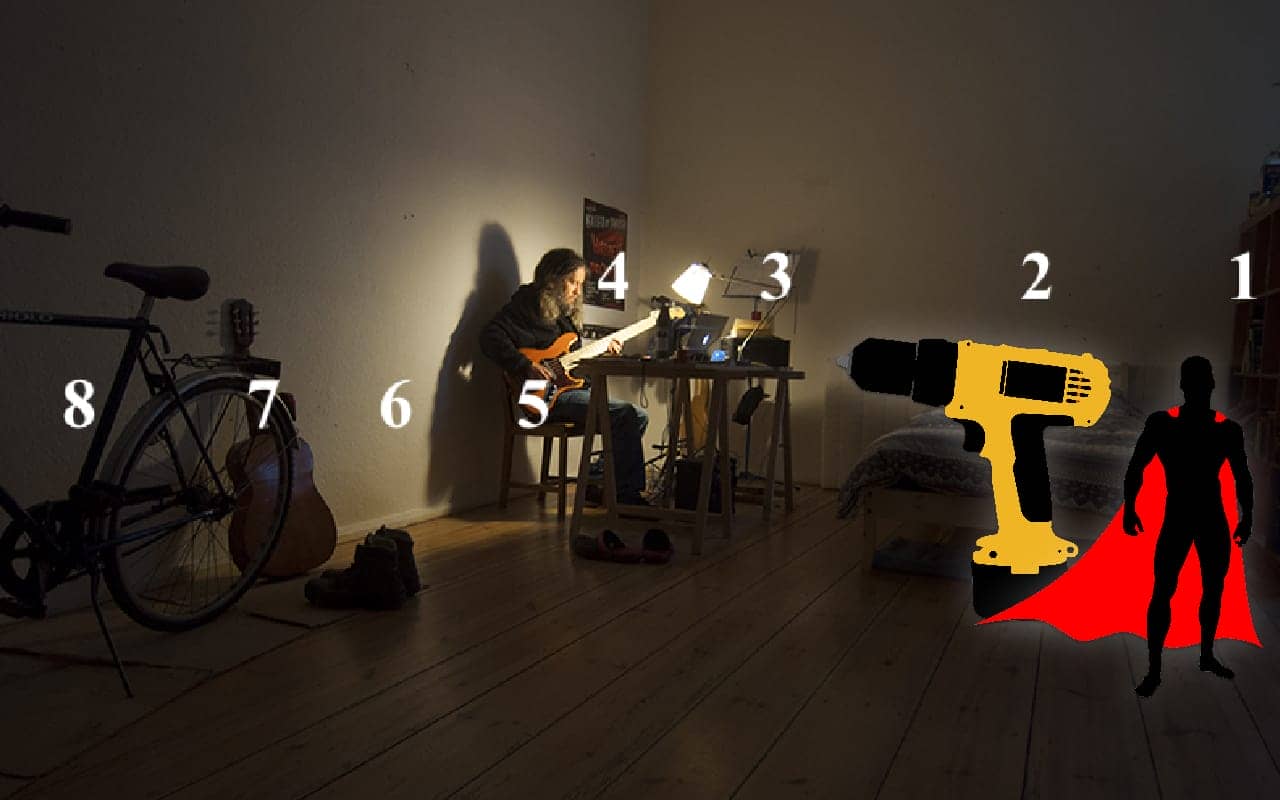
To increase the power of this mnemonic imagery, use the elaborate technique we just discussed. For example, you could imagine that the drill is turned on and you have to leap over it to avoid being hurt.
If you want to practice, memorize the example words for yourself.
Once you’re done with hero and drill, use your third station to imagine a spacecraft flying around inside your Memory Palace. You can elaborate the association by exaggerating the movement of the spacecraft, or have it do something silly, like leave a trail of glitter.
Here’s a summary of the main steps above with a few additional details:
In addition to using the Memory Palace journey to help you trigger associations to call back whatever you want to memorize, you can link your associations within the Memory Palace.
In other words, you can have the hero throw the drill at the spaceship.
As I share in my post explaining how I memorize names at events, I use the room we’re in as the Memory Palace. Then I use associations that “link” together to make it faster and easier to recall all the names.

These are just a few examples. The trick is to select what you want to memorize and then start to explore how the technique works by coming up with associations and laying them out in your imagination.
It’s okay to make mistakes as you learn the technique. Just get curious about what you could do better and review the basic instructions to see if you’re missing any of the key steps.
Once you have one Memory Palace, you’re ready to create more and even link one Memory Palace to another.
Here’s a tutorial showing how to do that, including some processes that will help you “teleport” or shift from one Memory Palace to another with ease:
https://www.youtube.com/watch?v=7RzQzqauhhM
As we’ve seen, the Memory Palace involves assigning stations in familiar locations.
Then, you take what you want to memorize and elaborate it by combining or pairing each piece of information with an association.
Over the years, many people have asked me questions like:
Here are some rapid fire answers to these common questions.
I have some Memory Palaces with hundreds of words. For example, as I discussed in my TEDx Talk, I’ve memorized dozens of Sanskrit phrases as part of my researcher into the connection between memorization and mindfulness.
Generally, I like to let the project itself decide how much information will go inside each Memory Palace. The key is to get started and develop your own “mnemonic style” with using this technique.
When it comes to “attaching” or “connecting” information to your stations, this is why I draw my Memory Palaces. The Memory Palace is always based on a location that is already in memory. The drawing helps me settle on the exact path I’ll follow. Then, I just have to stick with that path. In other words, the path itself is the connecting factor and the Memory Palace is like a piece of canvas I’m painting on.
To expand or extend any Memory Palace, you certainly can open up drawers or cupboards to place more associations and remember more. Renaissance mnemonists likes Giordano Bruno and Robert Fludd talked about tactics like these.
In my personal experience, I have not found this approach particularly useful for most learning goals. Still, if you think it might be fun and useful to extend your Memory Palaces in this way, I encourage you to experiment with the strategy.
You might be wondering if it will help to choose a Memory Palace that relates to the content that you want to memorize.
For example, many people wonder if they will get better results by using a biology classroom for memorizing anatomy? Or would it be any easier to use a church as part of memorizing a prayer? Or would it help to memorize foreign language vocabulary related to cooking using a kitchen?
These are great questions and some research on context-dependent memory does show that you can expect a benefit by pursuing such an approach. I certainly found it helpful to use many of the buildings on York University campus while studying there as the source of my Memory Palaces.
By all means, make use of thematic connections. However, you want to be so good with using the technique itself that you can use any Memory Palace to commit any type of information to memory at any time.
Yes, and I do this quite a bit. It’s especially useful for committing information during conversations.
Because spontaneous Memory Palace generation is a slightly separate skills, I’ve created this tutorial on how to create Memory Palaces on the fly, such as in restaurants while dining. Or while walking through parks. In fact, you’ll see in this video tutorial how I spontaneously create a Memory Palace in a park to memorize the names of seasons in Chinese.
https://www.youtube.com/watch?v=XpZHPG3KrhM
This is a great question because some people worry that the Memory Palace technique is only good for memorizing lists.
Fortunately, this objection is easily removed when you realized that everything you want to memorize follows time’s arrow. So it’s all list-like in the end.
With that point in mind, here are some advanced application tutorials:
This concern is so common, I created this detailed video tutorial on how to find countless Memory Palace options:
https://www.youtube.com/watch?v=Wn05eskjIFg
In addition to all the possible options for your Memory Palaces that I listed above, I’m confident you’ll find that you never run out of options for using this wonderful memory technique.
If you’re still struggling to find viable options, check out this list of additional Memory Palace ideas.
Another option is to learn how to make use of the same Memory Palaces several times over. Let’s discuss this strategy next.
A lot of people ask me about using the same Mind Palace a second or third time.
It is possible, but the precise process can be more than a little finicky. To explain what I mean, please check out this thorough video guide on the topic:
https://www.youtube.com/watch?v=Umt-innA-u8
As you can see, not even the most skilled memory experts reuse Memory Palaces. If you set yourself up correctly, it’s not really necessary.
That said, doubling up does make for great brain exercise, and that’s usually the way I treat the practice. I think it might have helped me experience a breakthrough with aphantasia, actually.
But what this question has taught me the most over the years is that many students of memory improvement put the cart before the horse. They worry about advanced skills before they’ve mastered the fundamentals – advanced skills that the pros have already determined might be great, but aren’t really worth using.
I recommend that you use at least a dozen, if not two dozen Memory Palaces to get the hang of how they work before worrying about reusing them. Following that principle helped me succeed when I innovated a way to reuse them with greater ease. Here’s a case study that shows you what I mean.
Have a look at this Memory Palace example based on a neighborhood called Kelvin Grove in Brisbane, Australia:
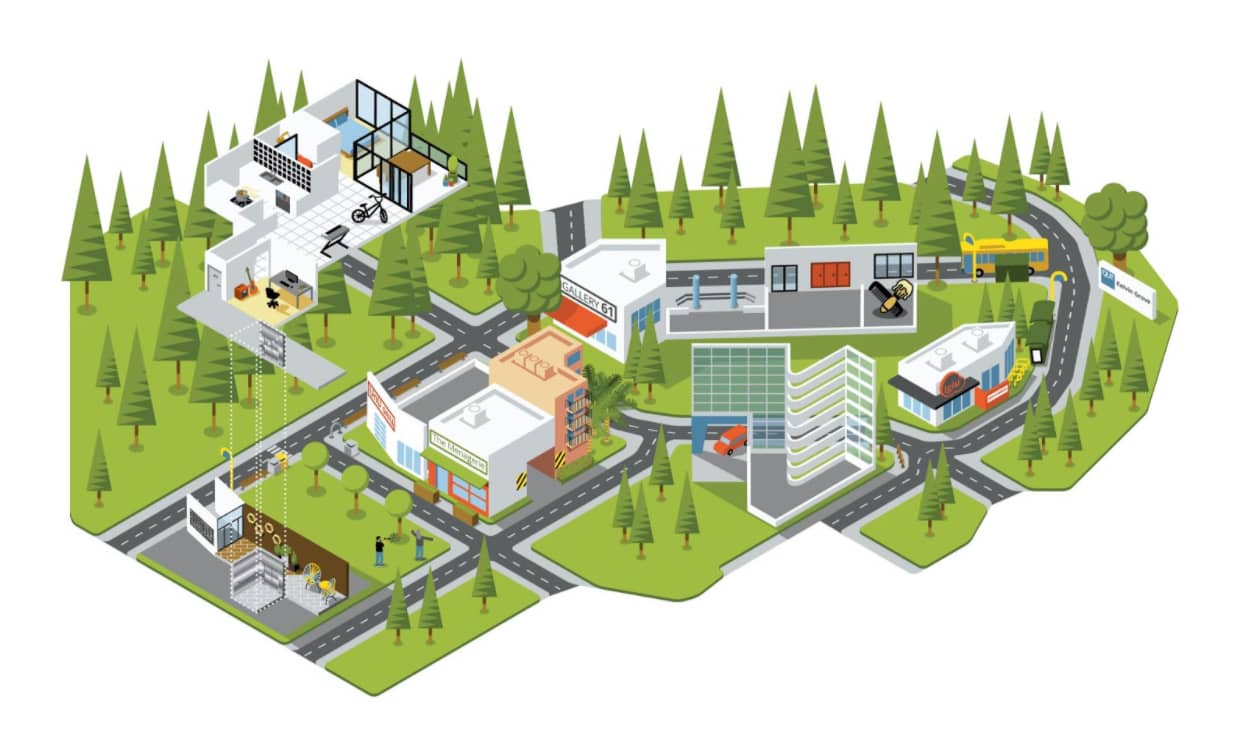
I’ve used it three times for memorizing:
Frankly, I did manage to pull this off successfully and am very happy with the results. But if I were to do it again, I would not use the same Memory Palace over and over again. Certainly not for something important as a TEDx Talk.
Although the following issue hasn’t happened to me, some people have issues with moving the furniture around in the rooms they base their Memory Palaces on.
In most cases, this shouldn’t be an issue once you have the fundamentals of this memory technique mastered. To do that, please make sure that you devote yourself to the loci method thoroughly and completely. It will serve you well for the rest of your life.
But another option is to simply not use furniture at all. If you look at the Kelvin Grove Memory Palace example above, you can see that most of it involves streets. In the few rooms that I did use, my loci were mostly the walls and corners.
I think of street corners and the architectural foundations of Memory Palaces as “Eternal Stations.” They’re very unlikely to change in the future. Using them makes this mnemonic method much more stable over the long term.
Some people assume that this technique requires a vivid visual imagination. This is not correct and not the experience of my students or memory champion friends. That said, you can’t blame people for confusing iconic memory with the fantasy of photographic memory.
When done correctly using all of the Magnetic Modes, you can memorize a very large amount of information relatively quickly without necessarily seeing the Memory Palace in your mind.
Here’s an infographic to teach you all about the different ways that your brain perceives information in a multi-sensory way:

Keeping the full range of the Magnetic Modes in mind, you can use any home or location with which you are familiar.
You can even use small areas, such as the inside of a broom closet. You can even use your own body, attaching information to different limbs.
Just keep in mind that you don’t necessarily have to see the Memory Palace. You can feel it, hear it, taste it, smell it and even just think about it. I’ve even gone through some of my Memory Palaces and touched the walls I’ll be using to help make them more substantial in my imagination. This simple action has helped me a lot over the years.
For example, when I was asked to memorize some Shakespeare in real time on the Guru Viking Podcast, I used a Memory Palace I have interacted with physically many times. This level of mental processing helped make the memory demonstration successful. In fact, I recalled the lines I was asked to memorize from Julius Caesar perfectly.
If shifting from a visual to a multi-sensory Memory Palace seems odd, let me add a few more details. They will help you understand how seriously well this technique works when you add more levels of sensory elaboration.
Many studies have been conducted to analyze the effectiveness of the Memory Palace. It’s all based on the scientific fact that your brain and spatial memory perceive space as a kind of image. Space itself is a kind of sensory experience, so it’s well worth focusing on.
Check out this lecture with memory expert Stephen Kosslyn for more information about how that works:
https://youtu.be/FkhU7i8hRK4
Cool, right?
The answer is a resounding “yes!”
And it gets even better. In 2020, researchers Dr. David Reser and Tyson Yunkaporta conducted a study at Monash University with medical students. Using an Aboriginal variation of the Memory Palace technique, they demonstrated that learners equipped with this learning method recalled far more than students who did not.
Many people have asked me over the years to suggest alternatives to the Memory Palace technique.
Of course, you can just use raw mnemonics to create associations and not locate them with reference to a building.
The problem with doing that, however, is that you remove a strong link that will help you think back to the target information.
That said, certain practitioners of the technique, especially in the Renaissance discussed using geometrical shapes as Memory Palaces.
Here’s a full video tutorial on these approaches:
https://youtu.be/HAPwOf31N7o
One thing to observe when using geometrical shapes, is that a triangle is reflected in the letter A. Circles show up in the letters B and C, etc., suggesting that you can turn the alphabet itself into a kind of Memory Palace. In other words, all information is inherently spatial.
In my experience with exploring and experimenting with these alternative approaches to the Memory Palace technique, they help strengthen your understanding of traditional Memory Palaces.
But when it comes to using the technique to passing exams or learning languages, I do not play around with abstract Memory Palace. I stick with the fundamental approach that has served our ancestors for thousands of years. I recommend that you do the same.
Over the years, some people have written to me that memory athletes and mnemonists must be smarter or have higher IQs than other people.
I don’t believe memory competitors are smarter or have bigger brains than the rest of us. It’s that they use mnemonics, and specifically the Memory Palace to memorize semantic information.
And they practice deliberately. That is the secret behind their impressive abilities. And because people who practice for a long time learn more about the techniques they’re using, that explains why they become really good (Maguire et al 2002).
This simple observation suggests that anyone with average abilities can use this technique to improve his/her memory. And scientists have shown that it’s well worth taking up the Memory Palace technique as a lifetime practice, especially when you consider the research on memory training with the elderly.
And once you know the drill, it’s really just a matter of spending some time with a few solid Memory Palace training exercises. Like the four I’ve shared in this video tutorial:
https://youtu.be/px1O-j3BIHo
Even if you are not seeking to learn large amounts of information, the Memory Palace still has something to offer. There’s even more evidence that the Memory Palace can help maintain a healthy brain during old age if you’d like to follow-up with the additional scientific references listed below.
As my student Sunil Khatri has shared on this episode of the Magnetic Memory Method podcast, the Memory Palace technique helped him master Japanese.
Personally, one of my favorite ways to practice the Memory Palace technique is to memorize playing cards, specifically for performing card magic. Whereas I used to practice the Mnemonica Stack, I’ve recently memorized the Redford Stack and am having a ton of fun with that.
It only takes me 2 minutes and 30 seconds to memorize a deck. And with a little practice based on how memory actually works, I’ll bet you can go even faster.
Ready to get started mastering the Memory Palace technique so you can enjoy learning more based on the spatial and multi-sensory nature of your mind?
Let’s do this thing!
Bower, G. H., “Analysis of a Mnemonic Device: Modern psychology uncovers the powerful components of an ancient system for improving memory” American Scientist, Vol. 58, No. 5, pp. 496-510, September–October 1970 Web. 21 Jan. 2016..
Engvig, Andreas, Anders M. Fjell, Lars T. Westlye, Torgeir Moberget, Øyvind Sundseth, Vivi Agnete Larsen, and Kristine B. Walhovd. “Effects of Memory Training on Cortical Thickness in the Elderly.” NeuroImage 52.4 (2010): 1667-676. 1 Oct. 2010. Web. 22 Jan. 2016.
Fan, Shelley. “Can a Mnemonic Slow Memory Loss with Age?” Scientific American Blog Network. 20 Mar. 2014. Web. 22 Jan. 2016.
Maguire, Eleanor A., Elizabeth R. Valentine, John M. Wilding, and Narinder Kapur. “Routes to Remembering: The Brains behind Superior Memory.” Nature Neuroscience Nat Neurosci 6.1 (2002): 90-95. Web. 22 Jan. 2016.
Want to Become a Mnemonics Dictionary? 5 Powerful Secrets Revealed!