What if a child repeats questions instead of answering?
What if they quote lines from a show or movie?
What if they repeat things that they have heard others say?
Well, this is called “echolalia” and it’s how some children learn language!
This page explains what “echolalia” is (when children repeat others instead of using their own words) and how we can help these children through speech therapy and home practice ideas.
Echolalia Meaning: Echolalia is the term used to describe when a child repeats or imitates what someone else has said or what they have heard from a show, movie, or toy.
Echolalia Examples:
Immediate Echolalia: Sometimes a child repeats your question instead of answering it. If you say, “Do you want a cookie?”, the child says “cookie” instead of “yes”.
Delayed Echolalia: This other type of echolalia occurs when the child repeats something he has heard before even though he did not recently hear it. For example, a child may repeat a line from a favorite movie even though that movie is not playing currently. Or, he may repeat a sentence he has heard before in specific situations, such as “do you want it?”
Children learn to navigate the world around them by repeating what they hear and see. It’s how we’re programmed.
All children repeat language they’ve heard when first learning to communicate.
Some children then move on to a phase where they speak single words to communicate with us (ex: “mama” or “up”).
Other children, however, continue to communicate with us using this imitation, or echolalia, by imitating whole chunks of language that they have heard previously.
Did you know that there are two ways that children acquire language?
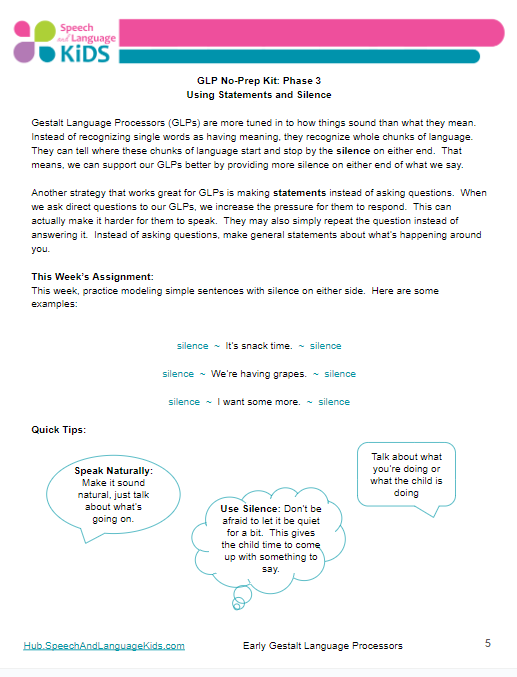
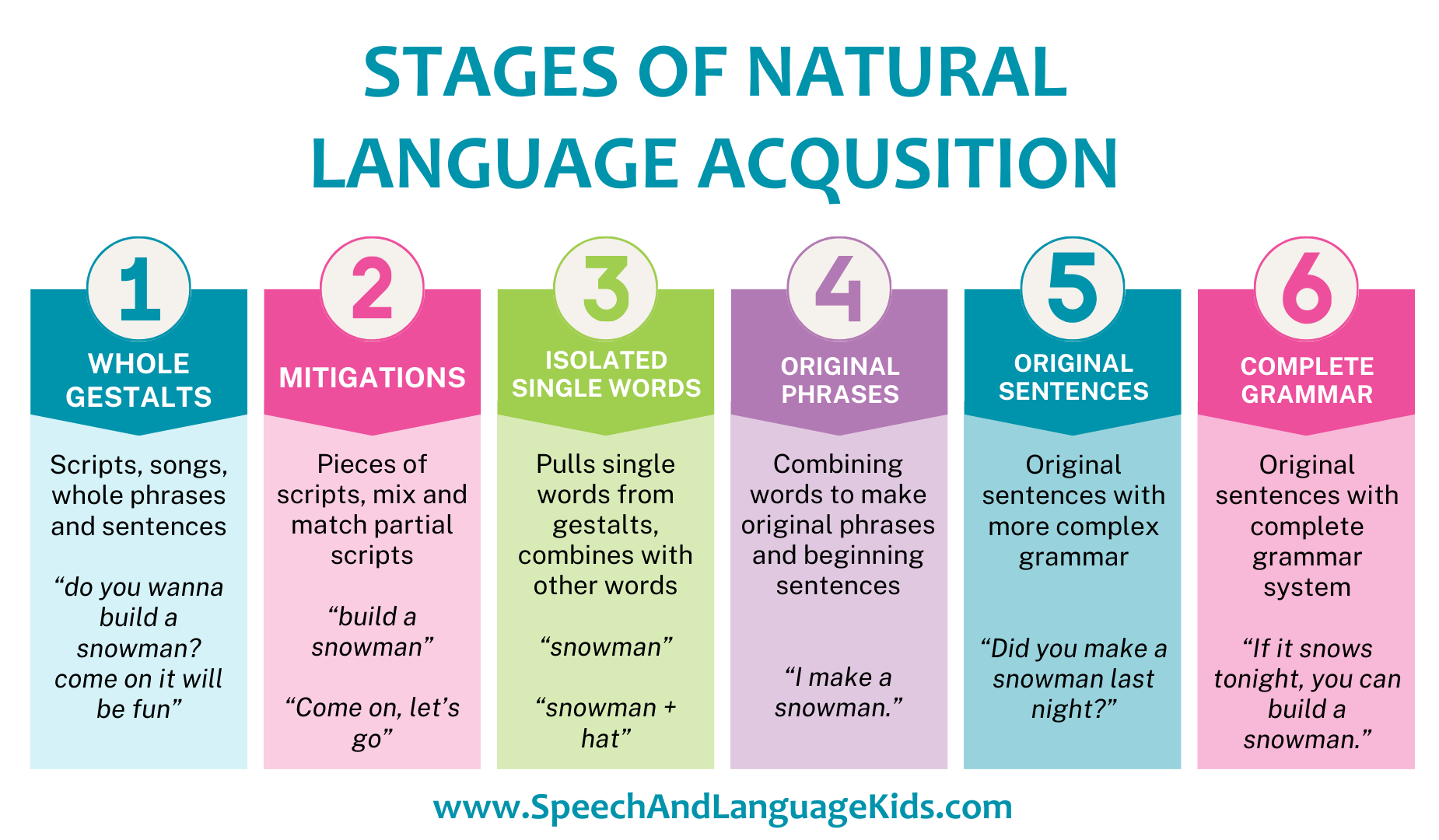
Gestalt Language Processors (GLPs) are children who are learning language in gestalts or chunks. This is not a disorder, it’s simply a different way to learn language. Not all GLPs will need therapy, many learn to speak on their own, though they follow a different path to get there from analytic language processors.
But some GLPs need a little support to move through the phases of natural language acquisition. When these children are given a “traditional” therapy approach, they may not make progress. That’s because their brain works differently.
Here are how GLPs acquire language more naturally:
If you are working with a gestalt language processor (GLP) who could use some extra help, check out our GLP Curriculum!
This is a structured program that will walk therapists, caregivers, and educators through the strategies that work best to help GLPs learn to communicate.
Speech/language therapy can help a child who uses echolalia learn to create their own spontaneous utterances as well. However, there is no one-size-fits-all treatment plan for children with echolalia.
There are different strategies that can be used depending on why and how the child is using their echolalia.
For that reason, I highly recommend that echolalia be treated by a licensed speech-language pathologist who can tease out exactly why the echolalia is being used. That being said, here are some strategies that will help reduce a child’s use of echolalia either in therapy or in conjunction with therapy.
Below are a few different speech therapy approaches and ideas for helping children with echolalia.
These are the strategies to use in speech therapy for gestalt language processors (GLPs).
Keep in mind, these are strategies that the adults in the GLP’s life should learn and acquire. These do not have to occur in this order and should eventually all be used together.
Need some therapy materials for this? Use our GLP Curriculum for Shaping Echolalia. We have a worksheet and visual aids for each of these strategies.
Echolalia when responding to questions is extremely common. This usually stems from the child not knowing how to answer the question appropriately but it can be very difficult to teach the child to answer the question if all he does is repeat the last word. Here’s what I do for this in therapy (keep in mind these steps may take weeks to master, this won’t happen all during one session):
This is my favorite because it’s so darn cute. It sounds like this:
Therapist: “Kevin, what does a puppy say?”
Kevin: “Woof woof. Good job, Kevin!”
That’s the moment when you realize, “Man, I must say “good job, Kevin” every time he gets it correct!” As cute as this is, it’s not very functional so it’s important to fade it out. The first thing you need to do, is stop saying whatever it is your child has associated with the next thing that comes after his response. Instead, just repeat the correct answer, pause, and then give your praise. So it would sound like this:
Therapist “Kevin, what does a puppy say?”
Kevin: “Woof woof. Good job, Kevin!”
Therapist: “Woof woof. A dog does say ‘woof woof’, you’re right.”
If that doesn’t fix the problem after several tries, then you can go back to the numbered steps above and use the same type of cuing system. For example, you would say “What does a puppy say? Woof woof.” Then, try to jump in and say “woof woof” again after he says it but before he can go on to say “good job”. It may take a while for him to get used to not saying the whole thing so just keep trying this and eventually it should fade out.
Some children use echolalia because they find it comforting. We call this self-stimulatory because they are finding ways to provide themselves with stimulation that makes them feel good. Some children flap their hands or rock back and forth as a self-stimulatory behavior. We call this “stimming” for short. There are also children who use echolalia as a form of stimming.
I often see this from children when they are stressed out because they find their movie scripts or tv show scripts to be comforting because they are predictable. If a child doesn’t understand the world around him or why something is happening, he may prefer to do something that he is familiar with and that is predictable, like reciting an entire movie for memory. It’s comforting to him because he knows that movie script will always sound the same no matter what.
Other children may use this delayed echolalia as stimming because they are bored or are not tuned into the world around them so they retreat into their own world where Frozen is playing non-stop in their head and they can just tap into that and recite the character’s lines for entertainment.
Keep in mind that this is a pleasurable activity that the child enjoys and there’s nothing wrong with that. The child should be allowed to have some time during his day to use this echolalia as down time, just like you would allow a boy who loves playing ball some time to play with his basketball outside for some down time.
However, there are certain times when it is not OK for a child to be using echolalia. This may be while the child is in class and the teacher is talking, or when the child is in a quiet location like the library or at church. It is not fair to exclude a child from these situations because he doesn’t know how to stop using echolalia so it can be important to help him understand when it’s OK and when it should wait.
The key to stopping echolalia that is self-stimulatory is to figure out why it’s happening. If the child is stimming with echolalia because he is stressed out, see if you can find alternative ways to de-stress the child. This may include reading him a social story about what’s going on around him or teaching him some calming strategies that will help him self-soothe in a quieter manner.
If the child is using echolalia because he is bored or tuned out, it may be helpful to remind him to tune back in. For example, if he’s quoting movie scripts during class time, you could have an adult sitting next to him reminding him to focus on the teacher. Or, the teacher could frequently ask the child questions about what she is talking about to focus his attention back on her. You could also give the child a small fidget toy that will allow him to move his hands so he can focus on the teacher better.
If the child doesn’t realize that he is using echolalia but is just doing it out of habit, you may need to teach the child rules about when it is ok to be talking and when it is not ok to talk. Then, have the teacher gently remind him of those rules when he is talking during a “no talk” time. Bringing his awareness to this and setting limits or rules may be enough to keep the child on track.
Click here to learn more about managing stimming and other self-stimulatory behaviors.
Our structured “Shaping Echolalia” Curriculum is perfect for learning the strategies needed to support children who are using echolalia to communicate, including gestalt language processors.

Hi, I’m Carrie! I’m a speech-language pathologist from Columbia, Missouri, USA. I’ve worked with children and teenagers of all ages in schools, preschools, and even my own private practice. I love digging through the research on speech and language topics and breaking it down into step-by-step plans for my followers.
Fun Fact: When I was in elementary school, there was a boy at my school with Down Syndrome. Everyone thought he was my brother because I had already decided that I loved helping others and was always helping him with anything and everything he needed. This love of helping blossomed into the amazing profession I have today!
Connect with Me:
The post Echolalia: What is Echolalia and How Can We Help? appeared first on Speech And Language Kids.