Hypernasality occurs when a child speaks with too much nasal resonance.
Airflow tends to be directed up into the nasal cavity during speech instead of primarily through the oral cavity.
Nasal emission is when that air comes all the way out through the nose. This can make a puffing or noisy sound in the nose during speech.
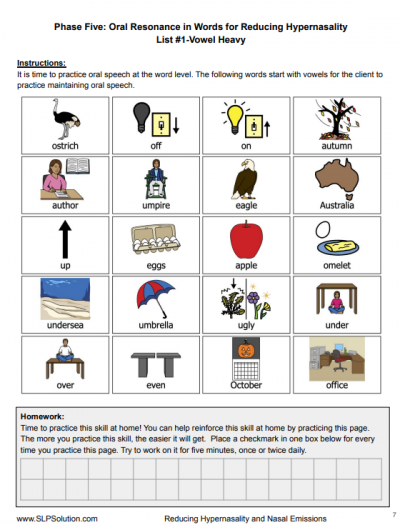
This page explains how to do speech therapy for hypernasal speech. We’ll also show you where you can access our full Resonance Curriculum for therapy or home use.
Check out this sample goal for hypernasality speech therapy! Keep in mind, you should modify this goal to meet the needs of each individual client or patient that you’re working with:
The patient will demonstrate appropriate oral and nasal resonance during a 30 minute unstructured conversation in 2 speaking settings with no more than 2 instances of hypernasality.
*** Discontinue Therapy if Not Making Progress: If no progress is made after 6 weeks, client should be re-evaluated by ENT.
Source:
The Voice and Voice Therapy, Seventh Edition: By Boone, McFarlane, and Von Berg

Hi, I’m Carrie! I’m a speech-language pathologist from Columbia, Missouri, USA. I’ve worked with children and teenagers of all ages in schools, preschools, and even my own private practice. I love digging through the research on speech and language topics and breaking it down into step-by-step plans for my followers.
Connect with Me:
The post Hypernasality Speech Therapy: Treatment Activities appeared first on Speech And Language Kids.