Perspective taking is our ability to think about a situation from someone else’s point of view.
If we can take a guess at how someone else is thinking or feeling, it can help us navigate social interactions and better understand the world around us.
On this page, we’ll talk about how we can help children and teens learn to use perspective taking to understand the world around them. We’ll do it in a neurodiversity-affirming way that honors individual differences and allows for each person to communicate in a way that feels authentic to them.
Imagine you’re dropped onto an alien world, surrounded by creatures who don’t talk or act like you at all. You have no idea what their gestures, words, and actions mean. Or why they are doing what they do. Think about how scary that would be!
Now think about our children and teens who struggle to understand the actions of those around them. The world can seem a scary place when you don’t understand what’s happening. That’s where this area of therapy comes in.
Our ability to understand a situation from another person’s point of view is called “perspective taking”.
Perspective-taking and empathy training have gotten a bad wrap with our newer understanding of neurodiversity. But that’s simply because the way we used to teach these skills was….maybe not the best. Our old teaching ways were (inadvertently) telling children that they needed to act like everyone else. That there was something wrong with them because their brains worked differently.
We now know that all brains work differently and there are many different “normal” ways of being! And this is amazingly empowering! But our neurodiverse populations still deserve to understand what’s going on around them.
So now, we teach perspective-taking as a way to understand the world around us. Not because we want kids to change and conform. But because they will feel more safe, secure, and loved if they understand why others do the things they do. And they can navigate social situations their own way.
As you work on this skill, make sure you are empowering your clients to use these tools to understand the world around them. And remind them that it’s OK to act, think, and speak differently than those around them. The important thing is that they find a way to move through this world that feels natural and authentic to them.
(And I should add that this type of education shouldn’t be kept JUST for kids with social impairments. I argue that literally every child in every school would benefit from this type of education so that we are ALL learning to understand and be respectful of individual differences.)
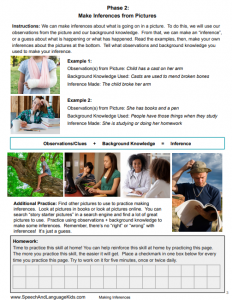
Here at Speech and Language Kids, we’ve put together an amazing program that you can use TODAY to teach perspective taking in a neurodiversity-affirming way.
Our Social Awareness Curriculum starts at the younger levels with teaching them to respond to and engage with others. It then goes on to teaching these skills:
This Curriculum is available with a subscription to the SLK Curriculum Program. We have plans starting at just $50 per month and that includes EVERYTHING, including our AI-powered social scenario generator that you can use to create custom scenarios to discuss and practice in therapy.
Have you ever seen 2 babies in a room and when one starts crying, the other starts crying too? That’s because babies don’t know that someone else’s discomfort is not their own. They don’t have the ability to take the perspective of someone else. We call this theory of mind (meaning that the child understands that other people have other perspectives than their own). Babies don’t have theory of mind yet.
Around 2-3 years of age, children start to gain an understanding that each person is experiencing different things. During the preschool years, we should see a child start to show concern for others who are upset. They may show concern for someone who is crying or try to do something to help that person.
However, at this stage, children still often confuse their own perspective with others. A preschooler may think that since she likes ice cream, everyone likes ice cream. This may lead to actions like giving someone who is crying a favorite toy because the child knows that would cheer him up if he had it himself.
Here are some ideas of what you can do with preschoolers who are not yet showing signs of understanding that other people have different perspectives and feelings than we do:
During these years, the child’s perspective-taking skills should continue to grow. The child should develop the ability to guess what people are thinking or feeling based on their behaviors and understand their motivation for certain behaviors.
Keep in mind that this is still happening at a very simplistic level. For example, if the child you’re working with watches another child hit his teacher, the K-2nd grader should be able to guess that the child hit his teacher because he was mad. He probably wouldn’t be able to tell you though that the other child was frustrated because the task that the teacher asked him to do was too difficult.
During these grades, children begin to develop the understanding that everyone sees situations from a different perspective and that people may therefore misinterpret what’s going on. For example, the child will understand if you explain to him that when he walked up to his friend and hit him on the back, he meant it as a greeting but his friend interpreted it as anger.
Children in these grades also begin to understand that a person may be hiding his/her true feelings. For example, they would begin to understand that if a child said “I’m okay” but still had tears in her eyes, she may not really be ok but she just wants others to think she is.
At this point, children continue to fine-tune their ability to take the perspective of others and understand someone else’s thoughts, feelings, and motives. They continue to develop the skills we’ve mentioned previously but in more complex ways.
These children are also beginning to understand that people often have multiple motives for their behavior and sometimes those motives are conflicting. For example, the child may understand that a teenager may be tempted to smoke because it will make him look cooler (peer pressure) but that he may be reluctant to do so because it is unhealthy and gross.
At this point, these young adults begin to understand that a person’s culture and environment impact their personality, behavior, and perspectives. They begin to see how we are all a product of our environment and that past events and present circumstances all affect how we see the world. For example, young adults may begin to see that a person who has always been discriminated against is more likely to assume he’s being discriminated against than someone who has never known discrimination.
These young adults are also beginning to understand that people may not always be fully aware of why they act the way they do. They may be acting a certain way because they were brought up that way or they are repressing some feelings that they don’t want to deal with.
Grab our social interaction workbooks and tools inside the SLK Curriculum:
Hi, I’m Carrie! I’m a speech-language pathologist from Columbia, Missouri, USA. I’ve worked with children and teenagers of all ages in schools, preschools, and even my own private practice. I love digging through the research on speech and language topics and breaking it down into step-by-step plans for my followers.
Fun Fact: I play the cello. I took lessons for cello and piano for most of my childhood, though I’m way better at cello than I ever got a piano. I also taught myself guitar as an adult. I have a super fun bright blue electric guitar that I get out every once in a while and play around on. And then I curse the fact that since I don’t play consistently, I don’t have my callouses built up.
Connect with Me:
The post Perspective Taking | Examples and Activities for Speech Therapy appeared first on Speech And Language Kids.