Induction is valid. Hume was wrong: there is no “problem of induction."
Inductions validly and logically formed are contextual absolutes. We can and should confidently and certainly form inductions, use them, and rely on them.
Necessity is in experience. It is in reality. It has epistemic and metaphysical priority over anyone’s imaginings and ramblings.
1. “Practical scientists [and adults] who rashly allow themselves to listen to [most modern] philosophers are likely to go away in a discouraged frame of mind, convinced that there is no logical foundation for the things they do, that all their alleged scientific laws are without justification, and that they are living in a world of naïve illusion. Of course, once they get out into the sunlight again, they know that this is not so, that scientific principles do work, bridges stay up, eclipses occur on schedule, and atomic bombs go off.
“Nevertheless, it is very unsatisfactory that no generally acceptable theory of scientific inference has yet been put forward. … Mistakes are often made which would presumably not have been made if a consistent and satisfactory basic philosophy had been followed.”
—An Introduction to Scientific Research by E. Bright Wilson, Professor Chemistry at Harvard. (About Edgar Bright Wilson: https://en.wikipedia.org/wiki/Edgar_Bright_Wilson)
2, "I fully agree with you about the significance and educational value of methodology as well as history and philosophy of science. So many people today — and even professional scientists — seem to me like someone who has seen thousands of trees but has never seen a forest. A knowledge of the historic and philosophical background gives that kind of independence from prejudices of his generation from which most scientists are suffering. This independence created by philosophical insight is — in my opinion — the mark of distinction between a mere artisan or specialist and a real seeker after truth."
—Albert Einstein (Letter to Robert A. Thorton, Physics Professor at University of Puerto Rico (7 December 1944) [EA-674, Einstein Archive, Hebrew University, Jerusalem]. See: https://en.wikiquote.org/wiki/Albert_Einstein)
3. "I should even think that in making the celestial material alterable, I contradict the doctrine of Aristotle much less than do those people who still want to keep the sky inalterable; for I am sure that he never took its inalterability to be as certain as the fact that all human reasoning must be placed second to direct experience."
—From the Second Letter of Galileo Galilei to Mark Welser on Sunspots, p. 118 of Discoveries and Opinions of Galileo, translated by Stillman Drake, (c) 1957 by Stillman Drake, published by Doubleday Anchor Books, Doubleday & Co., Garden City, New York
4.“Rule 1 We are to admit no more causes of natural things than such as are both true and sufficient to explain their appearances.
“Rule 2 Therefore to the same natural effects we must, as far as possible, assign the same causes.
“Rule 3. The qualities of bodies, which admit neither intensification nor remission of degrees, and which are found to belong to all bodies within the reach of our experiments, are to be esteemed the universal qualities of all bodies whatsoever.
“Rule 4. In experimental philosophy we are to look upon propositions inferred by general induction from phenomena as accurately or very nearly true, not withstanding any contrary hypothesis that may be imagined, till such time as other phenomena occur, by which they may either be made more accurate, or liable to exceptions.”
—Newton’s Rules of Reasoning in Science. See: http://apex.ua.edu/uploads/2/8/7/3/28731065/four_rules_of_reasoning_apex_website.pdf
5. "This is the case when both the cause and effect are present to the senses. Let us now see upon what our inference is founded, when we conclude from the one that the other has existed or will exist. Suppose I see a ball moving in a streight line towards another, I immediately conclude, that they will shock, and that the second will be in motion. This is the inference from cause to effect; and of this nature are all our reasonings in the conduct of life: on this is founded all our belief in history: and from hence is derived all philosophy, excepting only geometry and arithmetic. If we can explain the inference from the shock of two balls, we shall be able to account for this operation of the mind in all instances.
"Were a man, such as Adam, created in the full vigour of understanding, without experience, he would never be able to infer motion in the second ball from the motion and impulse of the first. It is not any thing that reason sees in the cause, which makes us infer the effect. Such an inference, were it possible, would amount to a demonstration, as being founded merely on the comparison of ideas. But no inference from cause to effect amounts to a demonstration. Of which there is this evident proof. The mind can always conceive any effect to follow from any cause, and indeed any event to follow upon another: whatever we conceive is possible, at least in a metaphysical sense: but wherever a demonstration takes place, the contrary is impossible, and implies a contradiction. There is no demonstration, therefore, for any conjunction of cause and effect. And this is a principle, which is generally allowed by philosophers.
"It would have been necessary, therefore, for Adam (if he was not inspired) to have had experience of the effect, which followed upon the impulse of these two balls. He must have seen, in several instances, that when the one ball struck upon the other, the second always acquired motion. If he had seen a sufficient number of instances of this kind, whenever he saw the one ball moving towards the other, he would always conclude without hesitation, that the second would acquire motion. His understanding would anticipate his sight, and form a conclusion suitable to his past experience.
"It follows, then, that all reasonings concerning cause and effect, are founded on experience, and that all reasonings from experience are founded on the supposition, that the course of nature will continue uniformly the same. We conclude, that like causes, in like circumstances, will always produce like effects. It may now be worth while to consider, what determines us to form a conclusion of such infinite consequence.
“ 'Tis evident, that Adam with all his science, would never have been able to demonstrate, that the course of nature must continue uniformly the same, and that the future must be conformable to the past. What is possible can never be demonstrated to be false; and 'tis possible the course of nature may change, since we can conceive such a change. Nay, I will go farther, and assert, that he could not so much as prove by any probable arguments, that the future must be conformable to the past. All probable arguments are built on the supposition, that there is this conformity betwixt the future and the past, and therefore can never prove it. This conformity is a matter of fact, and if it must be proved, will admit of no proof but from experience. But our experience in the past can be a proof of nothing for the future, but upon a supposition, that there is a resemblance betwixt them. This therefore is a point, which can admit of no proof at all, and which we take for granted without any proof.”
—From Hume’s (or maybe Adam Smith’s) “AN ABSTRACT OF A BOOK lately Published; entituled, A TREATISE OF Human Nature, &c. wherein The CHIEF ARGUMENT of that BOOK is farther illustrated and explained." See: https://davidhume.org/texts/a/
6. "This Platonic heritage, with its emphasis in clear distinctions and separated immutable entities, leads us to view statistical measures of central tendency wrongly, indeed opposite to the appropriate interpretation in our actual world of variation, shadings, and continua. In short, we view means and medians as the hard 'realities,' and the variation that permits their calculation as a set of transient and imperfect measurements of this hidden essence. ... But all evolutionary biologists know that variation itself is nature’s only irreducible essence. Variation is the hard reality, not a set of imperfect measures for a central tendency. Means and medians are the abstractions."
—"The Median Isn’t the Message" by Stephen Jay Gould (See: https://www.edwardtufte.com/notebook/classic-articles-on-statistical-thinking/)
7. “I can imagine." Uniformity. Future vs past.
Self-contradiction. Applies also to deduction, reasoning, language, etc. And we are part of nature: we are not immune from what he says.
8. And why is causality custom or habit? What causes it? Why only custom or habit? Why not anything else? Why is this suddenly a stopping point, and Hume does not “imagine things to be different again?” Are habit and custom necessary, or not? Are they uniform? How do you know about tomorrow or other instances?
And I disagree: there are no “analytic” statements that are “true” in the mind only.
9. Works of David Hume: https://davidhume.org/
"The Problem of Induction": https://plato.stanford.edu/entries/induction-problem/
"Notes on Hume’s Argument(s) concerning Induction” by Peter Millican, Hertford College, Oxford https://davidhume.org/teaching/documents/Hume_Notes_Induction.pdf
10. Galilean Spiral:
i. https://mathcurve.com/courbes2d.gb/galilee/galilee.shtml
ii https://mathworld.wolfram.com/GalileanSpiral.html
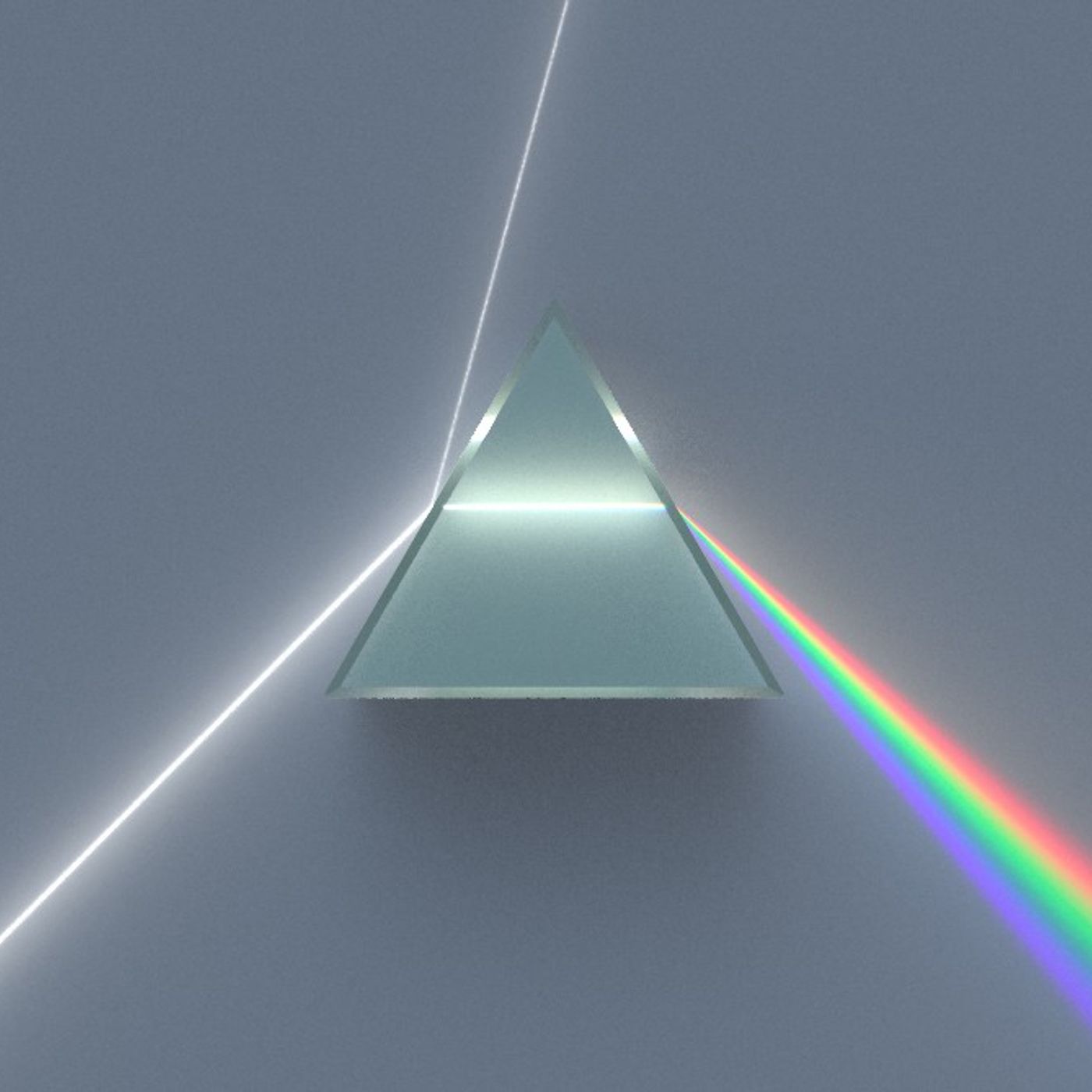
Dispersive Prism Illustration from Wikipedia.
Please consider liking us on your podcast app, and leaving a rational review.
Email us at ReasonRxPodcast@aol.com, michael@goldams.com, or goldmj@aol.com.
Host.
Michael: https://www.linkedin.com/in/michael-gold-2883921/
Gold Academy: https://goldams.com
Total Human Fitness: https://total-human-fitness.com