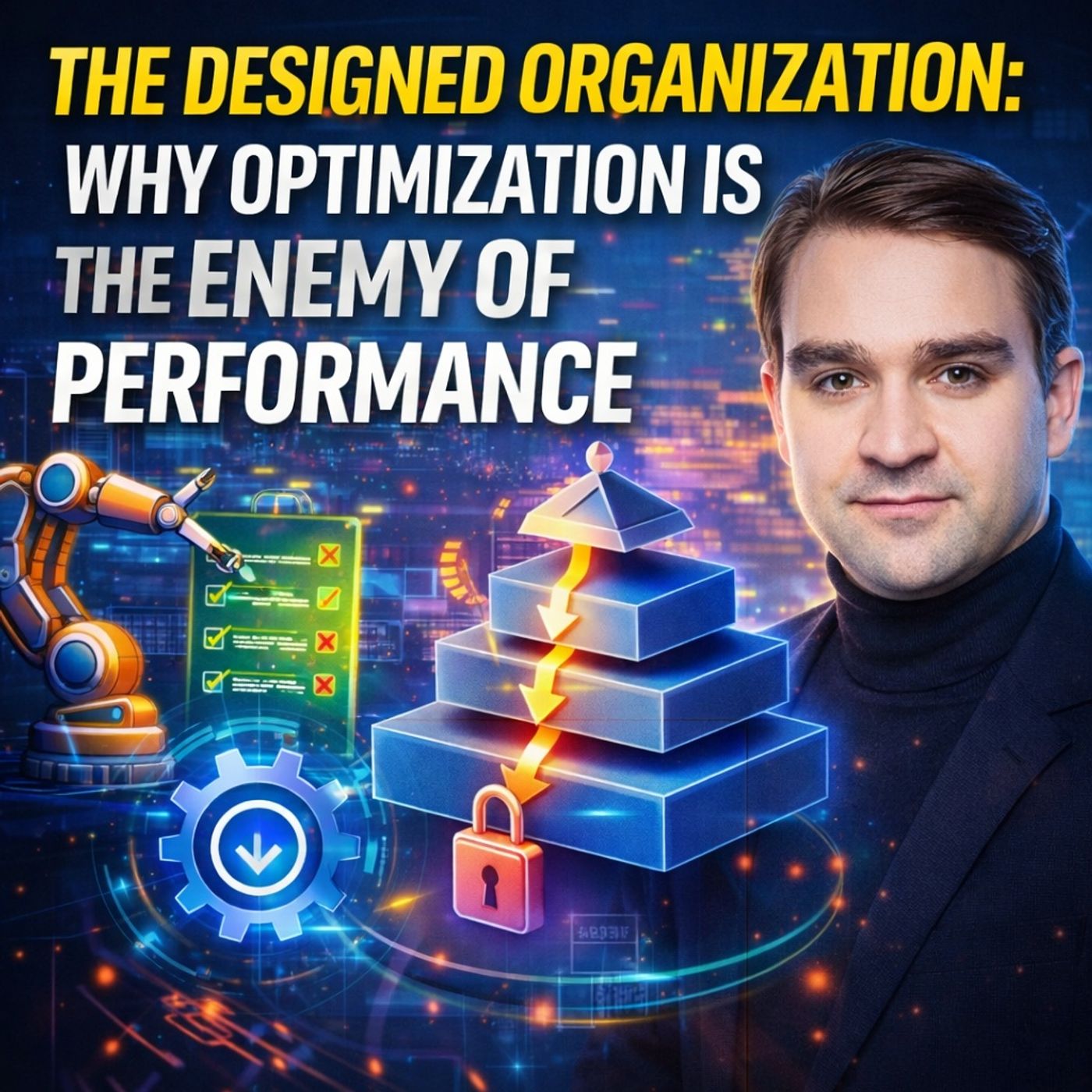
Optimization feels like progress. It gives leaders measurable wins, cleaner processes, and a sense of control. But inside most organizations, optimization is exactly how performance becomes slower, heavier, and more political over time. Because optimizing individual parts without redesigning the system doesn’t create flow — it creates fragmentation. In this episode, Mirko Peters breaks down why modern organizations struggle to turn intelligence into action, why AI is exposing structural weaknesses, and how performance actually emerges from designing flow, not improving parts. ⚠️ The Core Argument You cannot fix performance by improving isolated components. Performance is not the sum of optimized teams, tools, or processes. It is the result of how well your organization is designed to move:
- decisions
- data
- context
- and authority
If those flows are fragmented, optimization only strengthens the fragmentation. 🧠 The Optimization Trap Most organizations don’t fail because of bad decisions — they fail because of reasonable decisions made in isolation. Typical examples:
- Tightening governance
- Rolling out Copilot to a team
- Automating tasks with Power Automate
- Standardizing SharePoint structures
Each move looks like a win locally. But systemically, these actions often:
- reinforce silos
- increase handoffs
- fragment ownership
- and slow down decision-making
👉 The result:
Local excellence, global drag 🏗️ What an Organization Really Is An organization is not:
- an org chart
- a tech stack
- a governance model
Those are just the visible layers. The organization itself is a flow architecture — how things actually move. The 4 Core Flows 1. Decision Flow How signals turn into action:
- Who sees the issue?
- Who decides?
- How long does it take?
👉 Strategy is executed through decision velocity, not intent. 2. Data Flow Where truth lives and how it moves:
- What is the source of truth?
- Who owns definitions?
- How many versions exist?
👉 When truth fragments, decisions turn into negotiation. 3. Interaction Flow How context travels between people:
- Where is work discussed?
- Where is rationale stored?
- How is meaning preserved?
👉 Coordination moves tasks.
Connection moves meaning. 4. Power (Hidden Layer) Who can actually act:
- Who can override decisions?
- Who can delay work?
- Who really decides under pressure?
👉 The real operating model = the power map, not the process map. 🏛️ Why Governance Doesn’t Fix It Governance is not an operating model — it’s a control framework. When the system is misdesigned:
- Governance adds friction, not clarity
- Approvals multiply without improving decisions
- Policies formalize confusion
This leads to:
- “default-no” behavior
- escalation loops
- shadow governance (side channels, informal decisions)
👉 Governance should protect flow, not replace it. 📉 The AI Reality Check ~95% of generative AI pilots fail to create measurable business impact. Not because:
- models are weak
- prompts are bad
- users resist
But because:
👉 Organizations cannot absorb the output AI generates answers in seconds. But organizations still need:
- days to validate context
- multiple approvals
- repeated data reconciliation
👉 The constraint isn’t intelligence.
👉 The constraint is architecture. ⚡ Decision Velocity: The Metric That Matters The most important performance metric today is: Decision Velocity Time from signal → action Not:
- dashboard updates
- model accuracy
- activity levels
But:
- how fast the organization actually moves
AI compresses analysis. If your system cannot convert insight into action:
👉 You don’t have a technology problem
👉 You have a design problem 🔄 Why Transformation Programs Fail Most transformation efforts stall because they:
- deploy tools without redesigning flow
- map “ideal processes” instead of real behavior
- optimize silos instead of the system
- ignore power and incentives
Common failure patterns:
- Successful pilots that don’t scale
- Beautiful process maps that don’t reflect reality
- Increased activity without improved outcomes
- More dashboards, more meetings, less clarity
👉 Deployment ≠ transformation 🔍 The Hidden Reality Inside Organizations When you observe real workflows, you find:
- Decisions waiting for missing context
- Data being rebuilt multiple times
- Ownership disappearing at handoffs
- Work moving through side channels
- Approvals repeating without adding value
People compensate by:
- carrying context manually
- creating private trackers
- adding meetings
- building informal networks
👉 Humans become middleware for a broken system 🛠️ What Actually Works: Redesigning Flow Performance improves when organizations redesign how work moves. Key changes: 1. Decision Clarity
- Define clear decision owners
- Separate contributors from approvers
- Reduce unnecessary approvals
2. Data Ownership
Become a supporter of this podcast:
https://www.spreaker.com/podcast/m365-fm-modern-work-security-and-productivity-with-microsoft-365--6704921/support.
If this clashes with how you’ve seen it play out, I’m always curious.
I use LinkedIn for the back-and-forth.