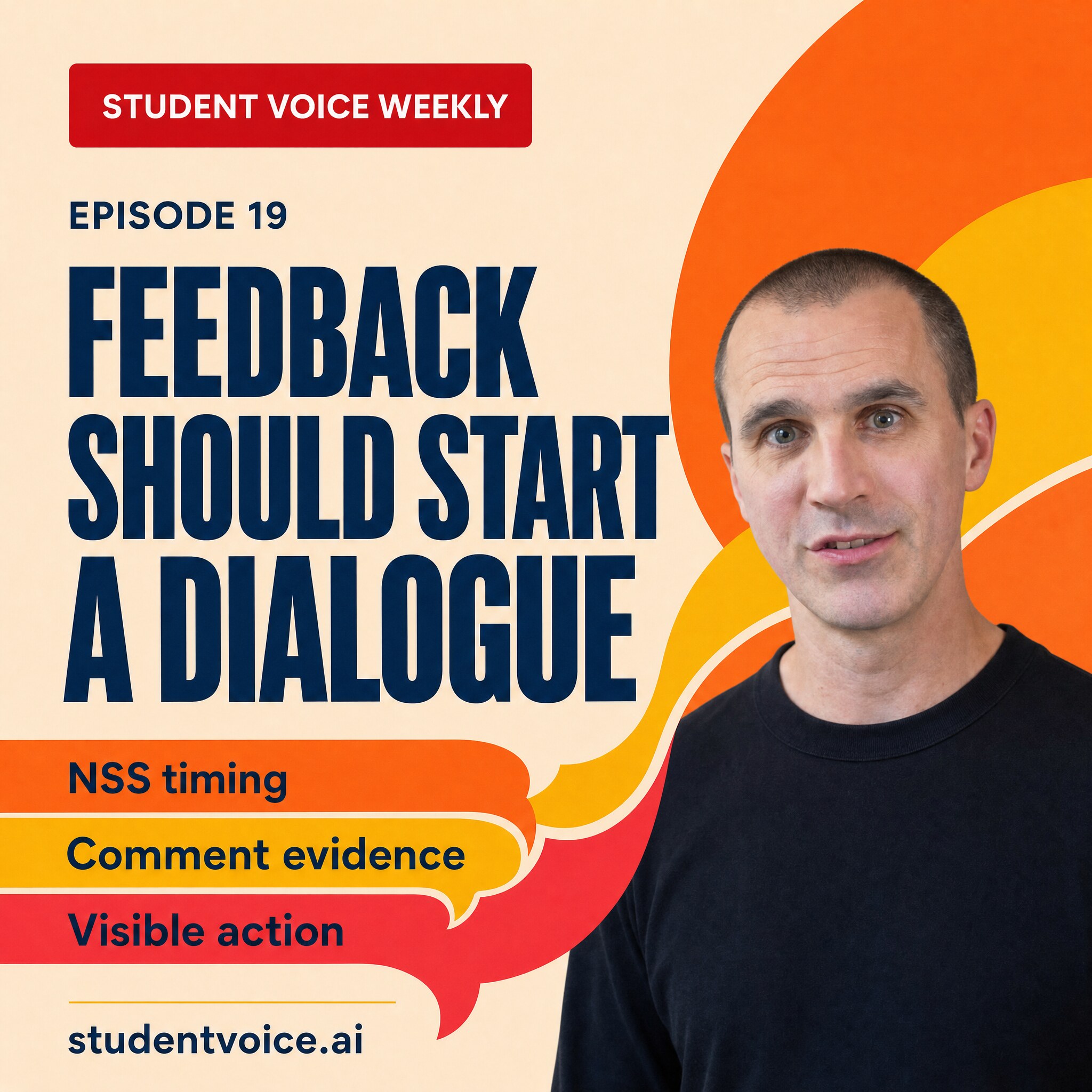
This week, Dr Stuart Grey starts with Daniel Robson and Helena Lim's Wonkhe piece on King's College London, where the NSS comment analysis work was delivered in collaboration with Student Voice AI.
The episode discusses why faster comment analysis matters only when it preserves enough detail for human review, academic judgement, and visible action while universities still have time to respond.
In This Episode
- What the King's College London example shows about turning NSS comments into usable evidence quickly.
- Why student feedback should not be treated as a direct verdict on teaching quality.
- Why NSS timing makes local, earlier feedback systems more important.
- How VLE feedback and reattempt loops change what universities should ask about digital learning.
- Why faster comment analysis matters only when it leads to earlier human review and visible action.
- How to separate comments about process, timing, interpretation, digital learning design, and trust.
Student Voice Practice
Feedback analysis should preserve enough context for dialogue. A useful approach distinguishes whether comments are about process, timing, interpretation, learning design, or trust, then routes the evidence to people who can act while action is still possible.
The King's example matters because it shows the practical value of keeping a traceable line between what students wrote, how comments were categorised, and the judgement course teams then make.
Research Spotlight
- Student evaluations should inform dialogue, not replace academic judgement: https://www.studentvoice.ai/blog/student-evaluations-should-inform-dialogue-not-replace-academic-judgement/
- VLEs scale better when feedback and reattempt are built in: https://www.studentvoice.ai/blog/vles-scale-better-when-feedback-and-reattempt-are-built-in/
Across the Sector
- Wonkhe's AI feedback analysis case shows how universities can act on NSS comments sooner: https://www.studentvoice.ai/blog/wonkhe-ai-feedback-analysis-nss-comments-action/
- Wonkhe's sector data warning shows why NSS and student feedback still arrive too late: https://www.studentvoice.ai/blog/wonkhe-sector-data-warning-nss-student-feedback-too-late/
From the Archive
- NSS open-text analysis methodology for UK HE: https://www.studentvoice.ai/resources/nss-open-text-analysis-methodology/
- The current understanding of student voice in assessment and feedback: https://www.studentvoice.ai/blog/the-current-understanding-of-student-voice-in-assessment-and-feedback/
- How to enhance student voice in university governance: https://www.studentvoice.ai/blog/how-to-enhance-student-voice-in-university-governance-through-student-representation/
Practical Takeaway
Treat student feedback as the beginning of a structured conversation. Keep enough detail in the comments to show what students meant, who needs to respond, and whether action can still happen in time.
Subscribe
Subscribe to The Student Voice Weekly: https://www.studentvoice.ai/blog/newsletter/