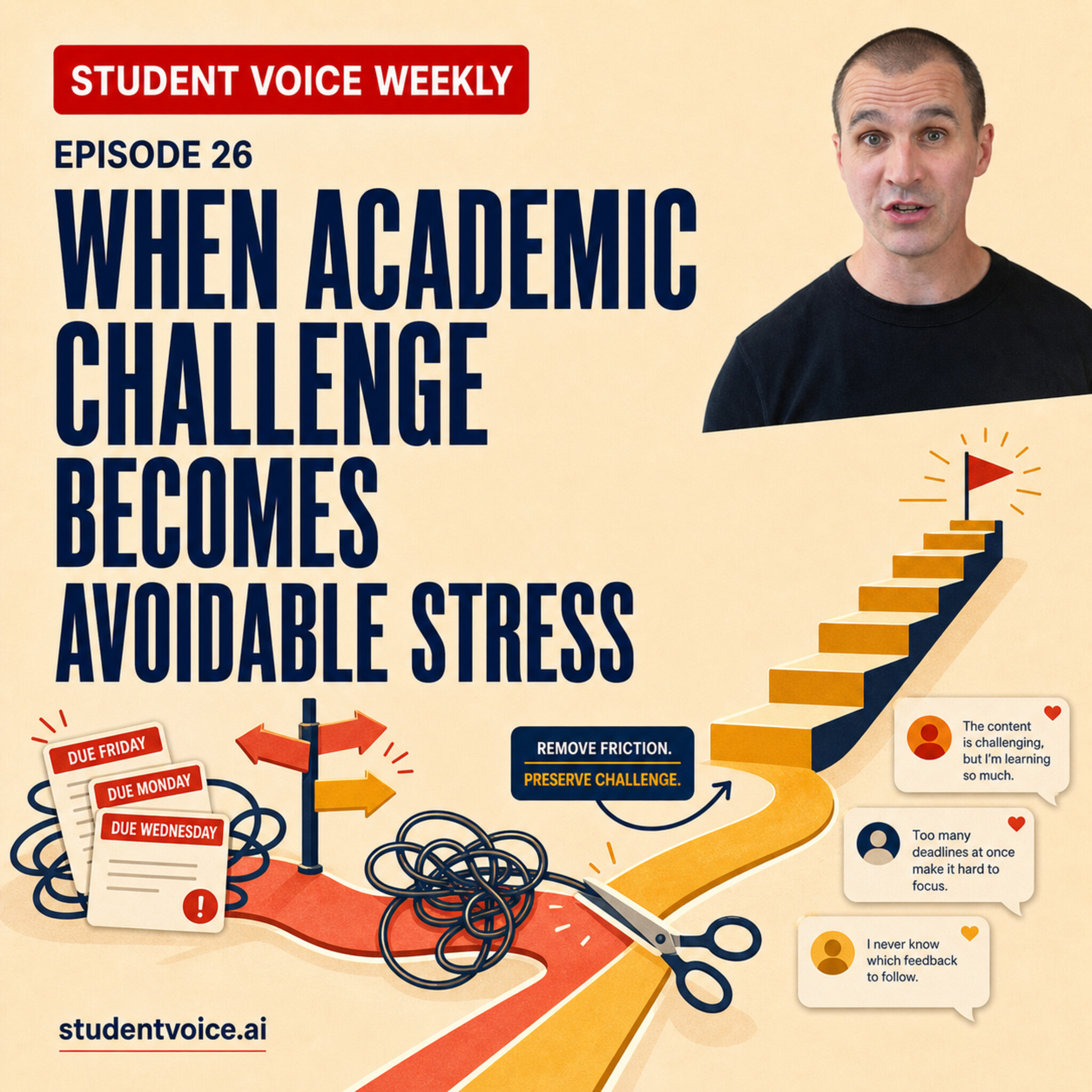
This week, Dr Stuart Grey asks where responsibility for academic stress actually sits.
Drawing on a national study of more than 19,000 undergraduates and research into how early-career academics use student evaluations, Stuart explores how universities can distinguish worthwhile academic challenge from avoidable pressure created by course design.
In This Episode
- Why academic stress cannot sit with counselling and wellbeing services alone.
- What a large Australian study suggests about the relationship between course experience and student distress.
- How workload bunching, unclear criteria and weak explanations of purpose create avoidable friction.
- Why evaluation scores show where to look while comments help explain what happened.
- How developmental conversations make student feedback more useful and safer for staff.
- Why repeated evidence and traceable comments matter when feedback concerns individual staff.
Research
- Academic stress is the strongest university-related distress signal: https://www.studentvoice.ai/blog/academic-stress-is-the-strongest-university-related-distress-signal/
- Student evaluations become useful when comments explain the scores: https://www.studentvoice.ai/blog/student-evaluations-useful-when-comments-explain-scores/
Further Reading
- Three new QAA Subject Benchmark Statements open to student voice: https://www.studentvoice.ai/blog/qaa-new-subject-benchmark-statements-student-voice/
- QAA Subject Benchmark Statements: https://www.qaa.ac.uk/the-quality-code/subject-benchmark-statements
Practical Takeaway
Choose one point in a programme where students report pressure and trace it back to the design decision behind it. Test whether the challenge is necessary, its purpose is clear, the workload is manageable, and the comments reveal avoidable friction that a course team can remove.
About This Recording
This episode was recorded by Dr Stuart Grey. The transcript was prepared from the final recording and lightly corrected for names, research terminology, and readability.
Subscribe
Subscribe to The Student Voice Weekly: https://www.studentvoice.ai/blog/newsletter/.