Shows

FuturologyOur Mind Meld with Machines Is Coming (with Max Hodak and Nils Gilman)Big Tech already lives rent-free in our heads. The attention economy monetized and industrialized our mental real estate long ago. Now, with brain-computer interfaces, companies with ambitious names like Science are preparing to barge through the doors of perception and take up permanent residence inside our minds.
In this episode, Hodak – a co-founder of Neuralink and now the founder and CEO of Science – is more familiar with how to create this mind meld with machines than nearly anyone on Earth. Hodak is part of a growing cadre of true believer tech accelerationists who argue that humanity’s best ch...
2026-02-041h 08FuturologyCan 'Big Math' Solve for the Future? (with Terence Tao and Dawn Nakagawa)As AI floods the world with answers that merely sound right, math tethers them to the need to be actually right. New machine learning tools and collaboration platforms are pushing theoretical mathematics toward something bigger: large, open projects where progress is shared early; rabbit holes are avoided; and more people can contribute.
In this episode, Terence Tao, a Fields Medal-winning mathematician at UCLA, lays out his case for “big math.” He explains what AI can do well — and where it still fails. The question isn’t whether machines can produce answers. It’s whether we can build systems, hum...
2026-01-201h 04FuturologyWhy Consciousness Matters in the Age of AI (with David Chalmers and Nils Gilman)It’s extremely difficult to doubt that you’re conscious, but still nearly impossible to explain why. As AI starts to speak in a voice that feels familiar, this ancient philosophical puzzle is becoming practical. If a system can persuade us it has an inner life, what does that do to the way we decide who – or what – matters?
In this episode, philosopher David Chalmers makes the case that consciousness needs to move beyond the realm of mystery. Over the past three decades, serious work on the subject has gone from fringe curiosity to an active research frontier...
2026-01-131h 29FuturologyBreaking Out of a Black-and-White World (with Brook Ziporyn and Bing Song)We live in a culture that flattens the world into yes or no. Hot takes and hard binaries promise simplicity. But complexity is leaking through the cracks. Opposites depend on each other. If you try to tease out the uncertain from the certain, you destroy the reality of the thing itself.
In this episode, Taoist scholar Brook Ziporyn makes the case that Taoism and Buddhism aren’t puzzles to solve but tools for living. Reckoning with Eastern paradoxes can help us navigate the desire to end desire. Modern science has unlocked humanity's potential to see the emptiness of...
2026-01-0656 min
The Ezra Klein ShowThis Question Can Change Your LifeI like to start the year with a few episodes on things I’m personally working on. Not resolutions, exactly. More like intentions. Or, even better, practices.One of those practices, strange as it sounds, is repeatedly asking the question: “What is this?” It’s a question I got from a book of the same name, by Stephen and Martine Batchelor. In that book, they are describing an approach to Buddhist meditation built on the cultivation of doubt and wonder. You can see that as a spiritual practice, but it’s also an intellectual and ethical one. It is, for...
2026-01-021h 05FuturologyThe Future of Sovereignty Is Closer Than You Think (with Graham Brewer and Grant Slater)The current world order seeks to make sovereignty simple. One map. One flag. One final authority. But in Indian Country, the borders break down. Tribal nations govern alongside the United States, and sovereignty overlaps in real, everyday ways. This isn’t a historical footnote. It’s the future, hiding in plain sight.
In this episode, Graham Brewer – the AP’s National Correspondent covering native lands and peoples – traces what sovereignty looks like when power overlaps and treaty promises from the 19th century adapt to the 21st. That negotiation is now playing out in the cloud: as languages are revive...
2025-12-231h 36FuturologyConjuring Art from Machine Hallucinations (with Refik Anadol and Claire Webb)For Artist Refik Anadol, data is not just information. It is pigment. He feeds weather records, river flows, forests and archives into custom AI models and treats the outputs as brushstrokes. The point is to let AI learn from our memories and then push beyond them, catching the moments when the machine’s vision glitches out and creates something truly novel.In this episode, Anadol talks Claire Web, the head of the Berggruen Institute’s Future Humans program, about how this collaboration has changed his sense of nature, authorship, and the edges of reality. They explore how training a mode...
2025-12-1656 min
Wisdom of CrowdsWhy are Charismatic Demagogues So Attractive?This week, the great Nils Gilman joined Damir Marusic and Samuel Kimbriel on the pod to unpack the complexities of American foreign policy and its implications for Europe — and beyond. The conversation starts by trying to make sense of Trump’s latest National Security Strategy as a jumping off point, before pivoting into a discussion of populism. Why do some causes, projects — and people — provide meaning while others fall flat? For example, why is Trump’s nationalism more politically effective than calls to global climate action? And is there a better way to create meaning in an increasing...
2025-12-151h 13FuturologyThe Dangers of Seeing Ourselves in Artificial Intelligence (with Anil Seth and Nils Gilman)Humans are built for pattern recognition. It is the engine behind perception, emotion, and the fragile sense of self that feels so solid from the inside. For Anil Seth, this pattern-making power explains why consciousness is not a light inside but a process the brain assembles from guesses about the world. And it matters that each of us perceives that world differently.
In this episode of Futurology, Seth talks with Nils Gilman about what these differences reveal about the nature of consciousness and why they matter for the debate over artificial minds. LLMs are pattern-recognition machines of...
2025-12-091h 05FuturologyWhat Whales Can Teach Us About Talking to Aliens (With David Gruber and Claire Webb)We’ve spent decades beaming radio waves into space listening for an answer. But it might be enough to start here on Earth, or more accurately, under the seas. Sperm whales live in complex clans and communicate in rapid-fire clicks. Even if we could decode their messages, is it safe to assume they want to talk to us? What, exactly, would we have to say to them?
The Cetacean Translation Initiative – CETI for whales not SETI for E.T. – is considering the implications of AI translation tools for the ocean’s depths. In this episode of Futurology, CETI Fou...
2025-11-251h 16FuturologyHow to Spot an Alien Civilization (with Adam Frank and Claire Webb)For the first time in human history, we can see other worlds. Nearly six thousand planets have been discovered orbiting distant stars — and more appear every year. Each one is a reminder that Earth is not unique, and humanity is not the center.
Astrophysicist and astrobiologist Adam Frank joins Claire Webb to talk about what this means for science and for us. From NASA’s search for technosignatures — the fingerprints of alien civilizations — to the planetary traces we ourselves leave behind, Frank argues that the hunt for life beyond Earth is also a way of seeing our own spec...
2025-11-111h 08FuturologyWhen the Machine Becomes the Medium (with Ken Liu and Nils Gilman)The first machines mimicked our muscles. Today, they’ve learned to mirror our minds. Now they’re beginning to imitate something even closer to the core of our humanity – imagination itself. Sci-fi author, translator, and technologist Ken Liu calls this new medium the Noematagraph: a tool for capturing creativity and collaborating with AI in the same way cinema tells stories with actors, sound and a splash of light on a screen.
In this episode of Futurology, Liu joins Berggruen Press’ Executive Editor Nils Gilman to explore how AI blurs the line between artist and audience, code and consciou...
2025-11-041h 26
Planetary ChoicesThe New Order of Planetary Governance - A Conversation with Nils GilmanIn our first episode of Mapping the Planetary, together with our hosts Hagen Schulz-Forberg and James Quilligan, we sit down with Nils Gilman, Vice President of Programs at the Berggruen Institute, and discuss his ideas on a planetary approach to governance.Gilman distinguishes the concept of the planetary from the global, framing it as a necessary shift in light of the bio-geo-chemical disruption of today. He reflects on the need for new forms of shared sovereignty and suggests that a move beyond anthropocentric frameworks may open a fundamental rethinking of core c...
2025-10-061h 21
KQED's ForumShould the U.S. Government Own Shares of Private Companies?In a highly unusual move, the Trump Administration announced the government will take a 10 percent equity stake in computer chipmaker Intel. The new arrangement makes the U.S. government the largest shareholder in Intel, a relationship many economists, policy experts and elected officials say is problematic, unnecessary and signals an overreach of presidential power. Earlier in August, fellow chipmakers Nvidia and Advanced Micro Devices agreed to pay the United States 15 percent of their revenue from selling chips in China. We talk about what those deals mean, the administration’s strategy and why experts say this is a step toward fa...
2025-08-2755 min
Unfixed: How AI Is Reshaping the UniversityEp. 7 Insecure UniversityIn this episode of Unfixed, we unpack the mounting pressures that are destabilizing higher education. From the looming enrollment cliff and partisan political attacks to the unresolved trauma of COVID-19 and the disruptive arrival of generative AI, universities are being pulled in multiple, often contradictory, directions. Nik and Zach explore how these forces intersect to create what they call the “insecure university.” What does it mean to learn, teach, and lead in institutions struggling to justify their very existence?Inside Higher Ed, “College-age demographics begin steady projected decline”Rufo in City Journal Venkatesh Rao, “Kn...
2025-07-1430 min
Techs on TextsEpisode #17: Daniel X. O'Neil on The Waste Land by T.S. EliotDaniel X. O'Neil, the worldwide entertainment juggernaut of the 21st century, joins us to discuss T.S. Eliot's The Waste Land. You will learn almost nothing about The Waste Land from this discussion, but you will learn about poetry, modernism, truth, hypermedia, (the "end" of) America, and enjambment. Show notes:[T.S. Eliot reads *The Waste Land* on YouTube](T.S. Eliot reads: The Waste Land)The Waste Land on WikipediaHypertext enjambmentBlueberry Boat by The Fiery FurnacesThe truly great Carl MalamudThe Military-Industrial-Congressional-Intelligence-Media-Academia-Think-Tank complexJack Dorsey talking about how dispatch systems influenced Twitter (Dorsey, like Eliot is from...
2025-06-241h 14
FARSIGHTSolutions to Planetary Problems w/ Nils GilmanSome problems are simply too big for nation states to solve. In this episode, we speak to historian and futurist Nils Gilman, co-author of Children of a Modest Star. Planetary challenges, such as climate change, pandemics, space junk, require radically reimagining governance - and Gilman talks to us about how this could be achieved.Nils Gilman is Executive Vice President of the Berggruen Institute and Deputy Editor of Noema Magazine.Subscribe to FARSIGHT by becoming a Futures Member at the Institute.Published by the Copenhagen Institute for Futures Studies
2025-03-311h 17
What is The Future for Cities?310I_Dr Stuart Cowan, Executive Director at Buckminster Fuller Institute"Cities can be the places that were how we do our metabolism as a spieces." Are you interested in ecological design? What do you think about bioregions in our planning? How can we avoid defuturing? Interview with Dr Stuart Cowan, Executive Director at Buckminster Fuller Institute. We will talk about his vision for the future of cities, futuring and protopia, Spaceship Earth, reciprocity, experimentation, and many more. Dr. Stuart Cowan is the Executive Director of the Buckminster Fuller Institute, advancing design science for systems change. He leads initiatives like the BFI Design Lab...
2025-03-261h 10
Sekeres & Price ShowFeb 26, 2025: Hughes back(?!) as Canucks enter another double-dipAfter two lacklustre offensive games led to losses, the Canucks are hoping that Quinn Hughes is on the right side of his gametime decision vs the Ducks. Matt and Blake talk about the importance of these back to back games in the standings, and in terms of the trade deadline, and they get into re-jigged lines as well. Is Brock Boeser on the 3rd line or is that up for debate? Can Nils Höglander seize the moment after being given a loftier assignment? TSN's Frank Corrado stops by to talk about the Canucks lack of centres, and where t...
2025-02-261h 29
Flux Podcasts (Formerly Theory of Change)Trump’s looming attack on higher educationEpisode Summary The second term of Donald Trump has officially begun, but despite all the things he’s unveiled in the past several weeks, we don’t know fully what his policies are going to be over the next four years.That is in part because Trump himself is a very erratic figure who says things that are nonsensical, even by his own standards. While there are documents such as Project 2025 which were created by Trump's ideological allies in the reactionary movement, that document itself is not particularly detailed in a number of ways.Bu...
2025-02-031h 12
LA Review of BooksWriting Climate FuturesOn July 18th, Los Angeles Review of Books and The Berggruen Institute hosted a panel discussion titled "Writing Climate Futures," featuring David Wallace-Wells, Jenny Offill, Bharat Venkat, and Jonathan Blake.
As our planet faces a climate crisis, questions about the role and efficacy of environmental writing assume greater urgency by the day. Through education, envisioning fictitious new worlds, and pushing forward the public discourse, writing holds the power to move the conversation we have around the future of our planet. LARB and The Berggruen Institute convened exciting voices in the climate movement from across genres to discuss how writing can...
2025-01-101h 03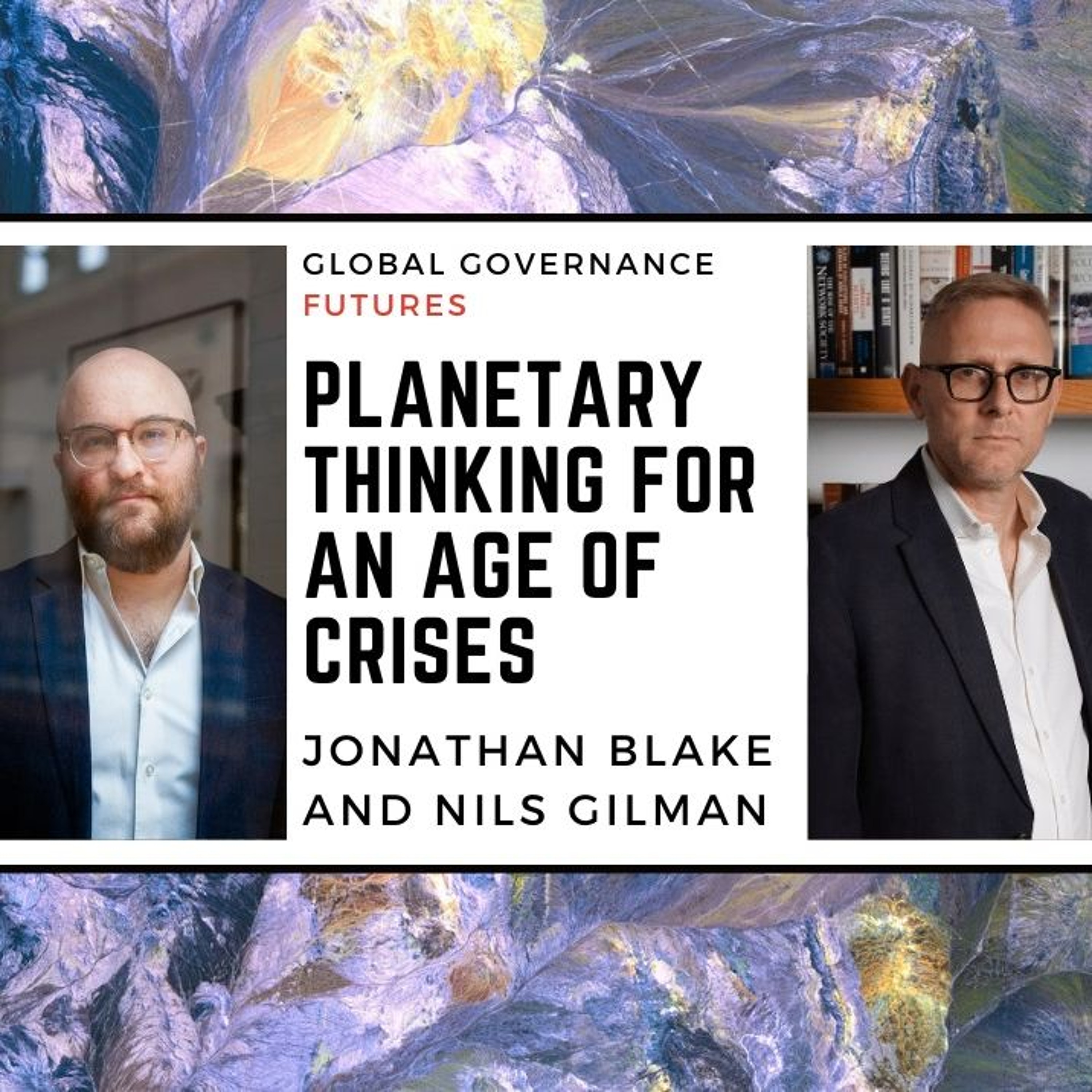
Global Governance Futures: Imperfect Utopias or Bust48: Jonathan Blake and Nils Gilman – Planetary Thinking for an Age of CrisesJonathan Blake and Nils Gilman join us to discuss their recent book, Children of a Modest Star: Planetary Thinking for an Age of Crises, in which they propose a framework of "planetary thinking" to address the interconnected crises facing humanity. Drawing on historical lessons from the COVID-19 pandemic, the International Atomic Energy Agency, and the eradication of smallpox, among other examples, Blake and Gilman advocate for moving beyond traditional state-centered responses. They urge a reorientation toward systemic, planetary-scale challenges that acknowledge humanity’s deep entanglement with ecological and biogeochemical systems.
In this episode, we explore why "planetarity" is an idea wh...
2024-12-151h 14
Future DiscontinuousWhy do we need a world government, Nils Gilman?In the second episode of Future Discontinuous, hosts Misha Glenny and Eva Konzett are joined by historian Nils Gilman, COO of the Berggruen Institute in Los Angeles. Together with their guest, they take a deep dive into the national, the global, and the planetary, and discuss how the outbreak of the Black Death in the 1300s differed from COVID-19, whether a world state could work, and what kind of institutions we need to tackle humanity’s many predicaments in the 21st century. Nils Gilman is a historian and currently the Chief Operating Officer and Executive Vice Pr...
2024-12-0641 min
Latest 300 | LSE Public lectures and events | VideoChildren of a modest starContributor(s): Nils Gilman, Dr Ganga Shreedhar, Professor Karen E Smith | Deadly viruses, climate-changing carbon molecules, and harmful pollutants across the globe are unimpeded by national borders. While the consequences of these flows range across scales, from the planetary to the local, the authority and resources to manage them are concentrated mainly at one level: the nation-state. This profound mismatch between the scale of planetary challenges and the institutions tasked with governing them is leading to cascading systemic failures.
Join us for this event featuring Nils Gilman, co-author of a new book, Children of a Modest Star: Planetary Thinking for...
2024-10-011h 30Latest 300 | LSE Public lectures and events | VideoChildren of a modest starThis event featuring Nils Gilman, co-author of a new book, Children of a Modest Star: Planetary Thinking for an Age of Crises draws on intellectual history, political philosophy, and the holistic findings of Earth system science.
2024-10-011h 30
LSE IQ podcastChildren of a modest starThis event featuring Nils Gilman, co-author of a new book, Children of a Modest Star: Planetary Thinking for an Age of Crises draws on intellectual history, political philosophy, and the holistic findings of Earth system science.
2024-10-011h 30
LSE: The BallparkChildren of a modest starThis event featuring Nils Gilman, co-author of a new book, Children of a Modest Star: Planetary Thinking for an Age of Crises draws on intellectual history, political philosophy, and the holistic findings of Earth system science.
2024-10-011h 30LA Review of BooksWriting Climate FuturesOn July 18th, Los Angeles Review of Books and The Berggruen Institute hosted a panel discussion titled "Writing Climate Futures," featuring David Wallace-Wells, Jenny Offill, Bharat Venkat, and Jonathan Blake.
As our planet faces a climate crisis, questions about the role and efficacy of environmental writing assume greater urgency by the day. Through education, envisioning fictitious new worlds, and pushing forward the public discourse, writing holds the power to move the conversation we have around the future of our planet. LARB and The Berggruen Institute convened exciting voices in the climate movement from across genres to discuss how writing can...
2024-08-091h 03
LARB Radio HourWriting Climate FuturesOn July 18th, Los Angeles Review of Books and The Berggruen Institute hosted a panel discussion titled "Writing Climate Futures," featuring David Wallace-Wells, Jenny Offill, Bharat Venkat, and Jonathan Blake. As our planet faces a climate crisis, questions about the role and efficacy of environmental writing assume greater urgency by the day. Through education, envisioning fictitious new worlds, and pushing forward the public discourse, writing holds the power to move the conversation we have around the future of our planet. LARB and The Berggruen Institute convened exciting voices in the climate movement from across genres to...
2024-08-091h 03
Cultures of Energy221 - Planetarity Now! (with Jonathan Blake and Nils Gilman)Dominic and Cymene are beaming to you this week from a European Cup-addled Berlin. They share a few reflections on their time in Cape Town and then ruminate on why it is it doesn't seem possible to hate anyone from California. Is it the sunshine? As if to underscore this point about the essential good of Californians, we welcome to the podcast (15:55) two brilliant residents of the Golden State, Berggruen Institute based political philosophers Jonathan Blake and Nils Gilman to talk about their new book, Children of a Modest Star: Planetary Thinking for an Age of Crises (Stanford UP, 2024...
2024-07-091h 22
Challenging Climate48. Jonathan Blake and Nils Gilman on planetary governanceJonathan Blake is Associate Director at the Berggruen Institute, where he leads the Planetary Program. Nils Gilman is Senior Vice President at the Berggruen Institute and Deputy Editor of Noema magazine. In this episode, we discuss the ideas in their recently published book, Children of a Modest Star: Planetary Thinking for an Age of Crises. We grapple with ideas of sovereignty, planetary governance and subsidiarity.Links:Jonathan Blake’s profileNils Gilman’s profileCheck out their book, Children of a Modest Star: Planetary Thinking for an Age of CrisesSupport the showSubs...
2024-05-2851 min
Energy vs Climate: How climate is changing our energy systemsBONUS | Nils Gilman on avocado politics and climate security from Challenging ClimateHey everyone, Ed here. David, Sara and Ed will be back next week with an episode about electricity interties in the clean energy system. Until then we’d like to share another podcast with you that we think might be of interest, called Challenging Climate. Hosted by Jesse Reynolds and Pete Irvine, Challenging Climate tackles tough questions about the science, technology, economics and politics of climate change. Their topics range from climate modelling, persuasive narratives, national security, international development and even biotech. Jesse, Pete and their guests cover similar topics to what we cover here at...
2023-10-2050 min
The ProgressiveThe old neoliberal consensus is dead, will a ‘designer economy’ replace it? Podcast: Theory of Change Podcast With Matthew Sheffield (LS 38 · TOP 2% what is this?)Episode: The old neoliberal consensus is dead, will a ‘designer economy’ replace it?Pub date: 2023-02-05Get Podcast Transcript →powered by Listen411 - fast audio-to-text and summarizationThis is a free preview of a paid episode. To hear more, visit plus.flux.communityConcerns about globalization and the rise of politicized religion have led to dramatic increases in political extremism in the United States and many other countries in recent years. But another huge factor...
2023-02-1528 min
Flux Podcasts (Formerly Theory of Change)The old neoliberal consensus is dead, will a ‘designer economy’ replace it?This is a free preview of a paid episode. To hear more, visit plus.flux.communityConcerns about globalization and the rise of politicized religion have led to dramatic increases in political extremism in the United States and many other countries in recent years. But another huge factor has been the shrinking of what people feel like they can expect from their government.For about the last 30 years or so, most countries with mature industrial economies have been ruled by left and right parties that espouse neoliberal views that governments can’t and shouldn’t do m...
2023-02-0528 min
Demos Helsinki Podcast14. Nils Gilman on avocado politics and climate security Podcast: Challenging Climate (LS 27 · TOP 10% what is this?)Episode: 14. Nils Gilman on avocado politics and climate securityPub date: 2022-07-12Notes from Demos Helsinki Podcast:First discussing avocado politics, what it is, and how it manifests in the US and Europe. The second half of the episode takes a look at climate change and security on global and national scales, and what it really means to prioritise climate change on the political agenda.Get Podcast Transcript →powered by Listen411 - fast audio-to-text and summarizationDr. Nil...
2022-07-2350 minChallenging Climate14. Nils Gilman on avocado politics and climate securityDr. Nils Gilman is the Senior Vice President of Programs at the Berggruen Institute and the deputy editor of Noema Magazine. We speak with Nils about two of his popular articles, "The Coming Avocado Politics" and "The Guns of Warming". We first discuss avocado politics, what it is and how it manifests in the United States and Europe. The second half of the episode takes a look at climate change and security on global and national scales, and what it really means to prioritize climate change on the political agenda. Links: Nils Gilman’s profileCheck out Noema...
2022-07-1250 min
From the New WorldNils Gilman: Why Can't We Build?Nils is the VP of programs at the Bergruen institute and deputy editor of Noema magazine.Issues and Timestamps:0:00 right-wing policy movement8:30 supreme court18:54 legitimacy29:12 right wing postmodernists32:50 state capacity52:00 fda and neuroticism1:39:00 populists right vs. libertarians153:30 aesthetic preferences223:00 problems of power analysis238:00 centralization vs. bureaucracy3:00:00 politics of recognitionRelevant links:Nils Gilman on twitter:https://twitter.com/nils_gilman?Noema magazine:https://www.noemamag...
2022-07-113h 12
InstitutionalizedThe Elites with Nils GilmanThis week we are joined by Nils Gilman to discuss elite accountability and state capacity.Recommendations:Francis Fukuyama's Liberalism and Its DiscontentsRobert Caro's Power Breaker: Robert Moses & The Fall of New YorkThe Technological Fix & Wicked Problems
2022-06-291h 06
noliesradioThe BradCast 2022-0118Encore: Dr. Nils Gilman on protecting American democracy from re-emerging 'demons of hell
2022-01-1858 minnoliesradioThe BradCast 2022-0110Dr. Nils Gilman on protecting American democracy from re-emerging 'demons of hell'
2022-01-0958 min
European StraitsThe State of the World w/ Nils Gilman. Thumbs Up/Down. Work-Life Balance Across Cultures.The Agenda 👇I spoke with Nils Gilman of the Berggruen Institute about intellectual history and the state of the world 🎧Thumbs up/down for last weekThread of the week: about productivity and work-life balanceA new essay by Younès Rharbaoui about “time-variant business models”For the latest episode of the Building Bridges podcast, I interviewedNils Gilman, who leads the research program at the Berggruen Institute, a think tank based in Los Angeles and Beijing.Nils and I met in February of last year at Tim O’Reilly’s Soci...
2021-06-3054 min
What The FUP? Downloads From The Secret Ghost LibraryEpisode 004 - The Violence Inherent In The SystemWhich insurgency will YOU join: the plutocrats or the criminal underclass? In this episode, we discuss Dr. Nils Gilman's fascinating paper "The Twin Insurgency" (https://www.the-american-interest.com/2014/06/15/the-twin-insurgency/). Brian takes the lead on the political and historical context of the rise of neoliberalism in the United States, and Lindsey connects the literature on evolved cheater detection mechanisms to political rhetoric. Here's a link to Tomasello's paper The Ultra-Social Animal, which comes up in the second half of the show: https://onlinelibrary.wiley.com/doi/pdf/10.1002/ejsp.2015.
Support the show at: https://www.patreon.com/fuppod
Email us at FUPpod...
2021-04-261h 36
New World Same HumansNew World Same Humans #58 – Audio VersionWelcome to New World Same Humans, a weekly newsletter on trends, technology, and society by David Mattin.If you’re reading this and you haven’t yet subscribed, then join 16,000+ curious souls on a mission to build a better shared future 🚀🔮Here in the UK, this week marks one year since the start of the first coronavirus lockdown.Time, then, to reflect. A note this week on what we know must change: about our relationship with markets, growth, and government. And why it’s time to reclaim an old, politically charged phrase: there is no alternati...
2021-03-2109 min
New World Same HumansNew World Same Humans #58 – Audio VersionWelcome to New World Same Humans, a weekly newsletter on trends, technology, and society by David Mattin.If you’re reading this and you haven’t yet subscribed, then join 16,000+ curious souls on a mission to build a better shared future 🚀🔮Here in the UK, this week marks one year since the start of the first coronavirus lockdown. Time, then, to reflect. A note this week on what we know must change: about our relationship with markets, growth, and government. And why it’s time to reclaim an old, politically charged phrase: there is no alternat...
2021-03-2109 min
DecoupleAvocado Politics feat. Nils GilmanOn the progressive side of the political spectrum, it is assumed that with an increasing acknowledgment of the reality of climate change will come default support for a progressive Green New Deal agenda. There is, however, another possible outcome of the far-right abandoning climate denial: Avocado Politics, green on the outside, brown(shirt) on the inside.
In the words of Nils Gilman, "The strong state demanded by right-wing environmentalists will not be one that is liberal, tolerant, or inclusive but rather one that prioritizes the welfare of the native-born and ethnically pure while enforcing punitive restrictions against f...
2021-03-1658 min
The American Mind PodcastEscalation | The Roundtable Ep. 36The Berggruen Institute’s VP of Programs, Nils Gilman, recently tweeted out what is tantamount to death threats against Michael Anton. No retraction has been forthcoming. Unrest in Louisville bubbled over into the shooting of three police officers. Add in the death of Ruth Bader Ginsburg, and you have a recipe for one thing: escalation. Get full access to Claremont Digital Plus at claremontinstitute.substack.com/subscribe
2020-09-251h 14
The American Mind PodcastOn Death Threats | The Roundtable Ep. 36 Segment 1Calling for the death of your political opponents is wrong, right? Right. Well, The Berggruen Institute’s Nils Gilman seems to think calling for death is acceptable if the target is a deplorable such as Claremont senior fellow Mike Anton. Our editors deplore this troubling development. Get full access to Claremont Digital Plus at claremontinstitute.substack.com/subscribe
2020-09-2522 min
Wisdom of CrowdsEpisode 32: The Looming Crisis of LegitimacyThe great Nils Gilman of the Berggruen Institute and Noema joins Shadi and Damir to talk about why the upcoming elections feel existential, why our federal government feels increasingly illegitimate, and why Shadi's most recent piece in The Atlantic has annoyed so many people. Reading List: "Human Rights and Neoliberalism," by Nils Gilman (LA Review of Books) "The Collapse of Racial Liberalism," by Nils Gilman (The American Interest) "The Democrats May Not Be Able to Concede," by Shadi Hamid (The Atlantic) This is a public episode. If you'd like to discuss this with other su...
2020-09-191h 15
COVIDCallsEP #97 - COVID-19 and the Future of Democracy - Nils GilmanToday, I talk about COVID-19, the government response and the future of democracy with Nils Gilman of the Berggruen Institute.
Dr. Nils Gilman is the Vice President of Programs at the Berggruen Institute, in which capacity he leads the Institute’s research program, directs its resident fellowship program, and is also Deputy Editor of Noema Magazine. He has previously worked as Associate Chancellor at the University of California Berkeley. Gilman has won the Sidney Award (for long-form journalism) from the New York Times and an Albie Award (for international political economy) from The Washington Post.
He i...
2020-08-071h 23
DecoupleConfucius Smiled: COVID-19 Lessons from the East feat. Nils GilmanPolitics, confidence in science and attitudes towards surveillance technology have led to very different outcomes between the East and the West when it comes to COVID-19. Many Asian countries have achieved containment of the virus while the West largely remains caught in a quagmire with no end in sight. What explains these differences? Cultural attitudes? Neo-liberalism vs. State capitalism? Bankrupt social welfare systems? Distrust of elites and institutions? I am joined by Nils Gilman of the Berggruen institute who helps us unpack the complexities and learn the lessons of our COVID successes and failures.
2020-06-2148 min
IDEAS IN ACTION | USC's Podcast SeriesDornsife Dialogues: “Pandemic Preparedness: What Went Wrong and What Have We Learned?”Why weren’t we better prepared for the COVID-19 outbreak and what can we learn from our current ordeal to be better prepared for the next pandemic? USC Dornsife’s Andrew Lakoff and Nils Gilman, Vice President of Programs at the Berggruen Institute, talks with journalist and author Mark Perry about how the U.S. did and didn’t prepare for COVID-19. Lakoff, Professor of Sociology and Divisional Dean of Social Sciences, is the author of Unprepared: Global Health in a Time of Emergency, in which he describes the challenges of properly anticipating and preparing for biological threats. Gilman previously w...
2020-05-2629 min
SpillMarch 22, 2020: Seeing Corona Through Climate-Colored Glasses with David Wallace-WellsAll the things the climate story has taught us, or not, about corona, with special guest co-host David Wallace-Wells. David is deputy editor of New York magazine and the author of The Uninhabitable Earth.Reading list:Coronavirus Poses Threat to Climate Action, Says Watchdog, Jillian Ambrose in the Guardian https://www.theguardian.com/environment/2020/mar/12/coronovirus-poses-threat-to-climate-action-says-watchdogWhat Coronavirus Teaches Us About Climate Change, David Wallace-Wells in New York Magazine https://nymag.com/intelligencer/2020/02/what-coronavirus-teaches-us-about-climate-change.htmlClimate Change Has Lessons for Fighting Corona Virus, by Somini Sengupta in The NY Times https://www.nytimes.com/2020/03/12/climate/climate-change-coronavirus-lessons.html We’re Getting a Clearer Pic...
2020-03-221h 38
3 Whisky Happy HourThe Most Gonzo Episode EverNils Gilman Is it possible for conservatives and left-of-center thinkers to have a civil and substantive conversation in the Era of Trump? Steve Hayward decided to find out, and the result is this completely gonzo episode. Steve sat down for a long and appropriately boozy dinner recently with Nils Gilman of the Berggruen Institute, and Ted Nordhaus of the Breakthrough Institute, for a grand tour... Source
2019-12-171h 14
Hudson Institute Events PodcastAre Plutocrats Drowning Our Republic?Francis Fukuyama, Walter Russell Mead, Tyler Cowen, Adam Garfinkle, Nils Gilman, Kurt Volker, Jeffrey Winters and Charles Davidson on liberalism in 2016.
2016-07-212h 36
Hudson Institute Events PodcastAre Plutocrats Drowning Our Republic?Francis Fukuyama, Walter Russell Mead, Tyler Cowen, Adam Garfinkle, Nils Gilman, Kurt Volker, Jeffrey Winters and Charles Davidson on liberalism in 2016.
2016-07-212h 36
Hudson Institute Events PodcastAre Plutocrats Drowning Our Republic?Francis Fukuyama, Walter Russell Mead, Tyler Cowen, Adam Garfinkle, Nils Gilman, Kurt Volker, Jeffrey Winters and Charles Davidson on liberalism in 2016.
2016-07-212h 36
PopTech Audio: PopCastsNils Gilman: Deviant globalizationDeviant globalization is the global flow of “repugnant” goods and services like drugs, human trafficking and illegal wildlife. Such globalization leverages the mainstream infrastructure of the formal economy along with any downsizing in the role of the state. Nils Gilman asks what this means for countries in flux like Greece and Libya.
2011-11-0321 min
Long NowNils Gilman: Deviant Globalization### The anti-state economy
Gilman described deviant globalization as "the unpleasant underside of transnational integration."
There's nice tourism, and then sex tourism, such as in Thailand and Switzerland. The vast pharmacology industry is matched by a vast traffic in illegal drugs. The underside of waste disposal is the criminal dumping in the developing world of toxic wastes from the developed world. Military activities worldwide are fed by a huge gray market in weapons. Internet communications are undermined by floods of malware doubling every year. Among the commodities shipped around the world are exotic hardwoods, endangered species, blood diamonds, and stolen art...
2010-05-041h 34
The Long Now FoundationNils Gilman - Deviant GlobalizationHidden and powerful and growing worldwide at twice the rate of the legal economy, "deviant globalization" is described by Nils Gilman as "human trafficking, drug dealing, gun running, cross-border waste disposal, organ trading, sex tourism, money laundering, transnational gangs, piracy (both intellectual and physical), and so on."
He adds: "The structure of the current global economy is not designed for equitable, plodding growth; it's designed to reward opportunistic, risk-seeking innovators. Were one to construct an investment portfolio of illicit businesses, it would no doubt outperform Wall Street."
In some parts of the world, with the decline of state sovereignty and...
2010-05-021h 34
European Futurists Conference LucerneNils Gilman - The Global Illicit EconomyA new class of global actors is playing an increasingly important role in globalization: smugglers, warlords, guerrillas, terrorists, gangs, and bandits of all stripes. Since the end of the Cold War, the global illicit economy has consistently grown at twice the rate of the licit global economy. Increasingly, illicit actors will represent not just an economic but a political force. As globalization hollows out traditional nation-states, what will fill the power vacuum in slums and hinterlands will be informal non-state governance structures. These zones will be globally connected, effectively run by local gangs, religious leaders, or quasi-tribal organizations – organizations that wi...
2009-02-0128 min