Shows
Waterlines: How Water Shapes Our WorldCalifornia’s Groundwater Checkup: Measuring Risk by Place and by PeopleGroundwater is easy to forget because it is out of sight, but millions of people depend on it every day. This episode follows a statewide California effort to answer a deceptively simple question: when a well test finds a problem, how do we describe the size of that problem fairly? Is it the number of wells, the amount of aquifer area affected, or the number of people who rely on that water? We unpack how USGS scientists used data from about 11,000 public-supply wells across 87 study areas to build two clearer yardsticks: affected area and equivalent-population. Along the way, we...
2026-06-0510 min
Waterlines: How Water Shapes Our WorldWho Gets Tap Water from Underground? Mapping America’s Public-Supply GroundwaterTurn on a kitchen faucet and the water may have traveled from a river, a reservoir, or a well drilled into layers of sand, gravel, limestone, or fractured rock. That hidden geography matters: it shapes which communities depend on which aquifers, which water sources need protection, and who may be affected when drought, contamination, or growth puts pressure on groundwater.In this episode, we unpack a national USGS mapping study that asks a deceptively simple question: where are the people who get public drinking water from groundwater, and which underground water-bearing regions supply them...
2026-06-0313 min
Waterlines: How Water Shapes Our WorldWhen Wetlands Whisper and Groundwater Speaks: Tracking Chemistry in a Flat Michigan StreamFlat, wetland-rich streams can look quiet from the road, but they help decide what nutrients, salts, and carbon move through our landscapes and into bigger rivers. That matters for drinking water, farm country, wetland protection, climate-linked carbon cycling, and how communities monitor water quality. In this episode of Waterlines, we visit Augusta Creek in southwest Michigan, where scientists sampled the same stream network again and again for nearly three years to ask a deceptively simple question: when stream chemistry changes, is the story written by wetlands on the surface, or by groundwater moving underground?...
2026-06-0112 min
Waterlines: How Water Shapes Our WorldThe Water Cycle Picture Is Missing UsEvery schoolkid learns the water cycle: sun, cloud, rain, river, ocean, repeat. But that familiar picture quietly shapes how adults think about dams, drought, pollution, farming, climate change, and who gets water in a crisis. This episode asks a surprisingly practical question: what happens when the most common map of water on Earth leaves people almost entirely out?We unpack a Nature Geoscience study that compared modern estimates of global water stores and flows with hundreds of water-cycle diagrams from textbooks, agencies, classrooms, and web searches around the world. The researchers found that human...
2026-05-2911 min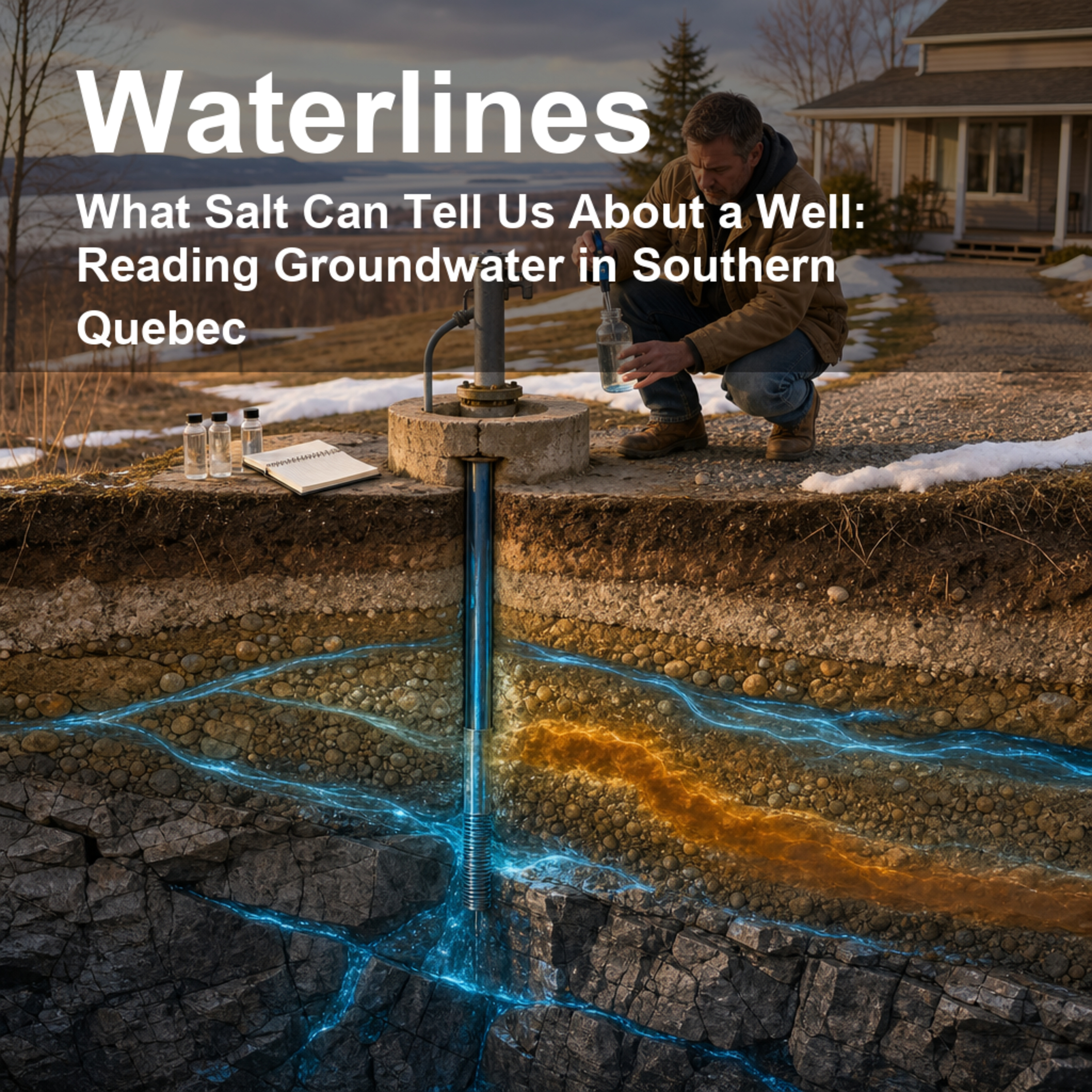
Waterlines: How Water Shapes Our WorldWhat Salt Can Tell Us About a Well: Reading Groundwater in Southern QuebecA glass of well water can look perfectly clear and still carry a hidden story from ancient seas, road salt, bedrock, clays, and slow underground flow. This episode matters because millions of people rely on private wells, and testing every possible chemical is expensive. We explore a practical question: can one easy field measurement give homeowners and water managers an early clue about what else may be in groundwater?The paper takes us to Southern Quebec, where researchers used 2,608 groundwater samples from a large public knowledge program. They sorted the samples by chloride, a...
2026-05-2711 min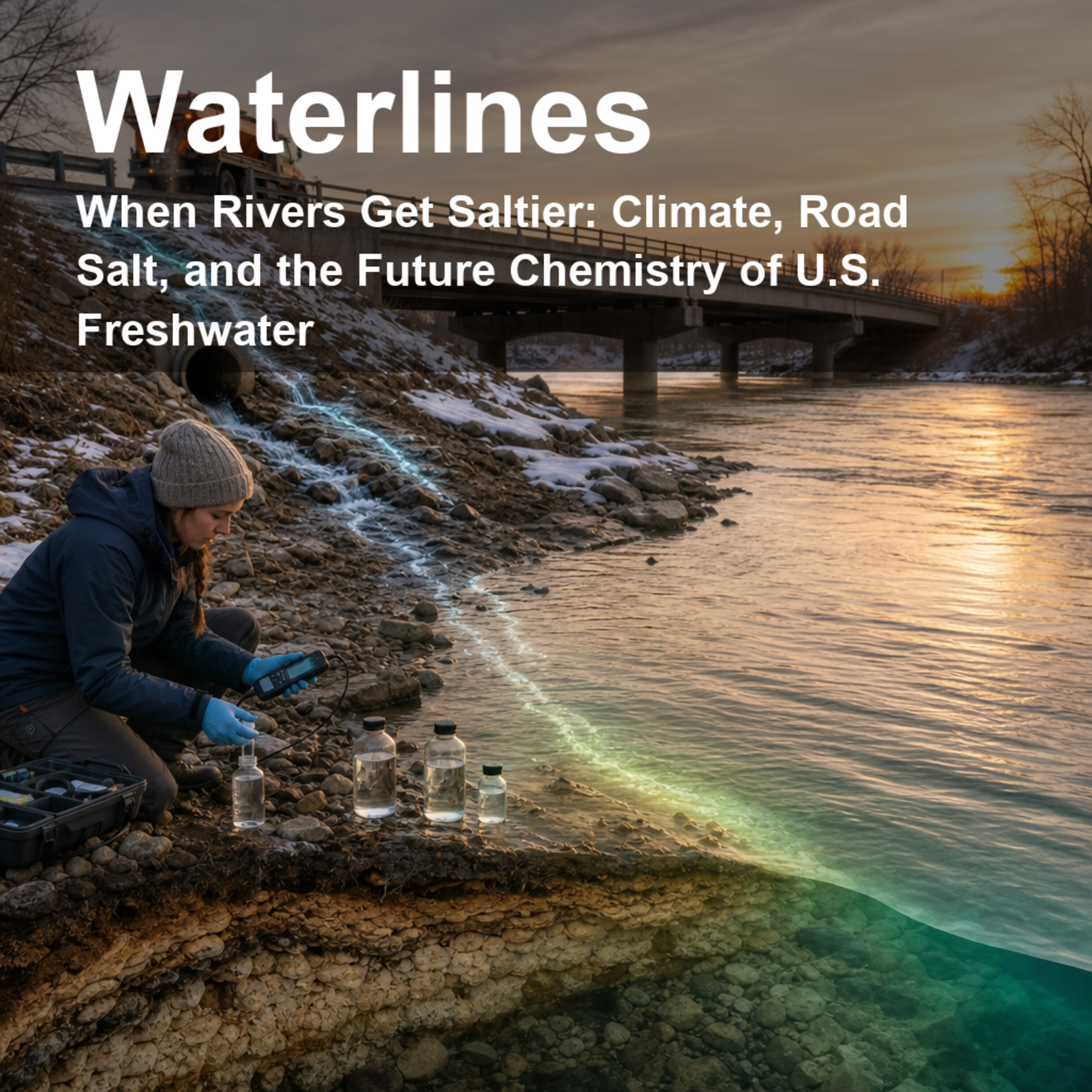
Waterlines: How Water Shapes Our WorldWhen Rivers Get Saltier: Climate, Road Salt, and the Future Chemistry of U.S. FreshwaterA glass of tap water, a winter road, a farm field, and a trout stream are all connected by river chemistry. This episode asks a practical climate question: as the U.S. warms, will freshwater become saltier, less buffered, or simply different in ways communities need to plan for? We follow a new study that used long-running river records and machine learning to look ahead from 2040 to 2100, linking sodium, alkalinity, road salt, rainfall, population, and bedrock geology across 226 U.S. river sites.Hosts A and B unpack why northern rivers may see lower sodium...
2026-05-2711 min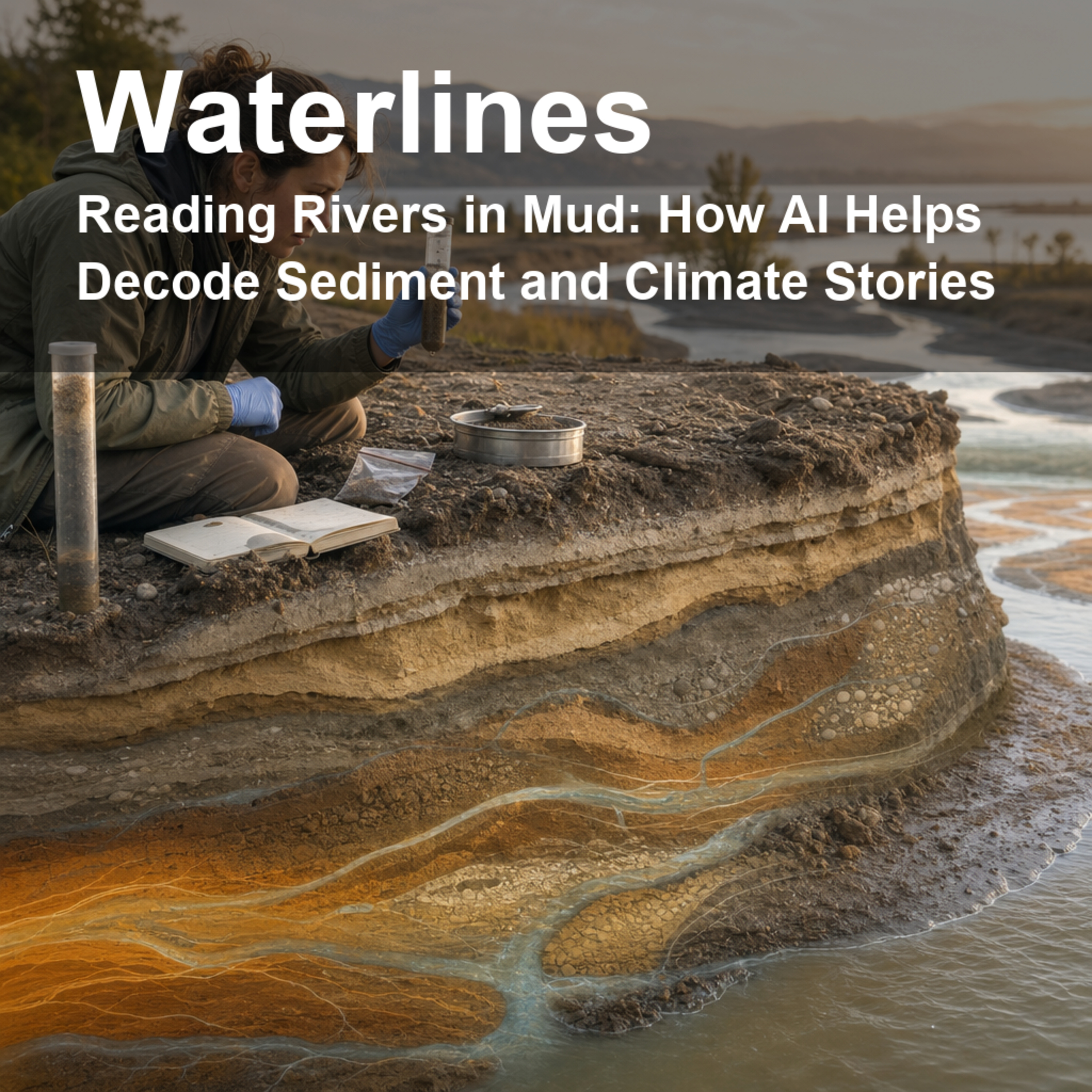
Waterlines: How Water Shapes Our WorldReading Rivers in Mud: How AI Helps Decode Sediment and Climate StoriesA handful of mud can hold the memory of a river flood, a lake edge, or a dust storm that crossed a continent. That matters because sediments are one of the main ways water leaves a record of past environments, climate shifts, and landscape change. In this episode of Waterlines, we unpack a new study that asks a practical question: if scientists use grain size to read those records, how can they reduce the human guesswork built into the methods?The paper follows 73,393 sediment samples from loess, river, and lake-delta settings, mostly in China...
2026-05-2711 min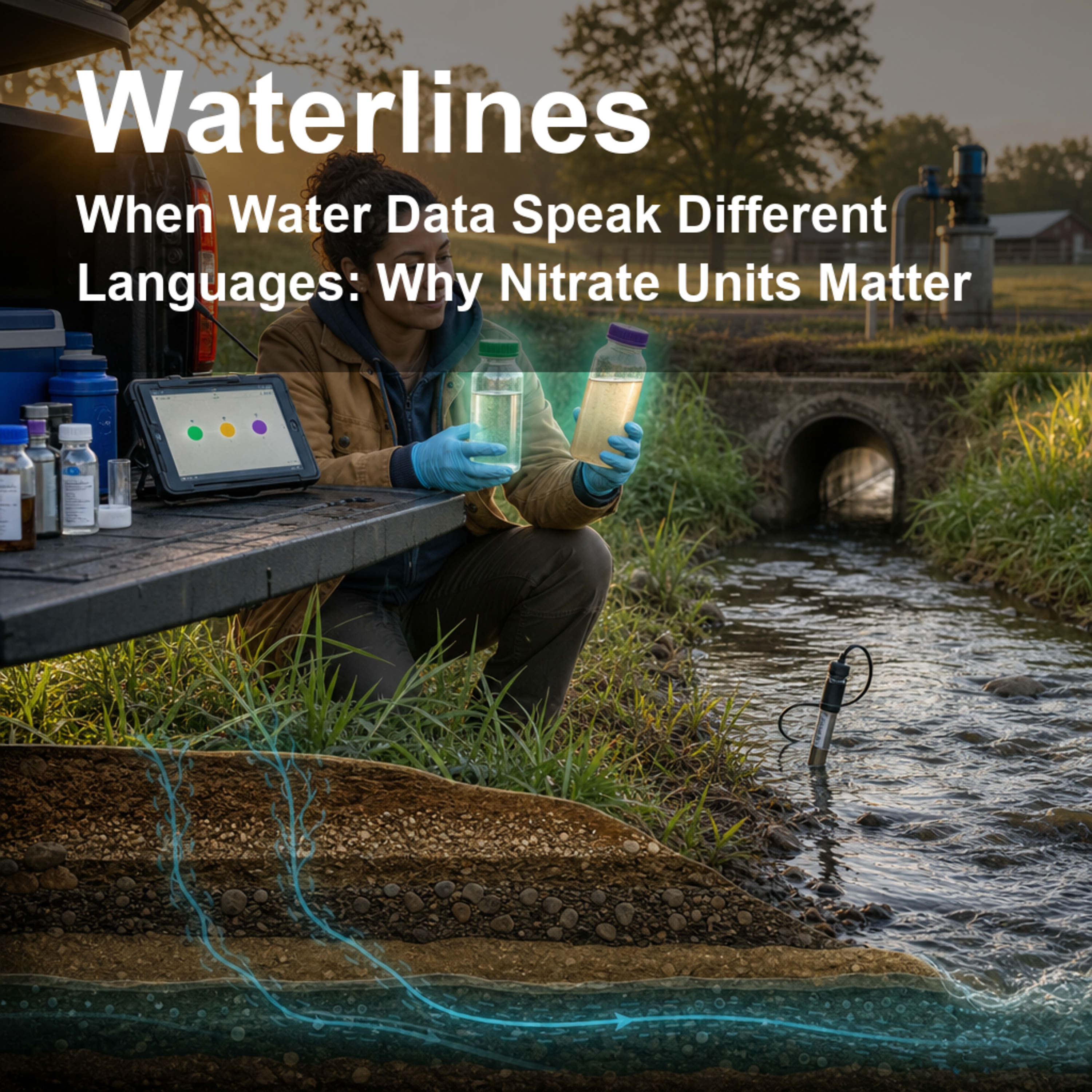
Waterlines: How Water Shapes Our WorldWhen Water Data Speak Different Languages: Why Nitrate Units MatterClean water decisions often depend on numbers in a database: a nitrate reading from a farm well, a phosphate measurement from a river, a trend line warning of algae blooms. But what if those numbers use different naming habits, missing units, or labels that can be misunderstood? This episode looks at a deceptively simple problem with big consequences: water-quality data are easier to share than ever, but not always easy to trust or combine.Hosts A and B unpack a short Environmental Science & Technology Viewpoint arguing that researchers, agencies, and labs can make water...
2026-05-2710 min
Waterlines: How Water Shapes Our WorldReading Deep Heat in Mexico’s Geothermal WaterGeothermal power sounds simple: bring hot water up, make electricity, send cooled brine back down. But underground, that loop can change where fluids flow, where steam forms, and how long a reservoir can keep giving heat. This episode visits Mexico’s Los Azufres geothermal field, where scientists used tiny traces of noble gases and strontium in water and steam to ask very practical questions: Where is the heat coming from? How has decades of production and reinjection changed the field? And what can invisible atoms tell us about managing clean energy below our feet?We...
2026-05-2711 min
Waterlines: How Water Shapes Our WorldWhen Methane Finds a Water Well: Tracking Gas Leaks in Shale CountryWhen people turn on a kitchen tap, they are trusting a hidden system of rock, fractures, wells, microbes, and chemistry. This episode matters because methane in groundwater is not only a household safety concern; it is also a clue to how energy development, geology, and water protection intersect. We visit Sugar Run in Pennsylvania, where researchers studied bubbling seeps, private wells, stream water, and the layered rocks beneath them to understand why methane sometimes appears near hydraulically fractured shale gas wells—and how to tell a new problem from an older, natural one.The co...
2026-05-2712 min
Waterlines: How Water Shapes Our WorldWhen Gas Wells Leak: How Scientists Trace Methane in Drinking WaterA glass of well water can look perfectly clear and still carry a hidden question: where did that gas bubble come from? This episode matters beyond one paper because millions of people rely on private wells, and energy development, rural water safety, climate concerns, and public trust often meet at the kitchen tap. We follow scientists as they sort out methane migration near shale-gas sites using chemical “fingerprints,” well-construction records, and a lot of cautious field detective work.The episode explains why methane in water is not usually treated like a classic poison, but can...
2026-05-2711 min
Waterlines: How Water Shapes Our WorldWhen Water Data Is Scarce: Teaching AI to Listen to ScienceMany of the water decisions that matter most—tracking contamination in seawater, understanding how rocks and soils release chemicals, or predicting a river’s response after a storm—happen with fewer measurements than anyone would like. This episode looks at a machine-learning idea built for that reality: instead of asking AI to learn everything from scratch, start with the scientific rule we already trust, then train the AI to learn what that rule misses. We unpack Knowledge-based Residual Learning, or KRL, through everyday analogies and water-relevant examples, including radioactive chemical measurements in seawater near Fukushima and chemical weathering in soils...
2026-05-2710 min
Waterlines: How Water Shapes Our WorldHelium in the Well Water: Tracing Hidden Groundwater Beneath MichiganGroundwater can look still from the surface, but deep below our feet it may be slowly moving, mixing, and carrying clues from rocks, ancient climate, and even Earth’s interior. This episode matters because communities depend on shallow aquifers for water, while society also asks the subsurface to store waste, energy, and carbon. A study from the Michigan Basin shows how tiny amounts of helium dissolved in well water can reveal whether deep salty waters are leaking upward into younger, fresher aquifers—and why that matters for water quality and long-term underground decisions.We foll...
2026-05-2711 min
Waterlines: How Water Shapes Our WorldWhy Water Data Needs a Cleanup Before It Can Tell Us What’s in Our StreamsBefore a community can ask whether a stream is changing, whether mining or drilling left a signal, or whether a restoration project is working, someone has to make thousands of water measurements speak the same language. This episode looks at a deceptively simple problem: water quality data may be online, but that does not mean they are ready to use. Different databases can call nitrate by different names, use different units, hide missing values in different ways, or repeat the same sample more than once. Those details can shape what scientists, agencies, and communities think they know about rivers.
2026-05-2711 min
Waterlines: How Water Shapes Our WorldMethane in the Creek: How Streams Can Reveal Hidden Gas LeaksA small creek can carry clues about big questions: energy, climate, drinking water, abandoned mines, old wells, and how communities notice changes in places they know well. In this episode, Waterlines follows researchers and volunteers across the northern Appalachian Basin as they use stream water to look for methane, a powerful greenhouse gas that can also change water chemistry underground. The surprise is not that every stream is full of methane. Most were not. The story is about the few places where groundwater seeps deliver methane into streams, and how those seeps can point to coal mines, old oil...
2026-05-2711 min
Waterlines: How Water Shapes Our WorldThe Glacier Water Hidden in Michigan’s Shale GasA gas well can feel far removed from everyday water concerns, but this episode shows why the water trapped deep underground matters for climate history, energy choices, and groundwater protection. In Michigan’s Antrim Shale, scientists used tiny traces of noble gases—helium, neon, argon, krypton, and xenon—as time stamps and travel tags. Those gases reveal that ancient brines from deeper rocks mixed with younger water likely pushed downward during Ice Age glaciations. They also help separate methane made by microbes from methane that formed deeper and hotter in the basin. For listeners, the story is a practical remind...
2026-05-2711 min
Waterlines: How Water Shapes Our WorldThe Forgotten Wells Beneath Our Water, Climate, and Clean Energy FutureOld oil and gas wells can sit quietly in farm fields, forests, neighborhoods, and under future energy projects. Some are forgotten, some are leaking, and many are close to the groundwater people drink. This episode matters because it connects a hidden piece of industrial history to everyday water safety, climate pollution, public spending, and the choices communities face as the United States moves toward cleaner energy.We unpack a national study of documented orphaned oil and gas wells: wells with no financially responsible owner. The paper asks where these wells are, who lives near...
2026-05-2711 min
Waterlines: How Water Shapes Our WorldWhen Methane Shows Up in Well Water: Reading the Chemistry CluesMethane in a home water well can be frightening, confusing, and politically charged—especially in regions where natural gas drilling, old oil wells, coal mining, and naturally gassy rocks all overlap. This episode matters because communities need ways to ask a practical question: is methane in groundwater long-standing and natural, or is it a fresh arrival that may point to a leaking well or another recent disturbance?We unpack a study from Pennsylvania’s Appalachian Basin that tested whether ordinary water-chemistry measurements can act like a first-pass detective kit. The researchers looked at more than...
2026-05-2711 min
Waterlines: How Water Shapes Our WorldPenguin Clues in Antarctic Mud: How Guano, Water, and Nitrogen Reveal Past ColoniesAntarctica can look empty, but its ponds, pebbles, and mud can hold a living history of birds, climate, nutrients, and water. This episode follows scientists into the Ross Sea region, where old Adélie penguin colonies left chemical traces in sediments. The surprise is that a routine lab step, washing samples with acid, may reveal how strongly penguins shaped a place. We unpack nitrogen isotopes without assuming a science background, explore why cold dry air changes guano after it lands, and ask what these muddy clues can and cannot tell us about past ecosystems in a warming polar world.
2026-05-2712 min
Waterlines: How Water Shapes Our WorldCan a Stream Spill Hide in Plain Sight? Mapping Water Clues Near Shale Gas WellsWhen something spills near a stream, the question people care about is simple: did it reach the water? The answer is rarely simple. Creeks twist through hills, sampling stations are scattered, and public reports may arrive long before any chemistry data can confirm what happened. This episode follows researchers who built GeoNet, a geospatial tool that treats streams like connected neighborhoods and compares water chemistry upstream and downstream of reported shale gas spills in Pennsylvania. We unpack why sodium and chloride can act like long-lasting clues, why sparse monitoring can miss real events, and why “not detected” is not the...
2026-05-2711 min
Waterlines: How Water Shapes Our WorldFracking, Drinking Water, and the Data People Need to TrustWhen people worry about the water from their tap or the creek behind their house, the question is not only “what does the science say?” It is also “who has the data, who gets to see it, and who is trusted to explain it?” This episode looks at fracking in Pennsylvania’s Marcellus Shale through that everyday problem: how communities, scientists, regulators, companies, and volunteers can argue less productively—or work together better—when water-quality data are shared, checked, and discussed in the open.Using the Shale Network effort as our guide, we explore why water cont...
2026-05-2711 min
Waterlines: How Water Shapes Our WorldThe Hidden Water Library: Why Sharing Chemistry Data MattersEvery water sample tells a small story: what flowed through a farm field, a mine, a city pipe, a forest soil, or a fractured rock underground. But if those stories stay trapped in notebooks, spreadsheets, or journal supplements, communities lose a powerful tool for spotting pollution, tracking climate-linked change, and understanding Earth’s life-support systems. In this episode, Waterlines follows a paper about the future of low-temperature geochemistry data—basically the chemistry of water, soils, rocks, air, and life at Earth’s surface—and asks a practical question: how do we make scattered environmental measurements useful to everyone who needs them?We...
2026-05-2711 min
Waterlines: How Water Shapes Our WorldTiny Tracers Under the South China Sea: How Noble Gases Reveal Water, Faults, and GasOffshore gas fields can feel far away from daily life, but the same underground plumbing that moves methane also moves salty water, heat, carbon dioxide, and clues about leakage. This episode follows scientists into the Yinggehai Basin, west of Hainan Island, where tiny amounts of helium and argon act like durable luggage tags on deep fluids. Because these noble gases barely react with anything, they can reveal where fluids came from, how faults guide them, whether reservoirs stayed sealed, and when gas was trapped. We unpack how water helps carry atmospheric gases underground, how hot rocks add crust-made helium and...
2026-05-2711 min
Waterlines: How Water Shapes Our WorldOld Wells, Road Salt, and Drinking Water: A Pennsylvania Groundwater Detective StoryGroundwater problems rarely arrive with a label saying where they came from. For families on private wells, a change in taste, saltiness, metals, or methane can raise urgent questions: Is it nearby drilling? Old oil and gas wells? Road salt? Natural geology? This episode follows scientists trying to answer those questions in two Pennsylvania landscapes with very different energy histories. One county had intense recent shale gas development; the other had more than a century of conventional oil and gas activity, plus road de-icing and brine use. The surprise is not a simple blame story. It is a careful...
2026-05-2711 min
Waterlines: How Water Shapes Our WorldWhat 11,000 Wells Reveal About Fracking, Methane, and Rural Drinking WaterPrivate wells are everyday lifelines: a kitchen tap, a stock tank, a shower before work. In shale country, those taps also sit above old rocks, natural gas pockets, fault lines, roads, farms, and modern drilling. This episode looks at what happens when scientists bring together more than 11,000 groundwater samples from Bradford County, Pennsylvania, to ask a plain but difficult question: is water quality changing where Marcellus shale gas development expanded quickly? We unpack how large data sets can reveal patterns that small studies miss, why methane in well water can come from both natural geology and human activity, and...
2026-05-2710 min
Waterlines: How Water Shapes Our WorldHot Springs, Helium, and a Moving Plateau: What Water Reveals Beneath TibetHot springs can feel like surface comforts, but the bubbles rising through them may carry messages from far below our feet. In this episode, we follow water and gas samples from the southeastern edge of the Tibetan Plateau, where researchers used helium isotopes in geothermal springs to ask a big question: is the plateau’s deep crust slowly flowing outward, like warm taffy under a hard shell? The answer matters beyond one mountain range because deep fluids move heat, gases, and chemical signals through faults, shape geothermal resources, and help scientists read tectonic landscapes that also host damaging earthquakes....
2026-05-2711 min
Waterlines: How Water Shapes Our WorldWhy U.S. Rivers Are Getting Saltier, and Why Their Chemistry Is More Complicated Than Road SaltFresh water is not just wet; it carries a chemical memory of roads, cities, rocks, soils, and weather. This episode matters because the salts and alkaline compounds moving through rivers can affect drinking water, stream life, bridges and pipes, and even how scientists think about carbon moving from land to ocean. We unpack a national-scale study that used machine learning to ask a practical question: when U.S. rivers get saltier and more alkaline, how much is driven by people, and how much by the landscape itself?The paper follows 226 U.S. Geological Survey...
2026-05-2711 min
Waterlines: How Water Shapes Our WorldWhen Satellites Meet Stream Boots: A Friendly Guide to Trusting Big Water DataWater decisions now lean on a flood of information: rain gauges, satellites, stream sensors, soil-moisture maps, and climate models. That can help us see droughts, floods, and groundwater risks far beyond any single field site, but only if the analysis is careful enough to trust. This episode unpacks a practical framework called GRRIEn analysis, which helps Earth scientists turn huge global Earth observations into useful, reproducible, and physically believable insight. We talk about why a satellite map is not automatically an answer, why nearby measurements can accidentally repeat the same story, why models can look accurate for the wrong...
2026-05-2710 min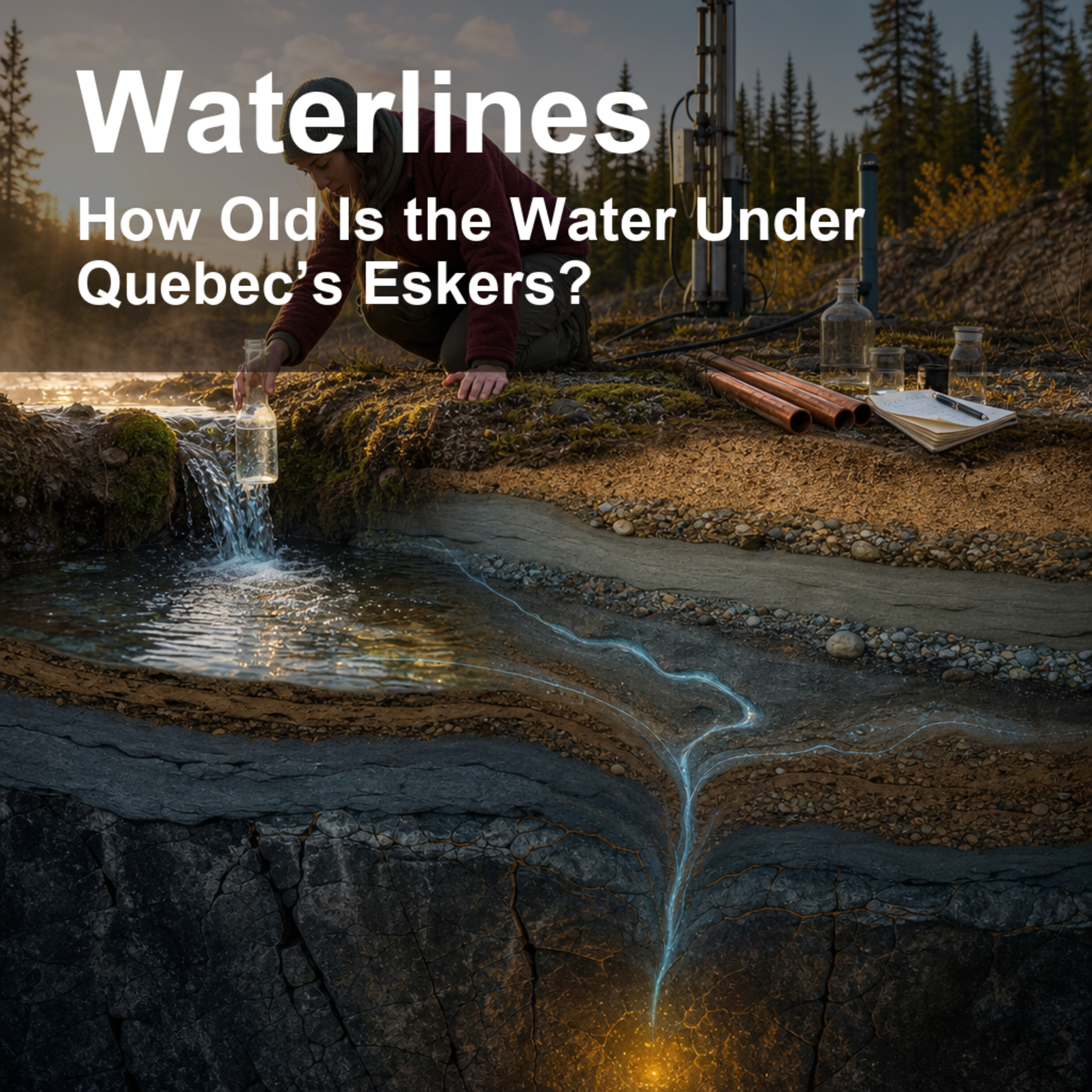
Waterlines: How Water Shapes Our WorldHow Old Is the Water Under Quebec’s Eskers?A glass of clear groundwater can look timeless, but its age matters for people deciding how much to pump, where to place roads and gravel pits, and how to protect drinking water from spills. This episode visits the Amos region of northwestern Quebec, where long ridges of sand and gravel left by melting ice, called eskers, store unusually clean water. Scientists used tiny traces of helium and tritium to ask a practical question: is this water being renewed quickly, or are some parts of the aquifer a one-time inheritance from ancient ice ages?We...
2026-05-2712 min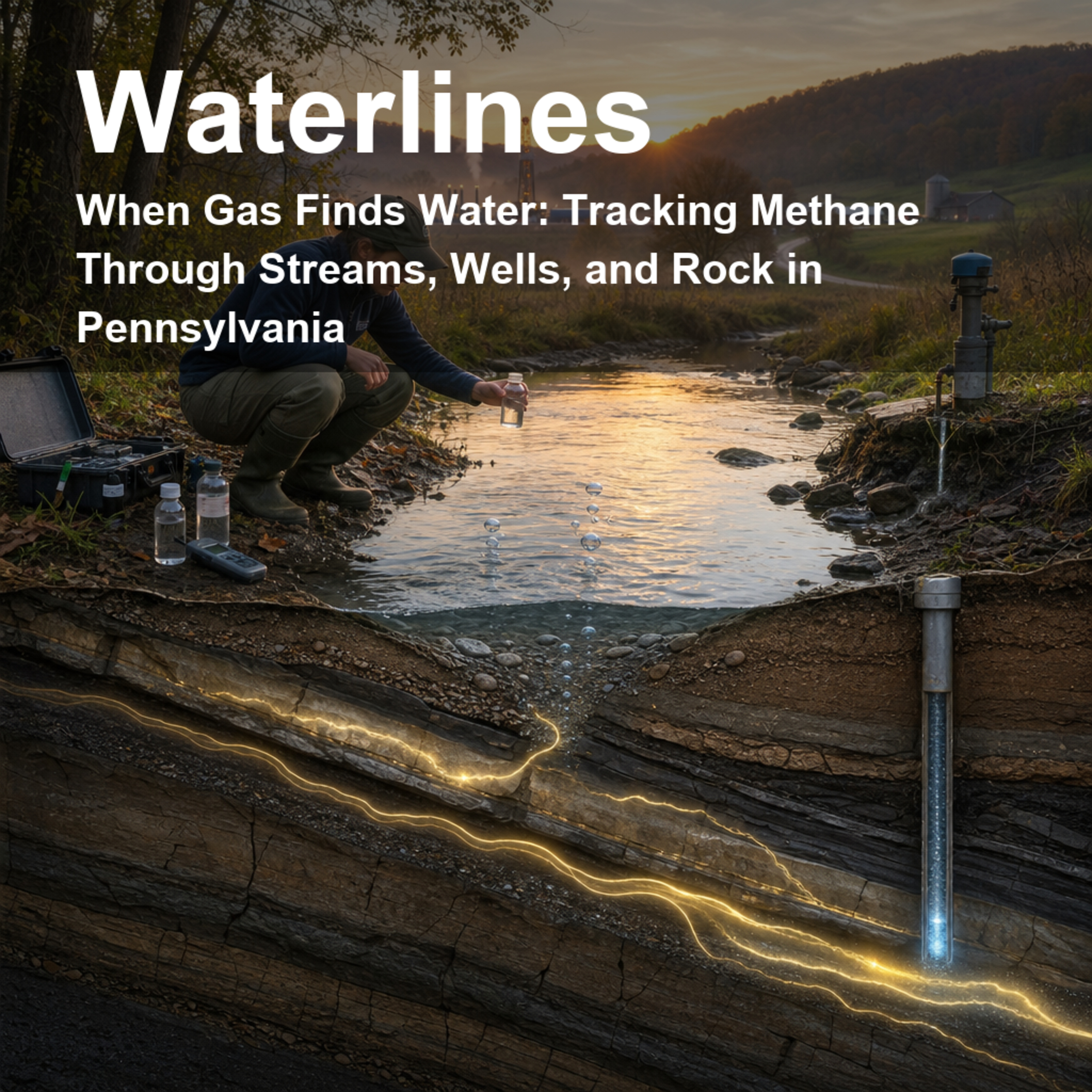
Waterlines: How Water Shapes Our WorldWhen Gas Finds Water: Tracking Methane Through Streams, Wells, and Rock in PennsylvaniaMethane leaks are often discussed as an air and climate problem. This episode asks a more local, watery question: if gas escapes underground, where does it actually go, and how would people notice? We follow three well-studied cases in Pennsylvania’s Marcellus Shale region, where scientists pieced together clues from drinking-water wells, bubbling streams, methane in the air, rock layers, and the chemistry of gas itself.The paper shows why methane migration is not a simple straight-up leak. In these cases, gas likely moved up leaky well spaces, then sideways through permeable rock layers ca...
2026-05-2712 min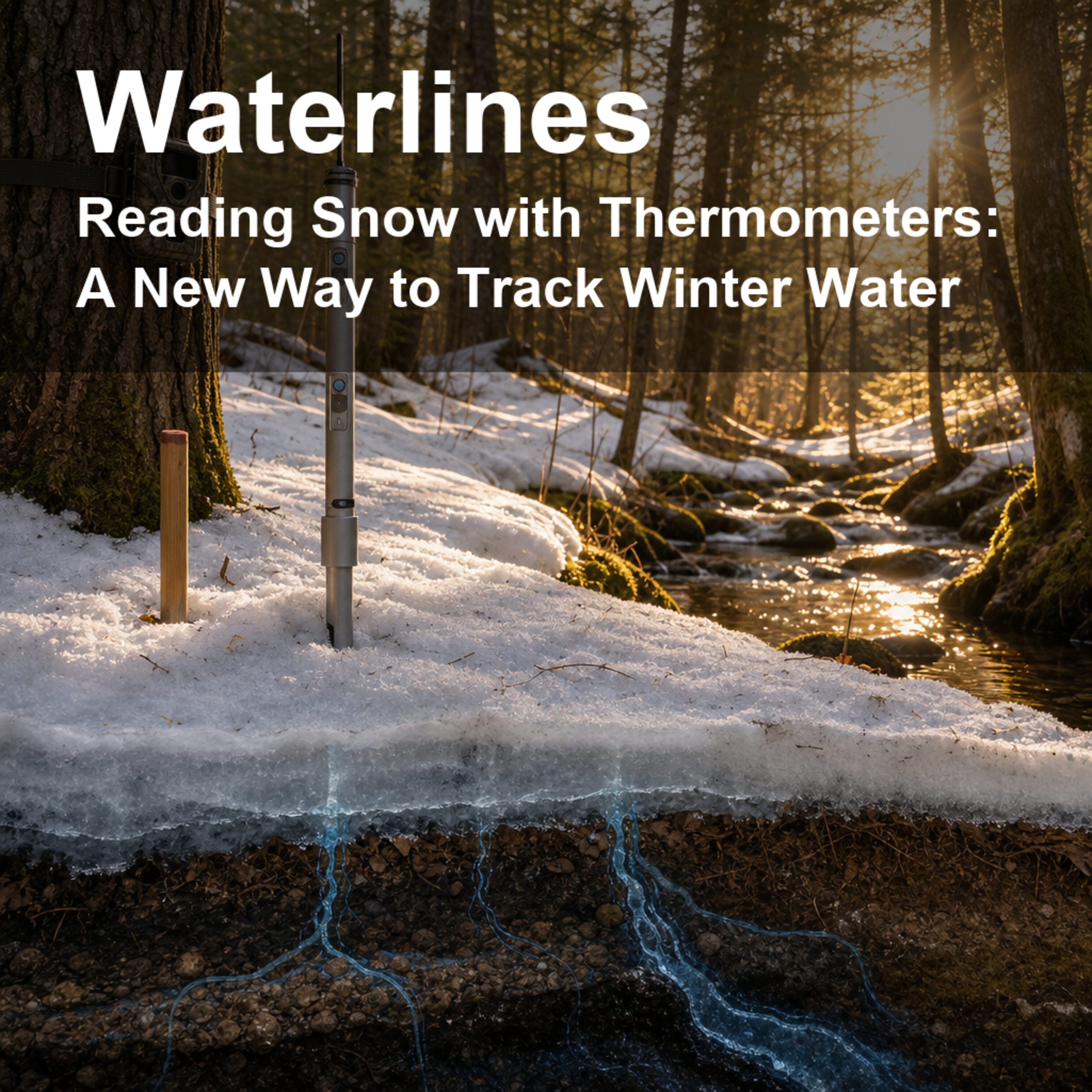
Waterlines: How Water Shapes Our WorldReading Snow with Thermometers: A New Way to Track Winter WaterSnow is more than winter scenery. It is a slow-release water reservoir, a blanket over soils and tree roots, and a clue to flood risk when warm spells or rain-on-snow events arrive. This episode follows researchers in New York’s Adirondack Mountains who asked a practical question: can simple temperature sensors, paired with machine learning, tell us how deep the snow is when no one is there to measure it?We unpack how snow acts like insulation, why temperature changes inside a snowpack can reveal its depth, and how field scientists used iButton sensors, PV...
2026-05-2711 min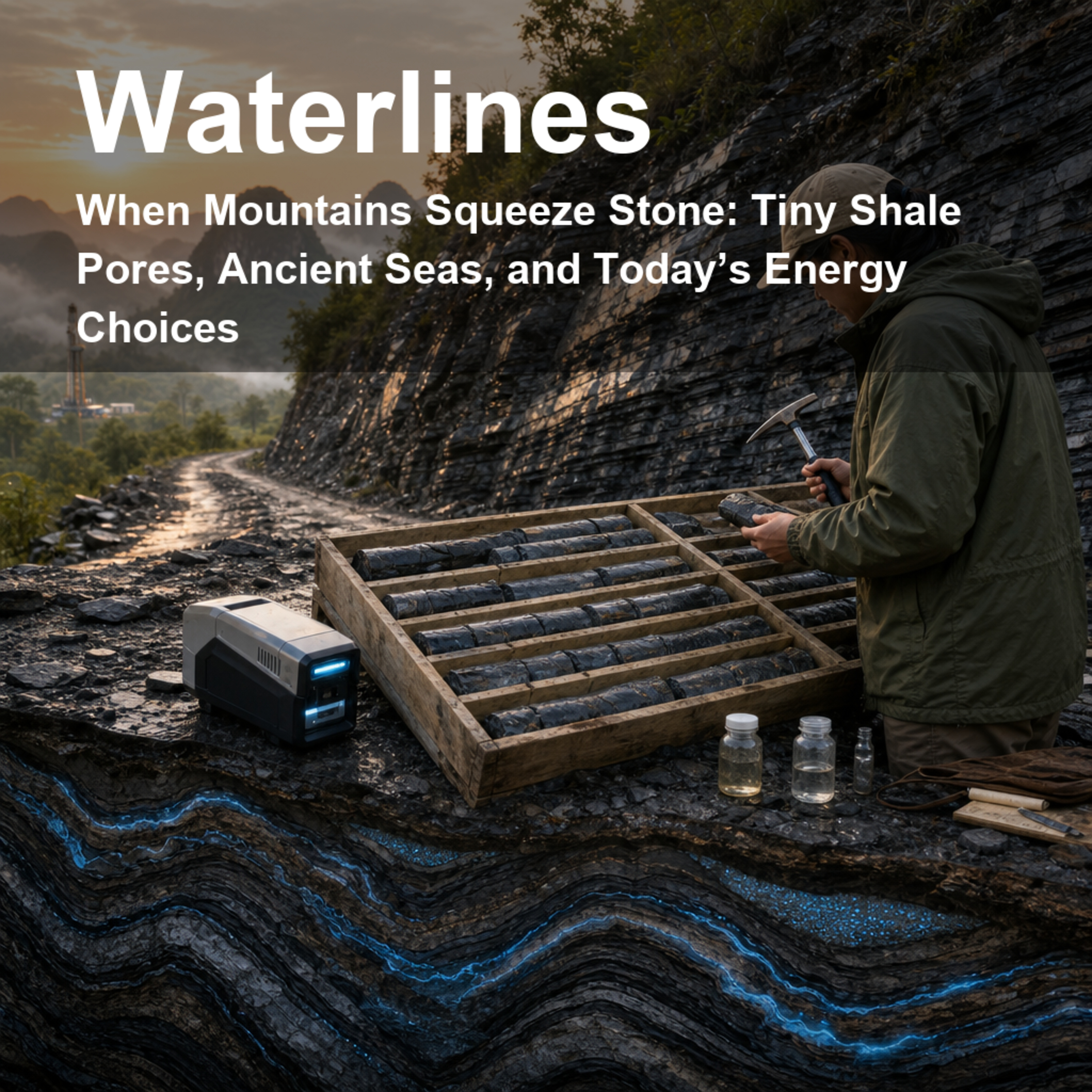
Waterlines: How Water Shapes Our WorldWhen Mountains Squeeze Stone: Tiny Shale Pores, Ancient Seas, and Today’s Energy ChoicesWhy this matters beyond one shale formation: the rocks beneath our feet are not still. They remember ancient seas, mountain-building pressure, buried heat, and the movement of fluids through spaces smaller than a speck of dust. This episode follows a study from China’s Yangtze Block that asks a deceptively simple question: what happens to the tiny pores in organic-rich shale when the rock is folded and squeezed? The answer matters for shale gas, but also for water use, groundwater protection, methane emissions, and how societies weigh underground energy resources in a changing climate.We...
2026-05-2711 min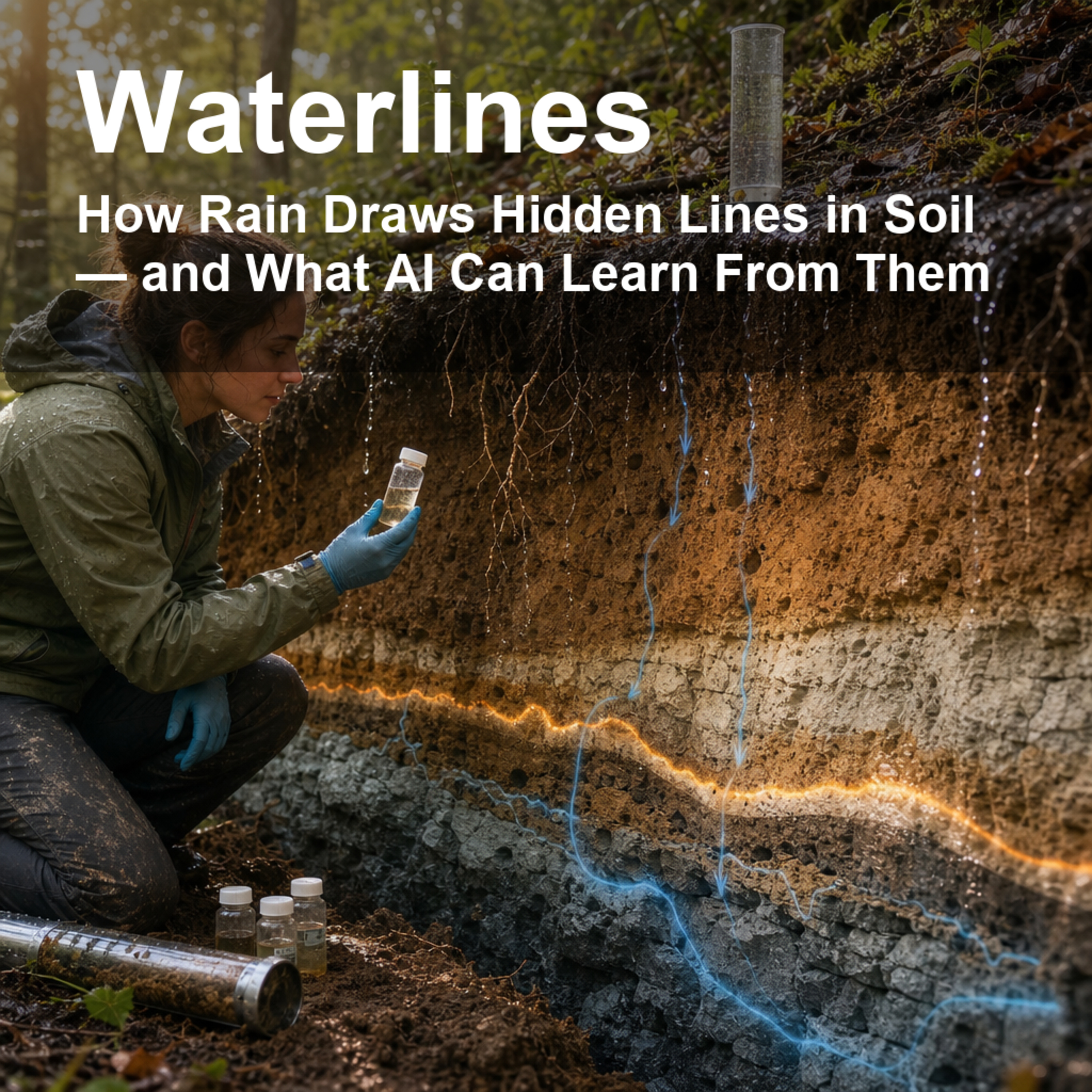
Waterlines: How Water Shapes Our WorldHow Rain Draws Hidden Lines in Soil — and What AI Can Learn From ThemEvery rainstorm does more than wet the ground. Drop by drop, water slips through soil, dissolves minerals, carries elements away, and quietly helps build the landscapes, ecosystems, and carbon cycles we depend on. This episode follows a study that asks a practical question for modern Earth science: can artificial intelligence learn from both field data and physical chemistry to predict where those underground weathering lines form?We explore soil “reaction fronts,” the hidden zones where minerals like feldspar dissolve as water moves downward through regolith. These fronts can record how long soils have been expo...
2026-05-2710 min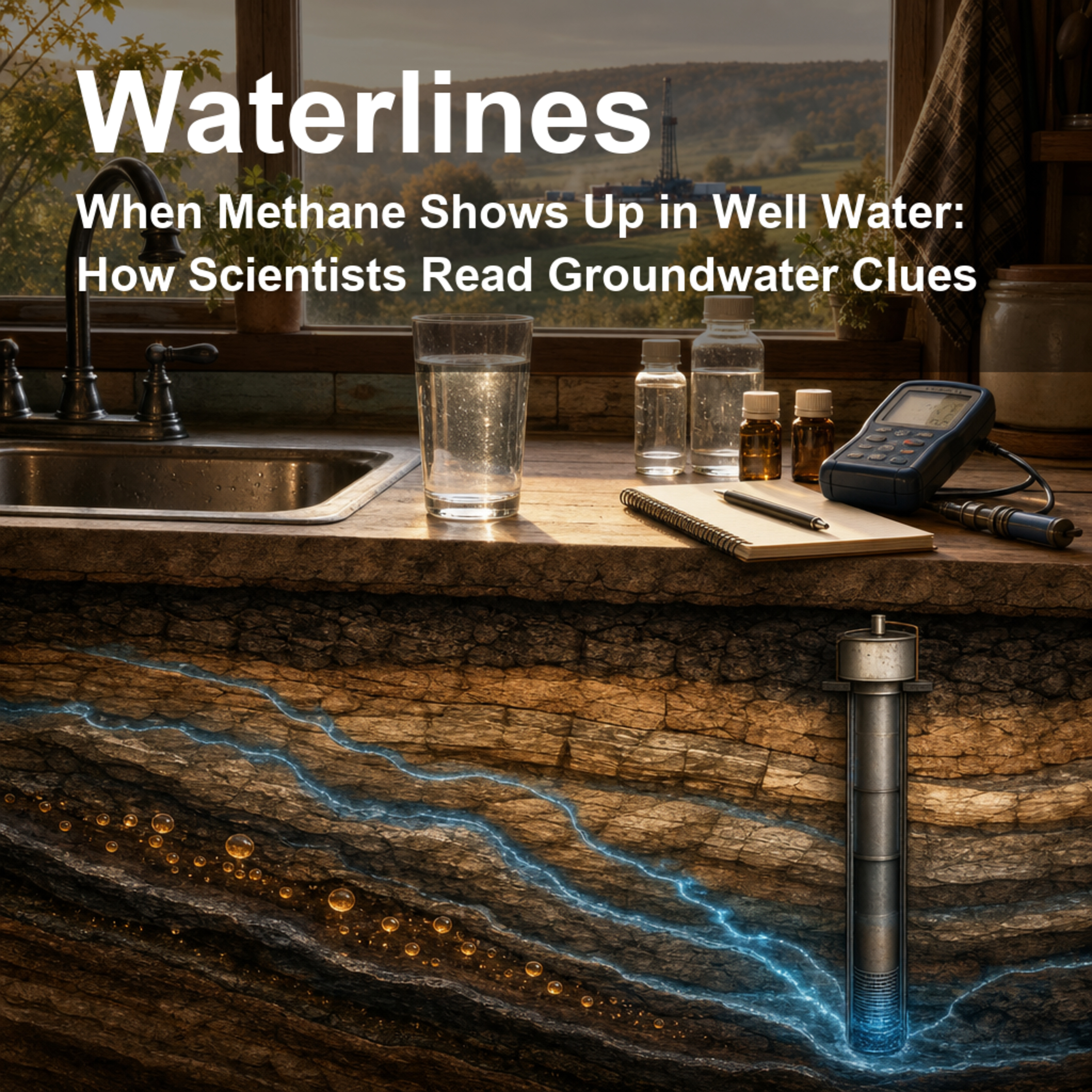
Waterlines: How Water Shapes Our WorldWhen Methane Shows Up in Well Water: How Scientists Read Groundwater CluesA glass of well water can look perfectly clear and still carry a hidden question: where did its methane come from? In gas-producing regions, that question matters for household safety, public trust, drilling decisions, and the basic right to understand what is happening underground. This episode follows researchers who asked whether everyday water chemistry—salts, iron, sulfate, pH, and other familiar measurements—can help flag methane that may have recently moved into groundwater from oil and gas activity, rather than methane that has been there naturally for a long time.We unpack how the team...
2026-05-2711 min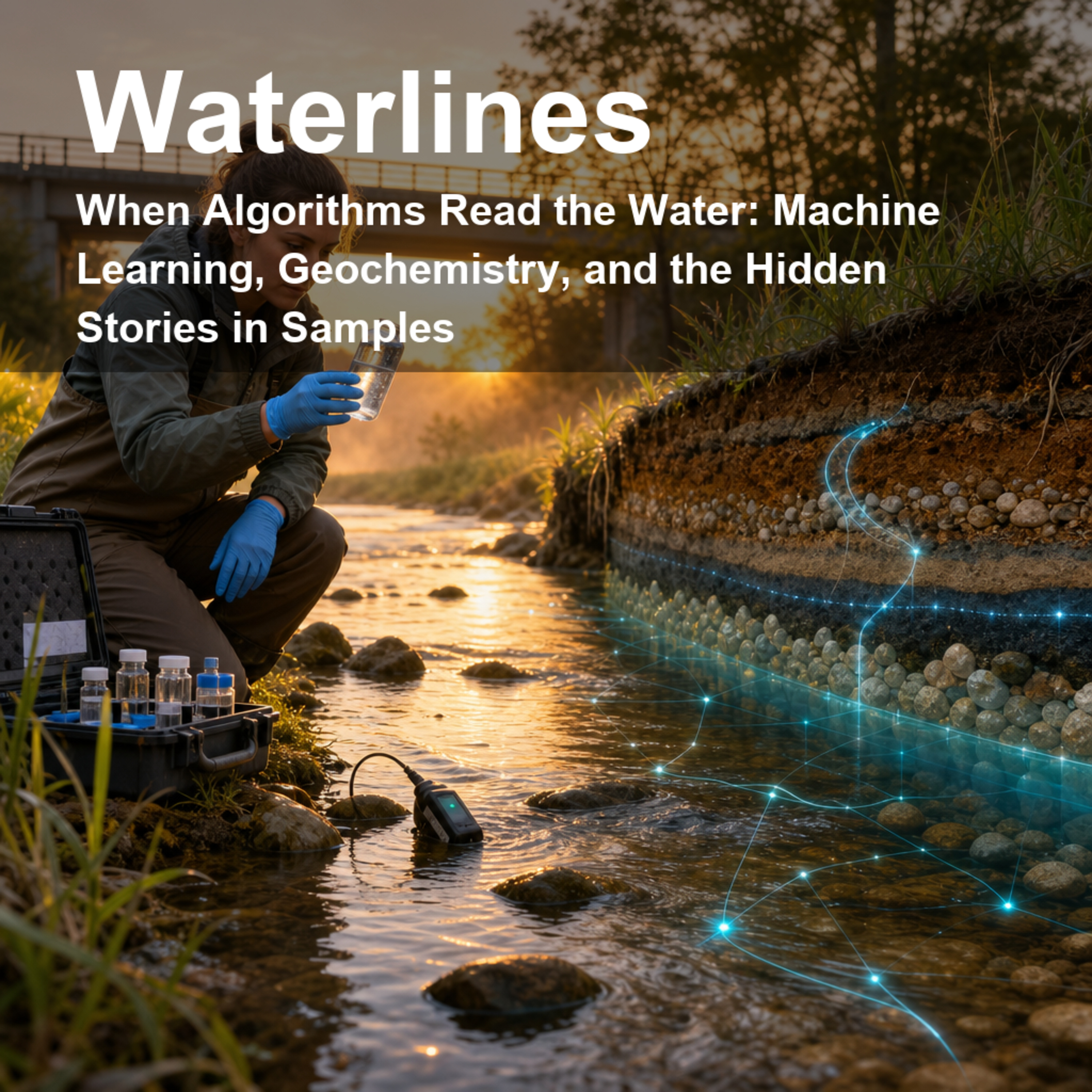
Waterlines: How Water Shapes Our WorldWhen Algorithms Read the Water: Machine Learning, Geochemistry, and the Hidden Stories in SamplesClean water decisions increasingly depend on reading patterns that no person can see by eye: small shifts in nitrate, arsenic, methane, metals, salts, and the chemistry of soils and rocks around a watershed. This episode uses a broad review paper as a map of how machine learning is changing geochemistry, from predicting water quality to improving lab instruments and even exploring the Moon and Mars. The promise is practical, but not magical: better pattern-finding can help scientists spot contamination risks, fill gaps between field samples, and test ideas faster, as long as the data are trustworthy and uncertainty is...
2026-05-2711 min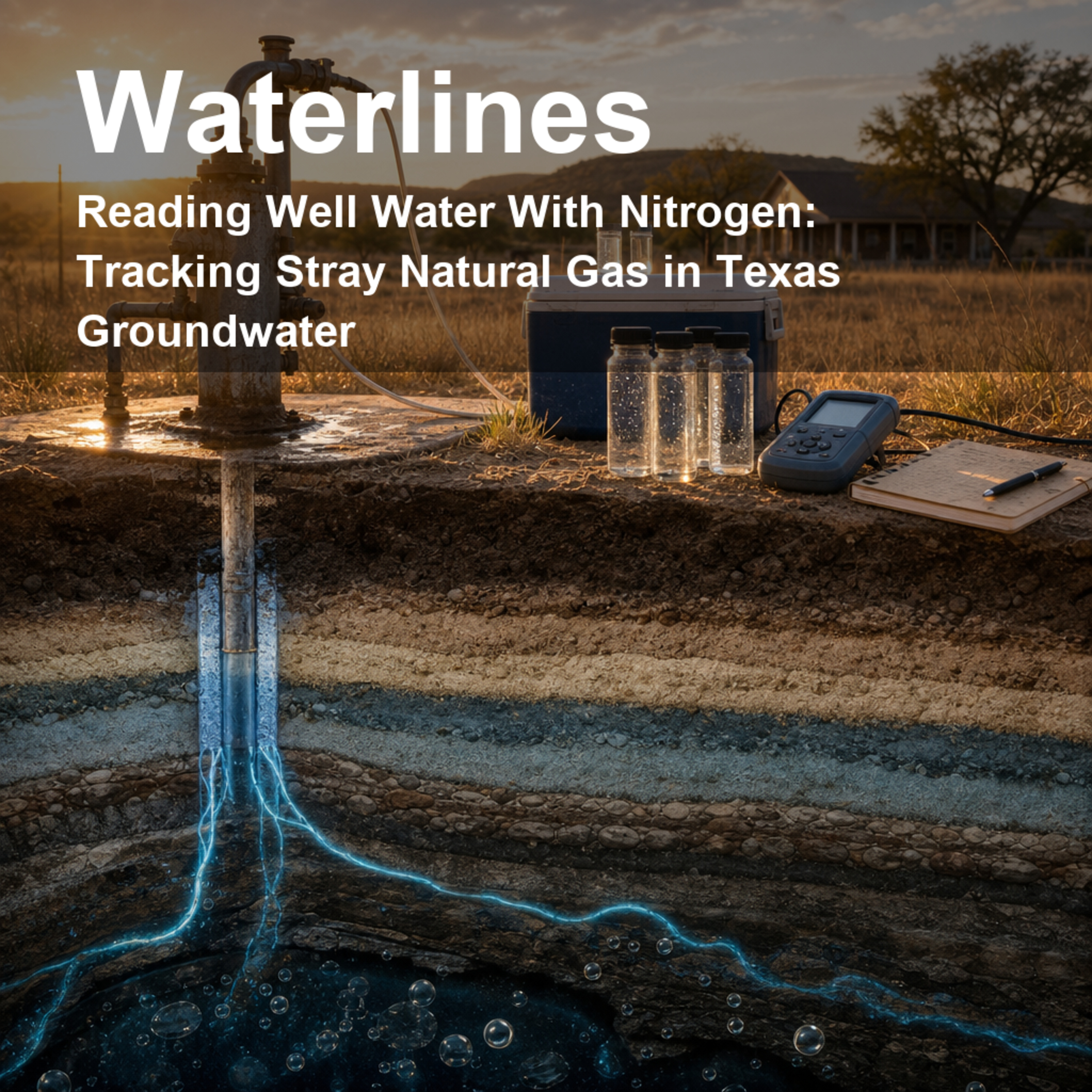
Waterlines: How Water Shapes Our WorldReading Well Water With Nitrogen: Tracking Stray Natural Gas in Texas GroundwaterWhen people turn on a kitchen tap near oil and gas fields, they are not asking an abstract question: they want to know whether their water is safe, where any gas came from, and what evidence can actually answer that. This episode follows scientists in Parker and Hood Counties, Texas, who used an unexpected clue—dissolved nitrogen—to help read the history of methane in groundwater. Methane alone can be a loud signal but a poor storyteller: a tiny amount of natural gas can make methane measurements jump. Nitrogen, because it is already abundant in air-recharged groundwater and relatively low...
2026-05-2711 min
Waterlines: How Water Shapes Our WorldA Slight Salt Signal in Groundwater Near Shale Gas WellsGroundwater can look perfectly clear and still carry a faint chemical story about what is happening on the land above it. In this episode of Waterlines, we head to Pennsylvania’s Marcellus Shale region, where many households rely on private wells and where shale gas development has produced enormous volumes of very salty wastewater. A new study asks a hard public-science question: can a regional groundwater data set reveal whether that wastewater has left a detectable mark?The answer is careful, not sensational. Researchers analyzed nearly 29,000 groundwater samples and found small but statistically meaningful in...
2026-05-2712 min
Waterlines: How Water Shapes Our WorldFinding the Hidden Ingredients in Rivers, Sediments, and LandscapesWhen you test a stream, scoop deep-sea mud, or scan a landscape from the air, the result is usually a mixture. Rainwater, soil water, groundwater, rock weathering, plankton shells, road surfaces, trees, and bare soil can all blur together in the data. This episode matters because many real environmental decisions begin with the same question: what are the ingredients, and how much of each is in the mix? We explore a new machine-learning approach that helps scientists infer those hidden “end-members” directly from geoscience data, without always needing perfect prior knowledge of the sources. Hosts unpack the idea with ever...
2026-05-2711 min
Waterlines: How Water Shapes Our WorldWhat Deep Oil Fluids Can Teach Us About Water, Rocks, and Energy ChoicesEnergy decisions, groundwater protection, and climate policy all depend on knowing what is moving through the deep subsurface. This episode uses a short editorial on light oil and condensate geochemistry as a doorway into a water story: how ancient organic matter, rock pores smaller than viruses, formation water, gases, and heat interact kilometers below our feet. We explain why these hard-to-read fluids matter for exploration, well management, environmental risk, and the bigger question of how societies handle fossil resources while moving toward lower-carbon futures.The paper is not a single field experiment; it is an editorial introducing a research collection...
2026-05-2711 min
Waterlines: How Water Shapes Our WorldWhat Is Salting Rural Wells? Road Salt, Brine, and the Groundwater Detective Story in AppalachiaA private well can look clean, taste a little salty, and still leave families wondering where that salt came from: winter roads, old geology, septic systems, or nearby oil and gas activity. This episode matters because millions of people rely on groundwater they cannot see, and the clues are often mixed together underground. We visit northern Appalachia, where Pennsylvania permits unconventional oil and gas development and New York bans it, creating a natural comparison zone for asking a hard public question: what is actually changing well water chemistry?Hosts A and B unpack a large study of 17,794 groundwater samples from 19...
2026-05-2711 min
Waterlines: How Water Shapes Our WorldTiny Gases in Ancient Shale Water: A Hidden Record of China's Mountain BuildingDeep underground, water is not just sitting still. It can carry a memory of vanished seas, buried oil, escaping gas, and mountain-building events that happened tens to hundreds of millions of years ago. This episode matters because the same hidden plumbing that shapes energy resources also shapes groundwater pathways, natural gas leakage, and how scientists read the deep crust without ever seeing most of it directly.We explore a study from the Upper Yangtze Block in South China, where researchers sampled gases from deeply buried Paleozoic shale and used chemically quiet noble gases, such as helium, neon, argon, krypton, and...
2026-05-2711 min
Waterlines: How Water Shapes Our WorldWhere Rivers Meet the Gulf: Making Sense of Water Data That Shapes CoastsRivers do not stop being important when they reach the ocean. Along the northern Gulf of Mexico, more than 50 rivers carry fresh water, nutrients, metals, salts, and signals of human activity into one of the most economically and ecologically important coastal regions in the United States. This episode explores why understanding that river-to-ocean handoff matters for fisheries, algal blooms, coastal acidification, hurricane recovery, pollution tracking, and everyday decisions about water and land.We unpack a new public database called ROcD-nGoM, which brings together river chemistry, river flow, ocean measurements, and satellite chlorophyll data for the northern Gulf of Mexico. Instead...
2026-05-2711 min
Waterlines: How Water Shapes Our WorldWhen Fracking Meets Old Oil Country: What Groundwater Chemistry Can RevealMillions of people rely on private wells, and those wells are often the first place where changes underground become personal: a glass of water, a farm tap, a kitchen sink. This episode looks at what happens when modern shale gas development is added to a landscape already crisscrossed by old oil wells, gas wells, and coal mines. The science is not a simple yes-or-no story. It is a detective story told through chloride, methane, old infrastructure, maps, and careful uncertainty.We unpack a study of nearly 7,000 groundwater samples from southwestern Pennsylvania, where Marcellus Shale...
2026-05-2712 min
Waterlines: How Water Shapes Our WorldVolcano Clues in Cold Groundwater: Noble Gases Beneath WeishanSome water looks ordinary at the tap or spring, yet it can carry news from deep inside the Earth. This episode visits Weishan volcano in northeast China, where there is no obvious hot spring or steaming ground, but shallow groundwater appears to hold a chemical memory of boiling far below. The story matters because communities, scientists, and planners often need to understand hidden geothermal heat and volcanic systems before the surface gives clear signs. It is also a reminder that groundwater is not just a local resource; it can be part of a deep, slow conversation between rain, rock...
2026-05-2711 min
Waterlines: How Water Shapes Our WorldWhen Power Plants Change Fuel, Do Nearby Streams Notice?When electricity gets made, the story does not end at the smokestack. What rises into the air can come back down with rain, move through soils, and show up years later in streams. This episode follows a Pennsylvania-based study asking a practical question for communities, regulators, and energy planners: as U.S. power plants burn less coal and more natural gas, can nearby waterways actually register the change?We unpack how sulfur dioxide from coal burning becomes sulfate in water, why sulfate is useful as a “breadcrumb” for tracking pollution, and why the answer is n...
2026-05-2708 min
Waterlines: How Water Shapes Our WorldWhen CO2 Meets Deep Seawater: Lessons from a Natural Storage Site in the South China SeaA coal plant, a cement kiln, or a steel mill can release carbon dioxide in minutes. But if that CO₂ is stored underground, what happens over thousands or millions of years? This episode follows a natural experiment beneath the South China Sea, where salty formation water, hot sandstone, and trapped CO₂ have been quietly reacting far below the seafloor. The study matters because carbon storage is not just about finding empty space underground. It is about whether water and rock can turn some of that CO₂ into stable minerals, and whether the seals above the reservoir can keep doing their...
2026-05-2109 min
Waterlines: How Water Shapes Our WorldWhat a Creek Can Tell Us About Hidden Chemistry UndergroundClean water problems often start in places we cannot see: cracks, minerals, old groundwater, buried reaction zones, and the long memory of land use. This episode follows a study that asks whether ordinary river chemistry can reveal the hidden “redox architecture” beneath a watershed, meaning the underground pattern of oxygen-rich and oxygen-poor zones that helps decide how contaminants move, linger, or break down. We focus on pyrite, a common iron-sulfide mineral sometimes called fool’s gold. When oxygenated water reaches pyrite underground, it produces sulfate, leaving a chemical clue in streams. By tracking how sulfate changes as rivers rise and fa...
2026-05-2108 min
Waterlines: How Water Shapes Our WorldNoble Gases and Stray Methane in the Trinity AquiferThis Waterlines episode examines how inert noble gases can help trace the source of methane found in shallow groundwater. The featured study compares noble gas fingerprints in Barnett Shale production gas, Strawn Group production gas, and flowing stray gas from water wells in the Trinity Aquifer in north-central Texas. The authors find that the stray gas more closely matches the shallower Strawn Group than the deeper Barnett Shale, supporting the interpretation that the gas likely came from Strawn accumulations rather than directly from the Barnett production interval.Citation: Wen, T.; Castro, M. C.; Nicot...
2026-05-1909 min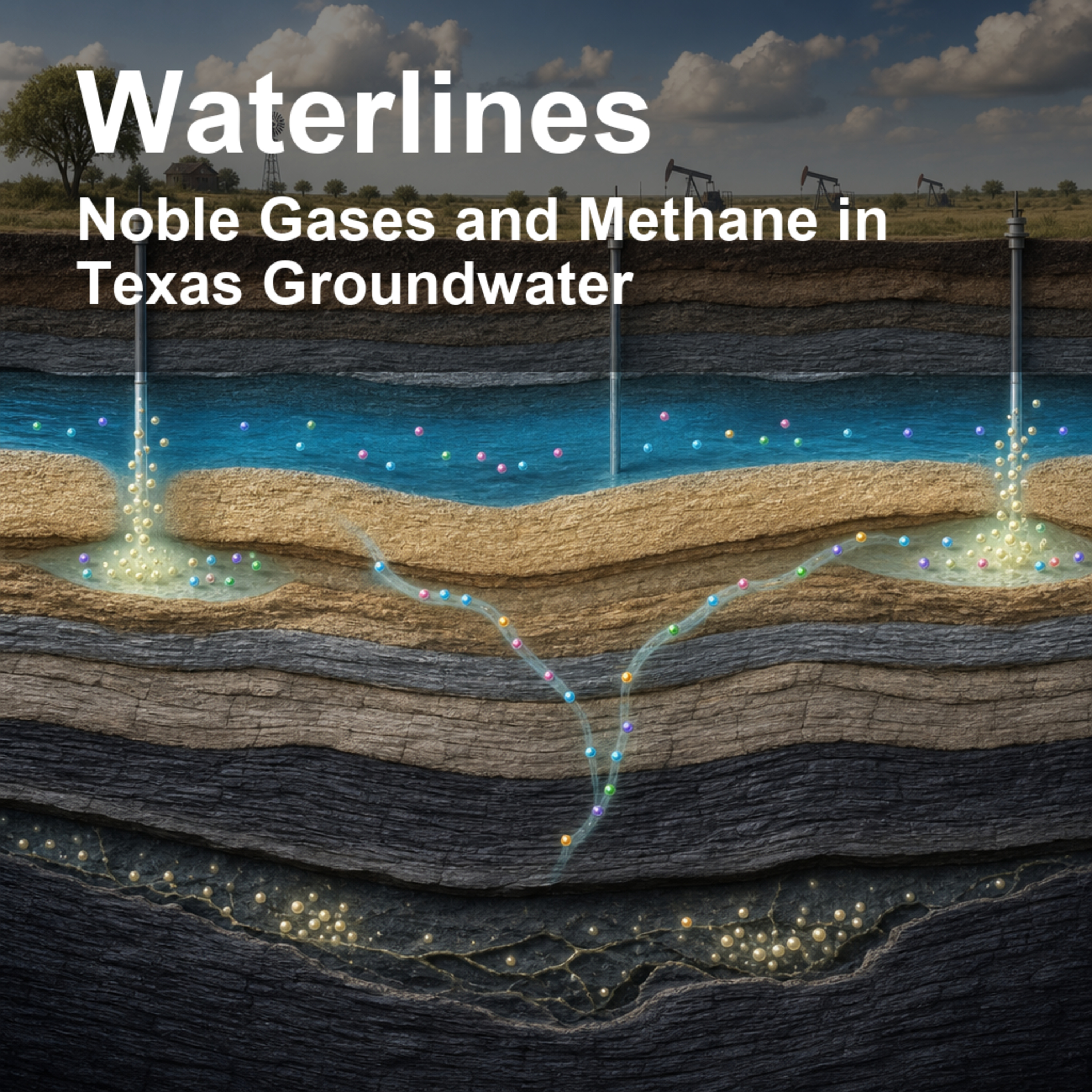
Waterlines: How Water Shapes Our WorldNoble Gases and Methane in Texas GroundwaterThis Waterlines episode discusses a 2016 study of methane in shallow groundwater wells in Parker and Hood Counties, Texas, within the Barnett Shale region. The paper uses dissolved noble gases—especially krypton and xenon—alongside methane and well-log information to evaluate whether methane in sampled water wells likely came from deep production wells, shallow natural accumulations, or other pathways. The researchers found that methane and crustal noble gases often varied together, pointing to a common sedimentary source, likely the Strawn Group. In four high-methane wells, atmospheric noble gases were strongly depleted in a pattern consistent with local gas-water contact, suggesting smal...
2026-05-1914 min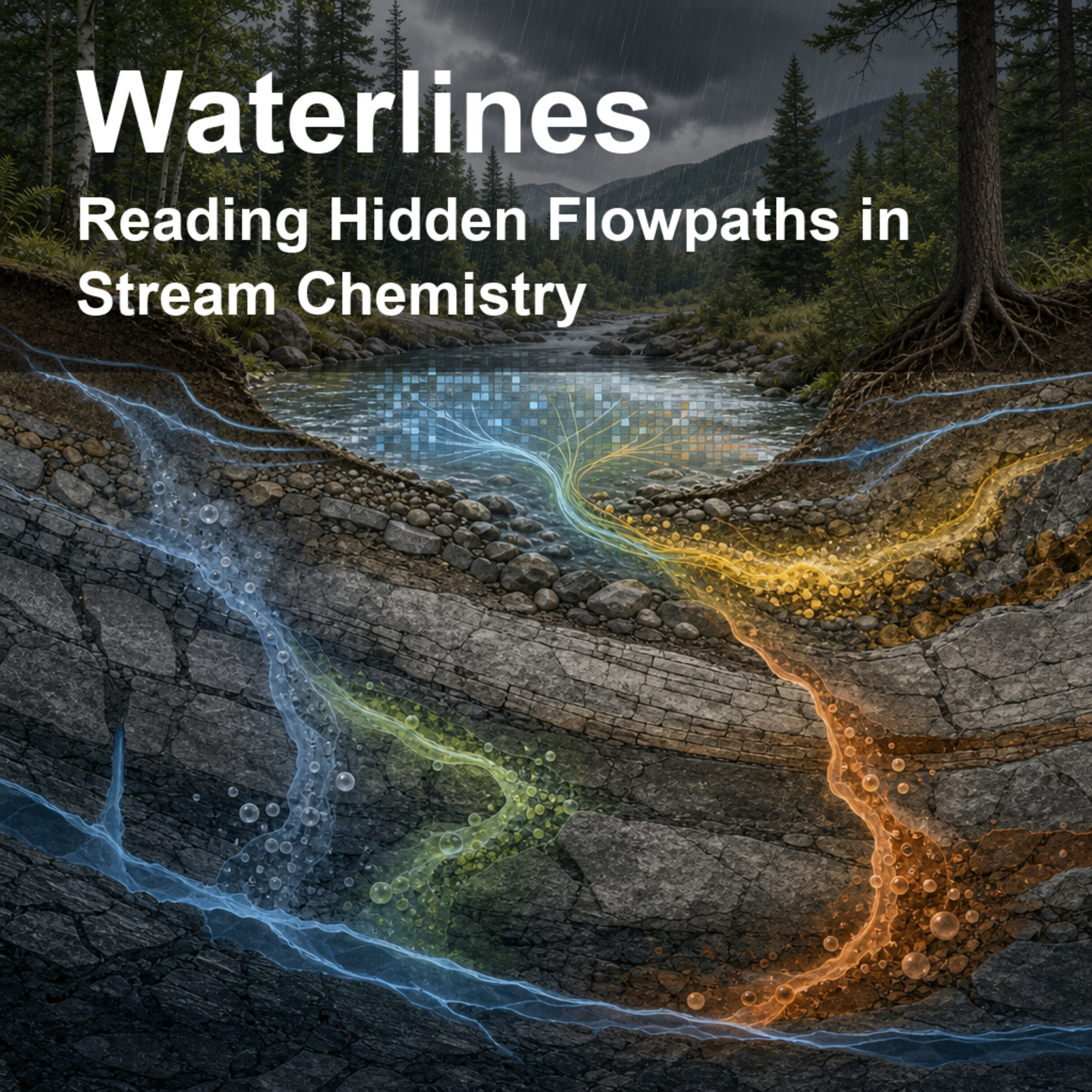
Waterlines: How Water Shapes Our WorldReading Hidden Flowpaths in Stream ChemistryThis Waterlines episode discusses how stream chemistry can reveal both subsurface water pathways and whether rock weathering is likely to remove or release CO₂ over geologic timescales. The featured paper uses non-negative matrix factorization, a machine-learning approach, to separate chemical signals in streams without first defining the endmembers. It applies the method to Shale Hills in Pennsylvania, East River in Colorado, and Hubbard Brook in New Hampshire, showing how acid rain, sulfide minerals, silicate weathering, and carbonate dissolution interact in different landscapes. Citation: Shaughnessy, A. R., Gu, X., Wen, T., and Brantley, S. L.: Machine learning deciphers CO...
2026-05-1912 min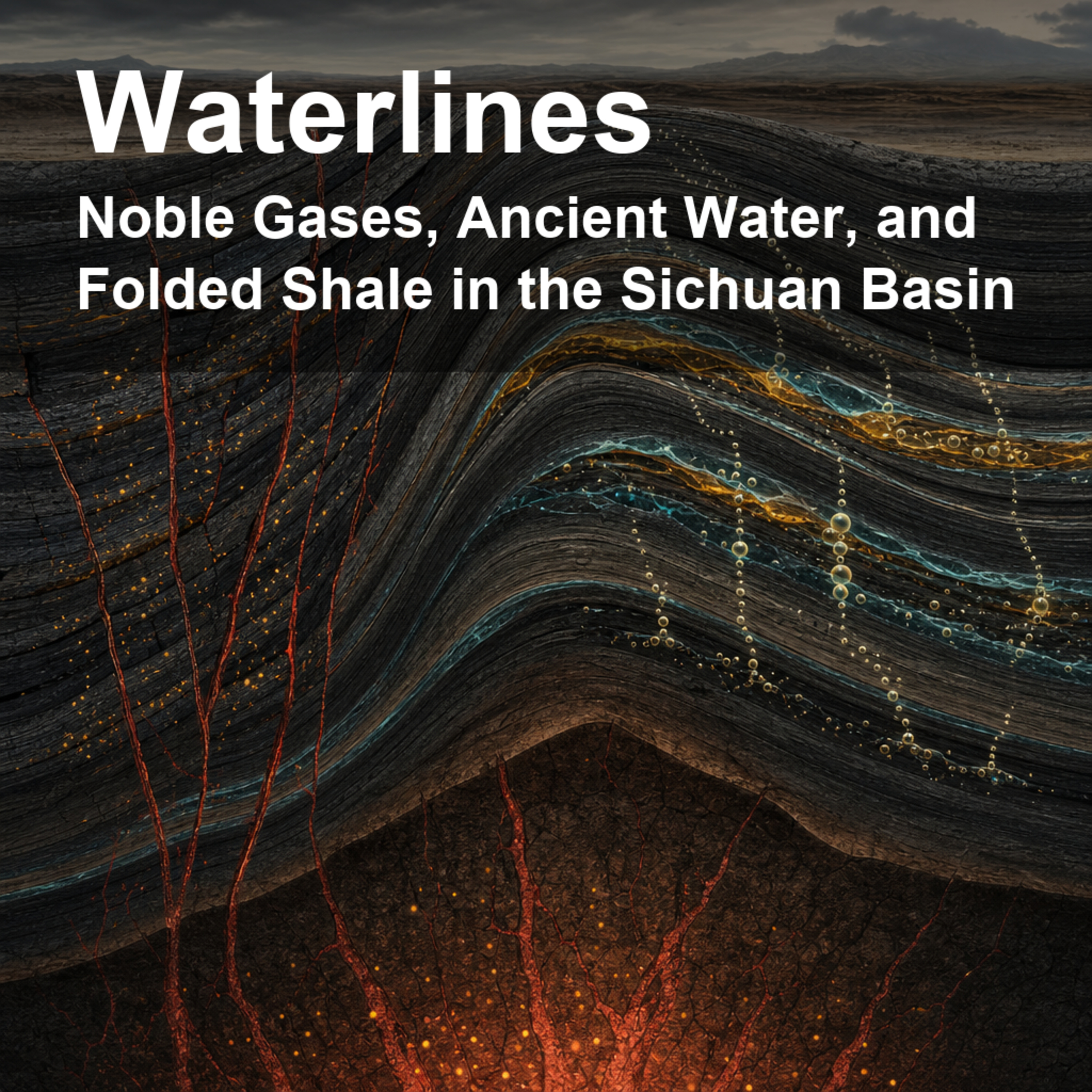
Waterlines: How Water Shapes Our WorldNoble Gases, Ancient Water, and Folded Shale in the Sichuan BasinThis Waterlines episode examines how helium, neon, argon, krypton, and xenon can reveal the movement and compartmentalization of deep formation waters and gases in China’s Wufeng-Longmaxi Shale. The study finds that shale gas from different structural positions carries distinct noble-gas fingerprints, shaped by tectonic folding, deep faults, diffusion, and long-term interactions among water, oil, and gas. The paper challenges the common assumption that shale reservoirs are geochemically uniform across large distances.Full citation: Liu, R., Wen, T., Amalberti, J., Zheng, J., Hao, F., & Jiang, D. (2021). The dichotomy in noble gas signatures linked to te...
2026-05-1913 min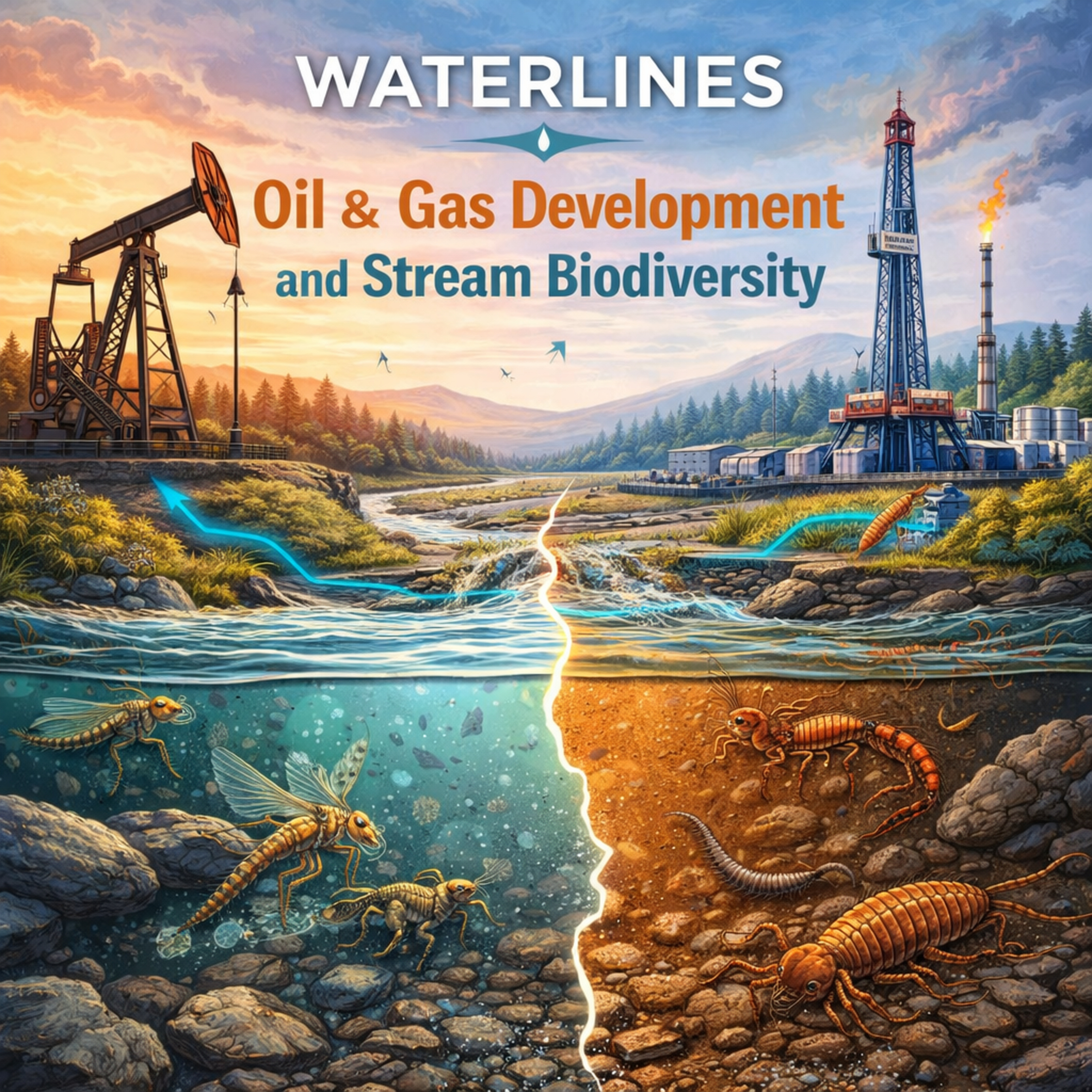
Waterlines: How Water Shapes Our WorldThe Ghosts of Drilling Past — What Tiny Stream Bugs Tell Us About Energy's True Footprint[NotebookLM AI Hosts] Welcome back to Waterlines, where we explore the hidden role of water in shaping our planet and our daily lives. In this episode, we dive into a surprising twist in the ongoing story of energy extraction and our waterways. For over a decade, headlines have focused almost exclusively on the environmental risks of modern fracking and unconventional oil and gas development. But what if the real threat to our streams is actually the ghosts of drilling past? Researchers recently analyzed over 6,800 water samples across Pennsylvania's Marcellus Shale region to uncover the truth. By studying benthic macroinvertebrates—ti...
2026-03-1022 min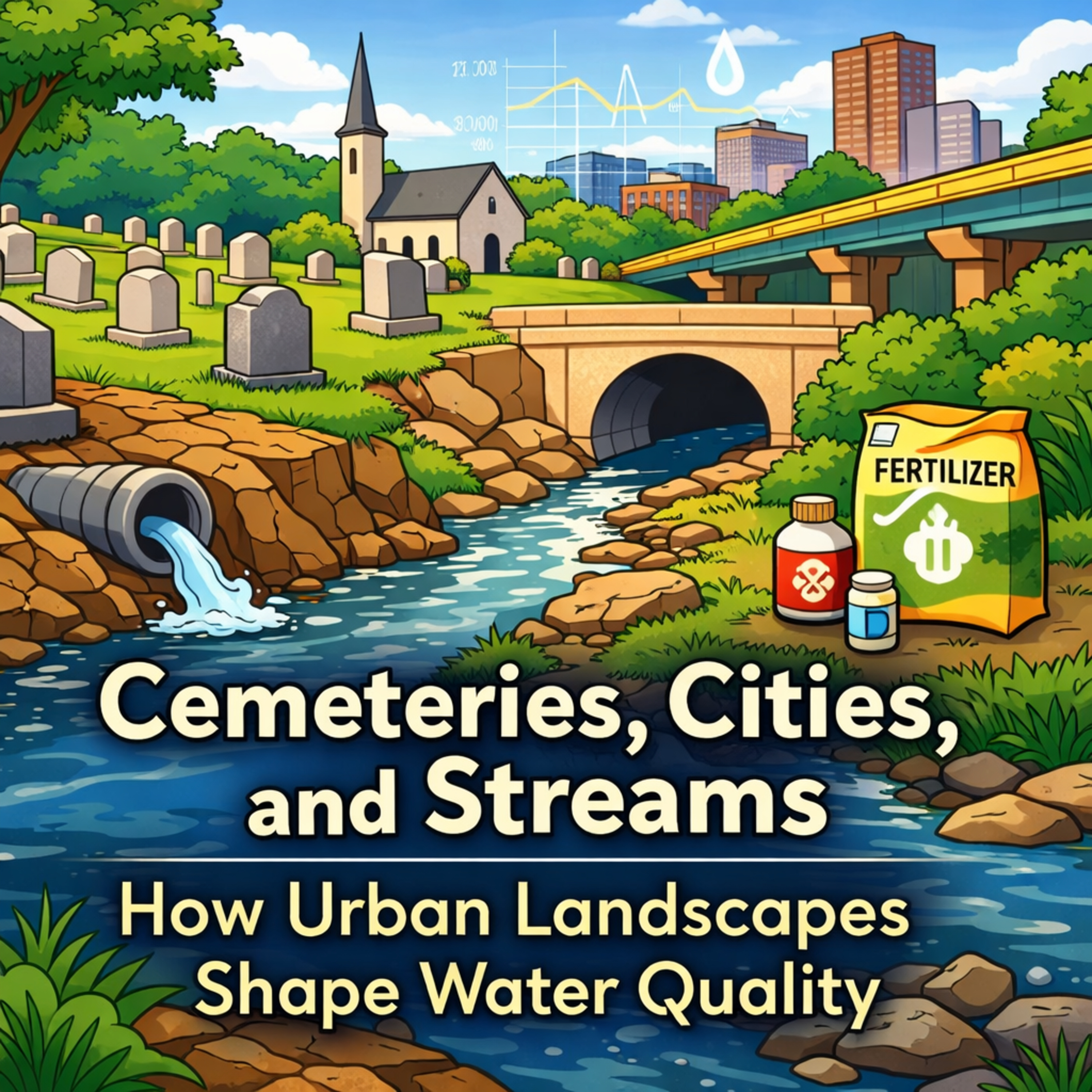
Waterlines: How Water Shapes Our WorldCemeteries, Cities, and Streams: How Urban Landscapes Shape Water Quality[Human Hosts] What happens when an urban stream flows through a cemetery? In this episode of ✦ Waterlines: How Water Shapes Our World ✦, a student interviewer sits down with hydrologist Sam Nesheim to unpack new research on how cemeteries and other urban infrastructure influence water quality.Together, they explore how nutrients, road salt, and groundwater interactions shape the chemistry of a city stream — and what scientists discovered about nitrate sources that challenge common assumptions. This conversation brings cutting-edge hydrology research into everyday language, revealing how human landscapes and natural water systems are deeply connected.
2026-02-1316 min